

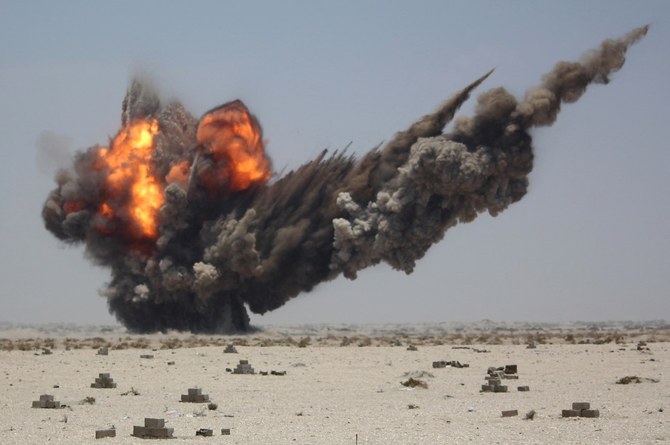
The Mine Ban Treaty: How the world decided to bury the use of mines

A Landmines and Cluster Munition Monitor report revealed that land-mine casualty rates have been on the rise since 2015, with 6,897 people killed or maimed in 2018. (AFP)
Short Url
Updated 03 April 2023
Follow

The Mine Ban Treaty: How the world decided to bury the use of mines

  • Although the agreement has reduced land-mine casualties, it has not protected civilians from devices laid by non-state armed groups

LONDON: On Dec. 3, 1997, representatives from 122 countries met in Ottawa, Canada, to establish an agreement that would eradicate the use of land mines in the hope of protecting civilian lives and facilitating the recovery of conflict-ridden regions.

By August 2022, 167 nations had ratified or acceded to the Mine Ban Treaty, formally dubbed the Convention on the Prohibition of the Use, Stockpiling, Production, and Transfer of Anti-Personnel Mines and on Their Destruction.

“The Mine Ban Treaty was a ground-breaking instrument when adopted in 1997,” Jared Bloch, communications manager at the International Campaign to Ban Landmines-Cluster Munition Coalition (ICBL-CMC), told Arab News.

“It shifted the disarmament narrative towards human security, put victims at the center of the discussion, and provided a template for subsequent disarmament treaties,” he added, highlighting that since the Treaty’s adoption, “the number of people killed and injured by land mines has decreased dramatically.”

In 1992, six NGOs, including Human Rights Watch and Physicians for Human Rights, joined forces under the umbrella of the ICBL-CMC to address the issue of land mines. Due to their impact on civilian lives, the group’s conclusion was that the best solution was to get rid of antipersonnel mines completely.

Owing to the efforts of the ICBL-CMC and several states, the treaty entered into force on March 1, 1999, banning the use, production, stockpiling and transfer of antipersonnel mines and obliging authorities to clear affected lands, destroy stockpiles and support victims.

The ICBL-CMC works with members to raise awareness of the impact of mines and cluster munitions on local communities, and to advocate for government adoption and implementation of the Mine Ban Treaty and the Convention on Cluster Munitions’ objectives.

Land mines date back to as early as 120 BCE, but their first use in modern history was during the American Civil War, according to the Federation of American Scientists’ website. But they really entered public consciousness as a serious problem following their extensive deployment during World War II. A 1993 paper entitled “The Cowards’ War: Landmines and Civilians” stated that “Germany, Italy, Britain and France laid between five and 19 million mines in North Africa alone.”

And these hidden explosive devices have become a growing threat across the Middle East and North Africa, with Yemen, which signed the Mine Ban Treaty in 1997 and ratified it in 1998, being one of the region’s most contaminated countries.

“Despite the fact that Yemen, since March 1999, has been a party to the Ottawa Treaty — which bans the use of antipersonnel land mines, warring parties — namely the Houthi militias, have not complied with the treaty and, instead, extensively laid antipersonnel mines, in blatant violation of the agreement,” Fares Alhemyari, executive director of the Yemeni Landmine Records, which comprises a group of volunteers who document land-mine casualties across the country, told Arab News.

The Carnegie Endowment for International Peace has said that Yemen “was the first Arab country to destroy its stockpile of antipersonnel mines completely,” but the current conflict has reportedly seen the Houthis plant thousands of mines across several governorates.

“Yemen was close to officially declaring itself a mine-free zone in early 2014, after years of efforts to clear affected areas, but the return of violence at the end of that year sent the country to point zero,” said Alhemyari. “Today, (Yemen) is one of the world’s most contaminated regions.”

Claiming that over two million mines had been laid across areas previously controlled by Houthi militants, Nabil Abdulhafiz, Yemen’s deputy minister of human rights, told Asharq Al-Awsat in April 2022 that it would take approximately eight years to clear affected lands.

And since being a signatory of the Mine Ban Treaty did not guarantee the protection of civilians against the threat of explosive ordnance, land mines and unexploded munitions, civil society organizations, supported by the relevant NGOs, took up the mantle to push for the elimination of these devices.

“Ensuring involvement of land-mine and cluster-munition survivors in advocating for their rights and needs is at the heart of our work,” said the ICBL-CMC’s Bloch.

“A good example of how civil society organizations contribute to eliminating (the) use of land mines by non-state actors is the work of our member Geneva Call,” he continued. “The organization has facilitated dialogue and negotiation with, and declarations by, non-state groups stating commitment to the principles of international humanitarian law and publicly renouncing the use of mines as indiscriminate weapons.”

A Landmines and Cluster Munition Monitor report revealed that land-mine casualty rates have been on the rise since 2015, with 6,897 people killed or maimed in 2018. This trend is in step with increasing large-scale violence across the world, including in Ukraine, Syria, Afghanistan and Nigeria. 

For this reason, “the Mine Ban Treaty continues to be incredibly relevant today,” according to Bloch.

“Extensive mine use by a small number of states outside the treaty, including Myanmar, Russia and Syria, and non-state armed groups in conflicts in Colombia, Yemen, and elsewhere means a prolongation of this terrible legacy of killing and maiming civilians; girls, boys, women and men,” he said.


US House of Representatives passes war powers resolution backing Trump’s attacks on Iran

Updated 2 min 30 sec ago
Follow

US House of Representatives passes war powers resolution backing Trump’s attacks on Iran

  • It’s the second vote in as many days, after the Senate defeated a similar measure
  • Republicans largely back Trump, and most Democrats oppose the war
WASHINGTON: The House narrowly rejected a war powers resolution Thursday to halt President Donald Trump’s attacks on Iran, an early sign of unease in Congress over the rapidly widening conflict that is reordering US priorities at home and abroad.
It’s the second vote in as many days, after the Senate defeated a similar measure. Lawmakers are confronting the sudden reality of representing wary Americans in wartime and all that entails — with lives lost, dollars spent and alliances tested by a president’s unilateral decision to go to war with Iran.
While the tally in the House, 212-219, was expected to be tight, the outcome provided a clarifying snapshot of political support for, and opposition to, the US-Israel military operation and Trump’s rationale for bypassing Congress, which alone has the power to declare war. At the Capitol, the conflict has quickly carried echoes of the long wars in Afghanistan and Iraq, and many Sept. 11-era veterans now serve in Congress.
“Donald Trump is not a king, and if he believes the war with Iran is in our national interest, then he must come to Congress and make the case,” said Rep. Gregory Meeks, the top Democrat on the House Foreign Affairs Committee.
House Speaker Mike Johnson warned that it would be “dangerous” to limit the president’s authority while the US military is already in conflict.
“We are not at war,” said Johnson, R-Louisiana, a close ally of Trump, contradicting others. He said the operation is limited in scope and duration, and the “mission is nearly accomplished.”
Republicans largely back Trump, and most Democrats oppose the war
Trump’s Republican Party, which narrowly controls the House and Senate, largely sees the conflict with Iran not as the start of a new war, but the end of a government that has long menaced the West. The operation has killed Iran’s Supreme Leader Ayatollah Ali Khamenei, which some view as an opportunity for regime change, though others warn of a chaotic power vacuum.
Republican Rep. Brian Mast of Florida, chairman of the House Foreign Affairs Committee, publicly thanked Trump for taking action against Iran, saying the president is using his own constitutional authority to defend the US against the “imminent threat” the country posed.
Mast, an Army veteran who worked as a bomb disposal expert in Afghanistan, said the war powers resolution was effectively asking “that the president do nothing.”
For Democrats, Trump’s attack on Iran, influenced by Israeli Prime Minister Benjamin Netanyahu, is a war of choice that is testing the balance of powers in the Constitution.
“The framers weren’t fooling around,” said Rep. Jamie Raskin, D-Md., arguing that the Constitution is clear that only Congress can decide matters of war. “It’s up to us.”
Crossover coalitions emerged among those in Congress. Two Republicans joined most Democrats in voting for the war powers resolution, while four Democrats joined Republicans to reject it.
The war powers resolution, if signed into law, would have immediately halted Trump’s ability to conduct the war unless Congress approved the military action. The president would likely veto it.
Trump officials provide shifting rationale for war
Trump has scrambled to win support for the nearly week-old conflict as Americans of all political persuasions take stock. Administration officials spent hours behind closed doors on Capitol Hill this week trying to reassure lawmakers that they have the situation under control.
Six US military members were killed over the weekend in a drone strike in Kuwait, and Trump has said more Americans could die. Thousands of Americans abroad have scrambled for flights, many lighting up phone lines at congressional offices as they sought help trying to flee the Middle East.
Trump said Thursday he must be involved in choosing Iran’s new leader. Yet Johnson, R-Louisiana, said this week that America has enough problems at home and is not about to be in the “nation-building business.”
Defense Secretary Pete Hegseth said that the war could extend eight weeks, twice as long as the president first estimated. Trump has left open the possibility of sending US troops into what has largely been a bombing campaign. More than 1,230 people in Iran have died.
The administration said the goal is to destroy Iran’s ballistic missiles that it believes are shielding its nuclear program. It has also said Israel was ready to act, and American bases would face retaliation if the US did not strike Iran first. The US said Wednesday it torpedoed an Iranian warship near Sri Lanka.
“This administration can’t even give us a straight answer of as to why we launched this preemptive war,” said Rep. Thomas Massie, the Republican from Kentucky, an outlier in his party.
Massie and Rep. Ro Khanna, D-Calif., who had teamed up to force the release the Jeffrey Epstein files, also pushed the war powers resolution to the floor, past objections from Johnson’s GOP leadership. Republican Rep. Warren Davidson of Ohio, a former Army Ranger, also voted for it. Democratic Reps. Henry Cuellar of Texas, Jared Golden of Maine, Greg Landsman of Ohio and Juan Vargas of California voted against.
“Congress must stand with the president to finally close, once and for all, this dark chapter of history,” said Rep. Michael McCaul, R-Texas.
Rep. Yassamin Ansari, D-Arizona, said that as the daughter of Iranian immigrants who fled their homeland, she opposes the regime but is concerned that a democratic transition for the people of Iran never seems to a priority for Trump or the officials who briefed Congress.
“War carries profound and deadly consequences for our troops, for the American people and for the entire world,” she said. “It’s the most serious decision that a nation can make.”
Other Democrats have proposed an alternative resolution that would allow the president to continue the war for 30 days before he must seek congressional approval. The House also approved a separate measure affirming that Iran is the largest state sponsor of terrorism.
Senators sit in their desks for solemn vote
In the Senate, Republican leaders have successfully, though narrowly, defeated a series of war powers resolutions pertaining to several other conflicts during Trump’s second term. This one, however, was different.
Underscoring the gravity Wednesday, Democratic senators sat at their desks as the voting got underway.
Senate Democratic leader Chuck Schumer of New York said that every senator will pick a side. “Do you stand with the American people who are exhausted with forever wars in the Middle East?” he asked. Or with Trump and Hegseth “as they bumble us headfirst into another war?”
Sen. John Barrasso, second in Senate Republican leadership, said, “Democrats would rather obstruct Donald Trump than obliterate Iran’s national nuclear program.”
The legislation failed on a 47-53 tally mostly along party lines, with Sen. Rand Paul, R-Kentucky, in favor and Sen. John Fetterman, D-Pennsylvania, against.