RAWALPINDI: If you’re a cricket fan anywhere in the world, chances are you know who Pakistan’s Chacha Cricket is.
The South Asian nation’s most famous cricket mascot, Chaudhry Abdul Jalil, 74, popularly called Chacha, or Uncle, Cricket, is a common fixture at Pakistan’s matches at home and abroad, always seen in his white beard and green salwar kameez, Pakistan’s national dress, entertaining crowds with humorous comments and chants, dancing with fans, signing autographs and welcoming the opposing team in his signature style.
The diehard cricket fan attended his first international game, between Pakistan and England, in 1969 at the Lahore Stadium when he was 19 years old. Since 1998, he has been sponsored by the Pakistan Cricket Board (PCB) to follow the Pakistan team around the world, even receiving a monthly stipend from the body.
But while everyone knows Chacha Cricket’s love for the game, few know about his affinity to the Middle East, particularly to the UAE, where he was employed as a foreman at the Abu Dhabi Municipality for 25 years, and to Sharjah, where he worked on the construction site of Sharjah Airport and also witnessed the building of the city’s now famed cricket stadium in 1980.
Jalil was there when the stadium hosted its first match between Pakistan and England in 1983. In fact, it was also at that very cricket stadium where the Pakistani super fan first shot to fame.
“I got my fame after a match in Sharjah, which was played between Pakistan and India in 1986, where people belonging to both countries cheered the two teams all day long,” Jalil told Arab News in an interview in Rawalpindi, where he was invited to a local cricket tournament as the chief guest.
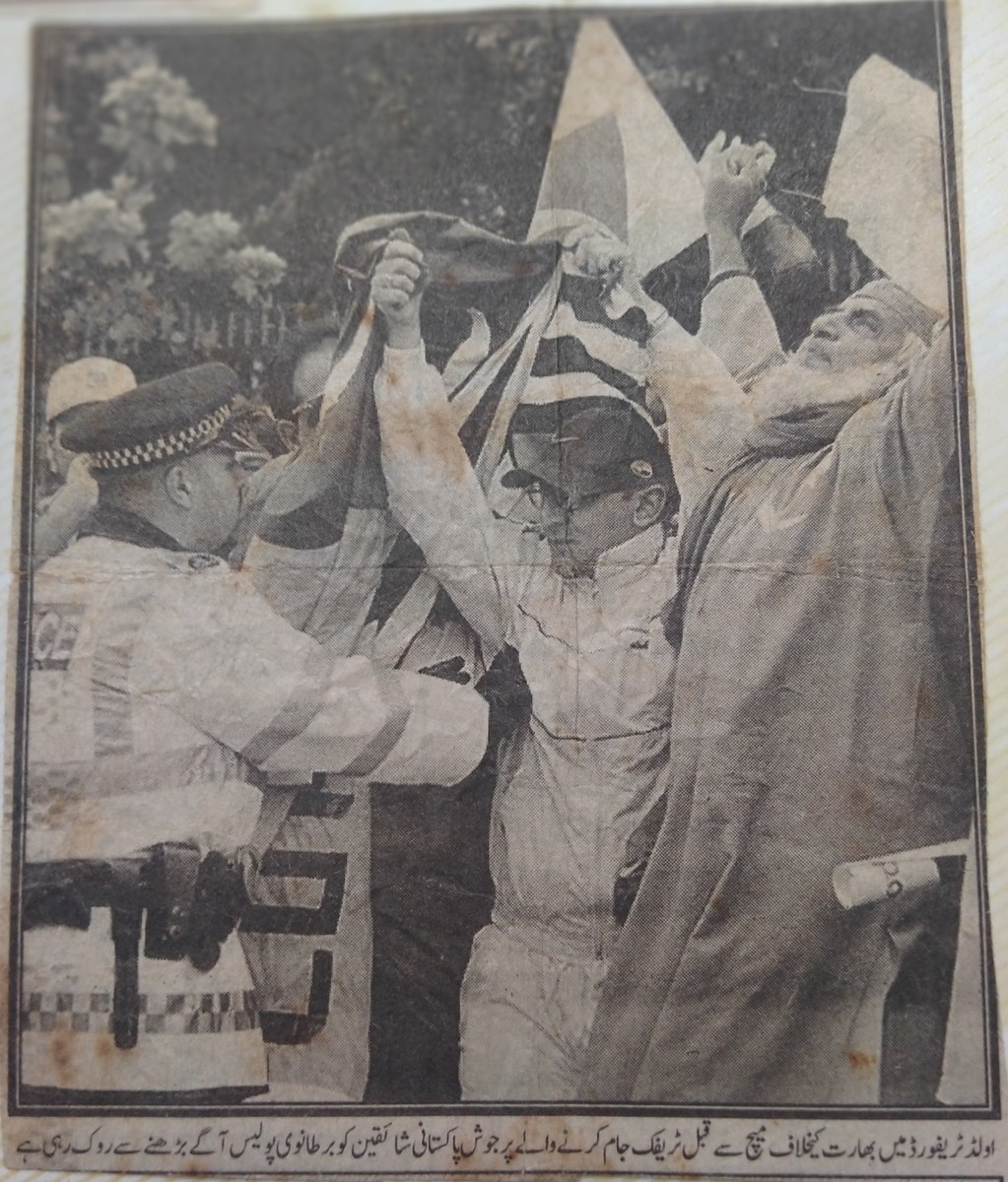
The undated photo shows a clipping from an urdu news paper with photo of Chaudhry Abdul Jalil (R), popularly known as 'Chacha Cricket', at the at Old Trafford cricket stadium in the United Kingdom. (Photo courtesy: Chacha Cricket (Official Fan Page)/ Facebook)
Regional rivals Pakistan and India have one of the most famous sports rivalries in the word. Matches between them are sold out months in advance and have been billed as a war without guns.
“Due to my unique attire as I wore the Pakistani flag dress for the first time, a lot of people gathered around me and I led them in sloganeering for the Pakistani team, which created an environment of competition with Indian fans who also gathered to compete with us,” Jalil said, recounting the scenes at Sharjah Stadium.
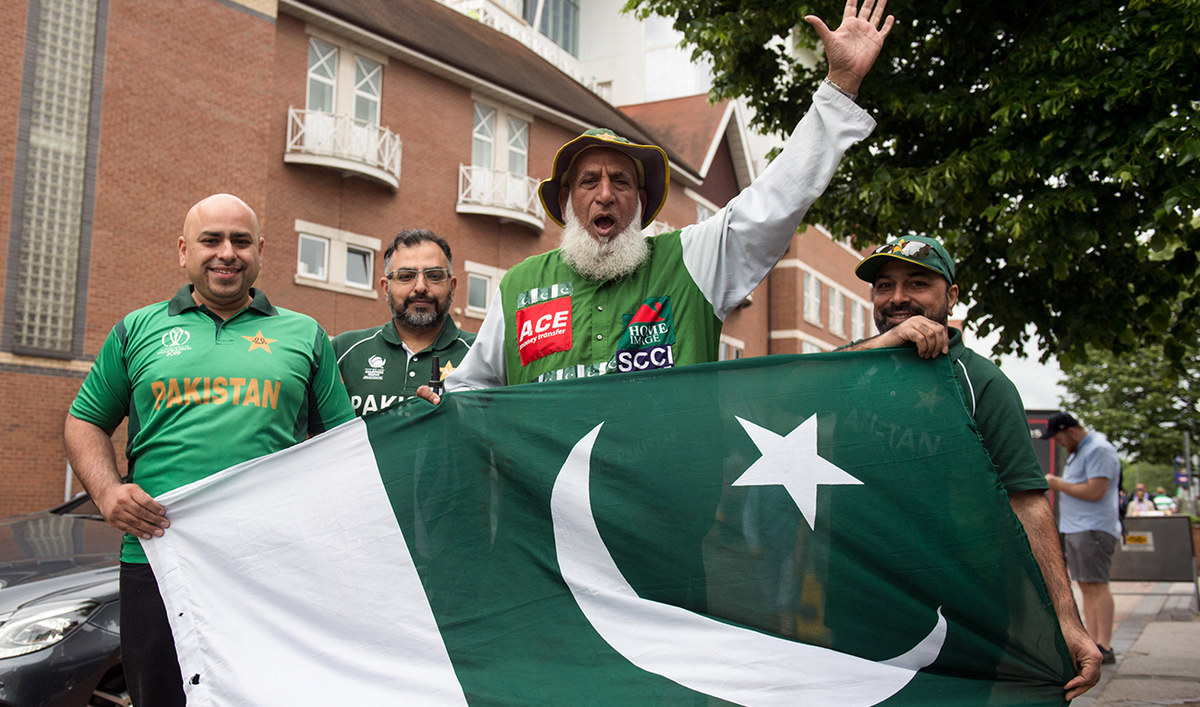
Pakistan super-fan "Chacha Cricket" (C), AKA Chacha Sufi Jalil, poses for a picture ahead of the 2019 Cricket World Cup group stage match between West Indies and Pakistan at Trent Bridge in Nottingham, central England, on May 31, 2019. (AFP/File)
“Due to my witty slogans, a lot of Pakistani supporters gathered and became part of the chanting, which attracted broadcasters who focused on me many times during the match,” he said.
People started recognizing him after the match, the mascot said, and “I then adopted this attire permanently.”
He recited the slogan that he first shouted in Sharjah and which has since become famous all over the world:
“Chachay di gal man kay kheelo, jum kay khelo, jum kay khelo, acha khelo, mil kay khelo, shaan say khelo, aan say khelo, dil say khelo, jaan say kheelo, jeetay ga bhai jeetay ga, Pakistan jeetay ga [Listen to uncle’s advice and play, play with conviction, play with conviction, play well, play together, play with glory, play with pride, play with your heart, play with your life, Pakistan will win, brother, Pakistan will win].”
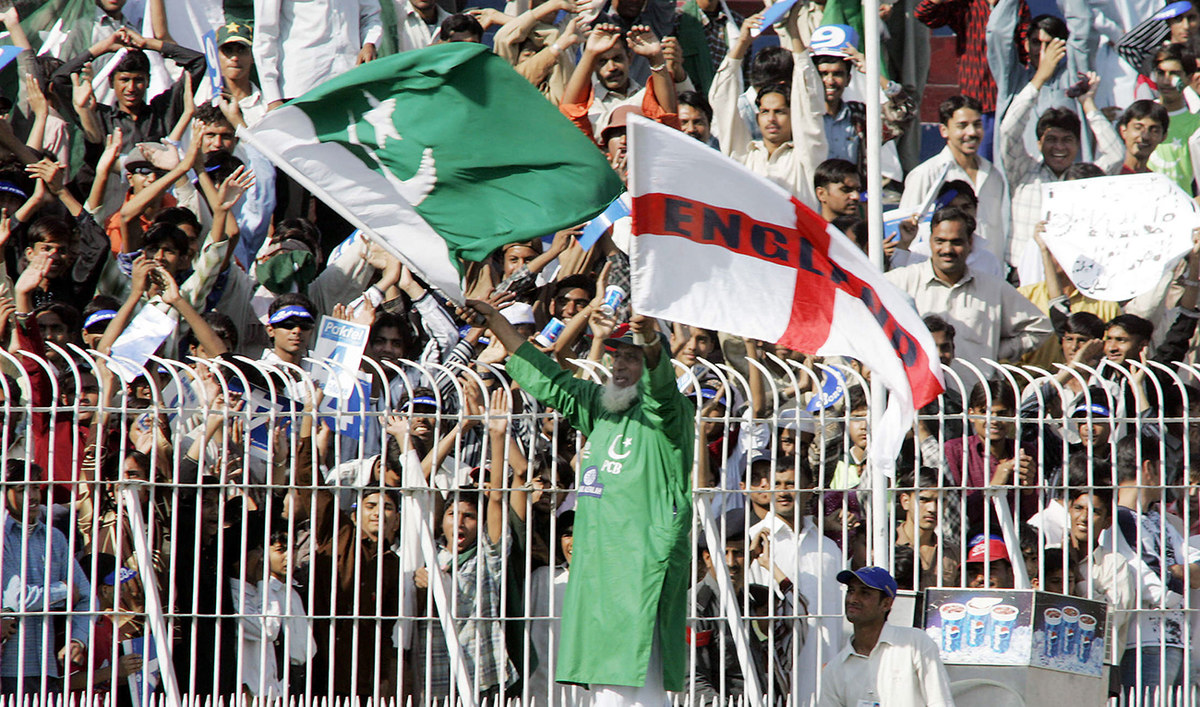
Pakistani cricket supporter Chaudhry Abdul Jalil known as "Chacha Cricket" (Uncle Cricket) shouts slogans as he waves Pakistani and England flags during play on the first day of the second Test match at The Iqbal Cricket Stadium in Faisalabad, 20 November 2005. (AFP/FILE)
“I have seen more than 100 matches in Sharjah,” Jalil added, “and never missed a match involving Pakistan during my stay in UAE.”
The UAE played an important role in his life, Jalil, who originally hails from Sialkot, said, and in the realization of his dreams.
“I have witnessed and participated in the building of the modern UAE,” Jalil said. “I went to the UAE in 1973 and initially worked as a laborer. Then from 1974 to 1979, I worked at Sharjah airport as a concrete in-charge. After that, I got a job with Abu Dhabi Municipality.”
Jalil stayed with the company for 25 years, during which time he said he witnessed firsthand the UAE’s “phenomenal development.”
Even during his early years in the UAE, Jalil remained obsessed with cricket.
“I was so fond of cricket that we used to alternately play it every Friday in Dubai and Abu Dhabi,” he said, smiling. “We even established a Sialkot Cricket Club in Dubai.”
Jalil left the UAE in 1998 when the PCB offered to sponsor him to attend matches. This year he celebrated 54 years of watching his favorite sport and offering his team noisy support around the world, including India, the United Kingdom, South Africa, Sri Lanka, and Bangladesh.
“I have seen the whole world, including Africa, Asia, and America,” he said. “In 1999, England gave me an honorary visa without checking my documents within an hour. Since then, I have done 13 tours of England and six of India.”
Asked who his favorite captain was after all the years of being a super fan, Jalil immediately named Imran Khan and Misbah-ul-Haq.
“But if I have to name only one player in the world,” he added, “it will be Wasim Akram.”
And his advice to the current squad:
“My message to all players and people is to play cricket with honesty, without cheating ... Be a good human, a good Pakistani, and a good Muslim.”