

Former Credit Suisse CEO ‘quite comfortable’ with state of global banking industry

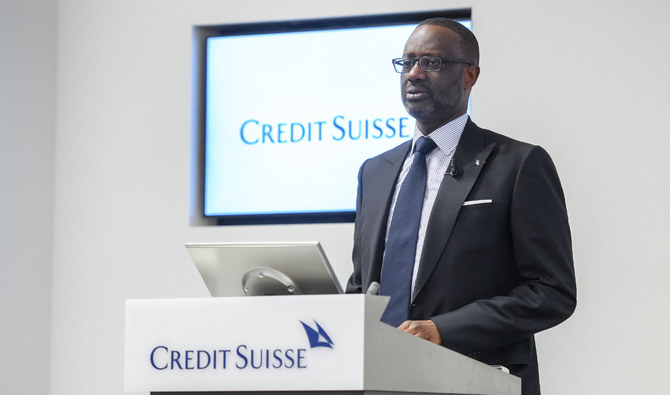
Tidjane Thiam gives his last press conference as Credit Suisse CEO during the annual results of the Swiss banking on February 13, 2020 in Zurich. (AFP/File)
Short Url
Updated 31 March 2023
Follow

Former Credit Suisse CEO ‘quite comfortable’ with state of global banking industry

  • Tidjane Thiam told the Future Investment Initiative’s Priority conference in Miami that the sector is not fragile, and his confidence is based in part on the strength of the global economy
  • He blamed the current crisis, after the collapse of Silicon Valley Bank and the emergency takeover of Credit Suisse, and fears for the future of Deutsche Bank on speculators

MIAMI: Credit Suisse’s former CEO Tidjane Thiam, now executive chairman of the Freedom Acquisition Corporation, on Thursday talked about the risks he believes the banking sector will face in the years ahead but said that, overall, he is “quite comfortable” about its current state.

Speaking during a panel discussion at the Future Investment Initiative’s Priority conference in Miami, he said the industry is not fragile, and his confidence is based in part on the strength of the global economy.

“Most banking or financial crises have their roots in challenges in the real economy,” he said. “So, the real economy is strong, the banks are profitable.”

The current profitability of the banking sector and strong balance sheets further bolster his level of confidence.

“It’s really a liquidity crisis that generally leads to the failure of an institution, not capital,” he said. “So, overall, I’m quite comfortable.”

Still, the collapse of US-based Silicon Valley Bank this month, followed by the emergency takeover of Credit Suisse by rival UBS, have shaken the confidence of some, and there have been concerns that Deutsche Bank might be the next major financial institution to face a crisis.

However, Thiam blamed the panic, and recent moves involving securities linked to Deutsche Bank, on speculators. Deutsche remains profitable and is protected by the “backstops” put in place by the European Central Bank in 2012, he said.

“After the euro market closes, speculators go and short the CDS (credit default swaps), increase the spread on the CDS, then you get articles saying that Deutsche is going bankrupt, and then they go into the ADR (American depository receipt) market, which is very illiquid, where they take a position and make good money,” he said.

“So, you really have to distinguish what is going on in the real economy and those speculative positions taken by people, basically aimed at making money.”

He also warned about low interest rates and liquidity, saying: “Excessive liquidity has led people to take riskier positions, and everybody knows the famous Warren Buffett sentence: ‘When the tide goes down, you can see who has been swimming without trunks.’

“They are exposed, and you will see that every time you have a long period of a given state in financial markets, and when you come out of that there are some casualties at the interest rates. But I think overall, it’s healthy for the world economy to have more normal interest rates.”


Saudi Arabia ranks 2nd globally in digital government, World Bank 2025 index shows


Updated 18 December 2025
Follow

Saudi Arabia ranks 2nd globally in digital government, World Bank 2025 index shows


WASHINGTON: Saudi Arabia has achieved a historic milestone by securing second place worldwide in the 2025 GovTech Maturity Index released by the World Bank.

The announcement was made on Thursday during a press conference in Washington, DC, which evaluated 197 countries.

The Kingdom excelled across all sub-indicators, earning a 99.64 percent overall score and placing it in the “Very Advanced” category.

It achieved a score of 99.92 percent in the Core Government Systems Index, 99.90 percent in the Public Service Delivery Index, 99.30 percent in the Digital Citizen Engagement Index, and 99.50 percent in the Government Digital Transformation Enablers Index, reflecting some of the highest global scores.

This includes outstanding performance in digital infrastructure, core government systems, digital service delivery, and citizen engagement, among the highest globally.

Ahmed bin Mohammed Al-Suwaiyan, governor of the Digital Government Authority, attributed this achievement to the unwavering support of the Saudi leadership, strong intergovernmental collaboration, and effective public-private partnerships.

He highlighted national efforts over recent years to re-engineer government services and build an advanced digital infrastructure, which enabled Saudi Arabia to reach this global standing.

Al-Suwaiyan emphasized that the Digital Government Authority continues to drive innovation and enhance the quality of digital services, in line with Saudi Vision 2030, supporting the national economy and consolidating the Kingdom’s transformation goals.

The 2025 GTMI data reflects Saudi Arabia’s excellence across key areas, including near-perfect scores in core government systems, public service delivery, digital citizen engagement, and government digital transformation enablers. This balanced performance places the Kingdom firmly in the “Grade A” classification for very advanced countries, demonstrating the maturity of its digital government ecosystem.

Saudi Arabia’s progress in the index has been remarkable: from 49th place in the 2020 edition, to third in 2022, and now second in 2025, confirming its status as a global leader in digital transformation and innovation.

The achievement also reflects the Kingdom’s focus on putting people at the center of digital transformation, enhancing user experience, improving government efficiency, and integrating artificial intelligence and emerging technologies across public services.