

Pakistan kicks off process to outsource three major airports

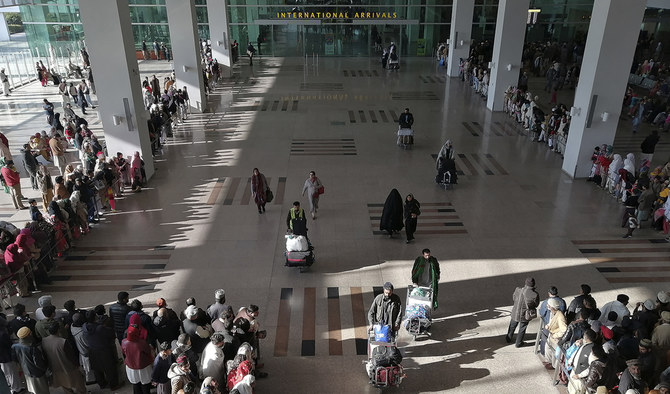
People gather to receive arriving passengers at the international arrival area of the Islamabad International Airport in Islamabad, Pakistan on February 3, 2020. (AFP/File)
Short Url
Updated 30 March 2023
Follow

Pakistan kicks off process to outsource three major airports

  • Pakistan's top economic body approves agreement with World Bank subsidiary to outsource airports
  • Pakistan has been in talks with Qatar to outsource operations of its Karachi, Lahore and Islamabad airports

KARACHI: Pakistan has initiated the process to outsource operations of its three major airports as a public-private partnership, the finance ministry announced on Thursday, as the South Asian country seeks to attract external finances to avoid an acute balance of payments crisis. 

Pakistan's railways minister, Khawaja Saad Rafique, revealed in January that Islamabad was in talks with Doha and would also approach the UAE to outsource operations of its Karachi, Lahore and Islamabad airports. 

He said the move would improve airport service standards and would also bring in much-needed foreign direct investment into the country. Rafique said Islamabad had acquired the services of the International Finance Corporation, a subsidiary of the World Bank, that has provided consultancy for dozens of airports.

In a meeting of the Economic Coordination Committee (ECC), Pakistan's top economic body, a summary to engage the IFC as a transaction advisor for the outsourcing process was presented. 

"The ECC after detailed discussion approved the draft Transaction Advisory Agreement (TASA), reached with the IFC by PCCA for outsourcing of three airports," the finance ministry said. 

Participants of the meeting were told that the outsourcing of three airports has been initiated within the scope of a public-private partnership to engage private investors/airport operators through a competitive and transparent process. 

The investors and airport operators would be required to "run the airports, develop appertaining land assets and enhance avenues for commercial activities and to garner full revenue potential," the statement added. 

The announcement comes with Pakistan facing a deep economic crisis, as it remains locked in so far unsuccessful talks with the International Monetary Fund (IMF) to unlock $1.1 billion in funds from a stalled $6.5 billion loan program. 

The South Asian country has been desperately seeking external financing to avoid defaulting on its obligations, with its dwindling foreign exchange reserves barely enough to cover a few weeks of imports and its national currency facing massive devaluation amid soaring inflation.



Pakistan reports current account surplus in Jan. owing to improved trade, remittances

Updated 17 February 2026
Follow

Pakistan reports current account surplus in Jan. owing to improved trade, remittances

  • Pakistan’s exports crossed the $3 billion mark in Jan. as the country received $3.5 billion in remittances
  • Last month, IMF urged Pakistan to accelerate pace of structural reforms to strengthen economic growth

ISLAMABAD: Pakistan recorded a current account surplus of more than $120 million in January, the country’s finance adviser said on Tuesday, attributing it to improved trade balance and remittance inflows.

Pakistan’s exports rebounded in January 2026 after five months of weak performance, rising 3.73 percent year on year and surging 34.96 percent month on month, according to data released by the country’s statistics bureau.

Exports crossed the $3 billion mark for the first time in January to reach $3.061 billion, compared to $2.27 billion in Dec. 2025. The country received $3.5 billion in foreign remittances in Jan. 2026.

Khurram Schehzad, an adviser to the finance minister, said Pakistan reported a current account surplus of $121 million in Jan., compared to a current account deficit of $393 million in the same month last year.

“Improved trade balance in January 2026, strong remittance inflows, and sustained momentum in services exports (IT/Tech) continue to reinforce the country’s external account position,” he said on X.

Pakistan has undergone a difficult period of stabilization, marked by inflation, currency depreciation and financing gaps, and international rating agencies have acknowledged improvements after Islamabad began implementing reforms such as privatizing loss-making, state-owned enterprises (SOEs) and ending subsidies as part of a $7 billion International Monetary Fund (IMF) loan program.

Late last month, the IMF urged Pakistan to accelerate the pace of these structural reforms to strengthen economic growth.

Responding to questions from Arab News at a virtual media roundtable on emerging markets’ resilience, IMF’s director of the Middle East and Central Asia Jihad Azour said Islamabad’s implementation of the IMF requirements had been “strong” despite devastating floods that killed more than 1,000 people and devastated farmland, forcing the government to revise its 4.2 percent growth target to 3.9 percent.

“What is important going forward in order to strengthen growth and to maintain the level of macroeconomic stability is to accelerate the structural reforms,” he said at the meeting.

Azour underlined Pakistan’s plans to privatize some of the SOEs and improve financial management of important public entities, particularly power companies, as an important way for the country to boost its capacity to cater to the economy for additional exports.

“This comes in addition to the effort that the authorities have made in order to reform their tariffs, which will allow the private sector of Pakistan to become more competitive,” the IMF official said.