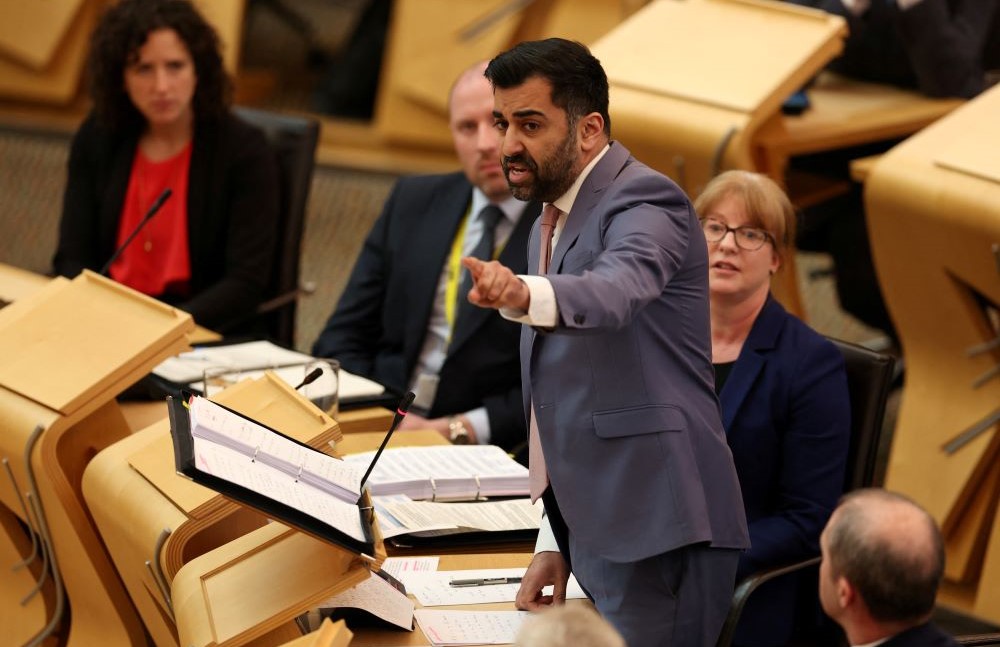
LONDON: Muslim community leaders and MPs have welcomed the election of Humza Yousaf as leader of the Scottish National Party and Scotland’s first minister.
His win adds to successes in Muslim representation within the UK’s political establishment in recent years, including Sadiq Khan’s election as London mayor in 2016 and re-election in 2021, the election of a record 18 Muslim MPs in the 2019 general election, and the SNP’s Anum Qaisar taking a by-election victory two years later.
Sunder Katwala, director of think tank British Future, which looks to foster diversity and inclusion, singled out the “pressure” that built following 9/11 and the London bombings of July 7, 2005, as a catalyst in this movement.
“In that moment of pressure and scrutiny, there was something that seemed to catalyze the determination among British Muslims to push toward greater integration and inclusion, and push back against the negativity surrounding Islam in the UK,” he told Arab News.
“If you travel abroad, it couldn’t be clearer. Maybe Canada aside, Britain is alone in its cross-party diversity.
“France has candidates from minority backgrounds on the left but not on the right. It has been normalized now (in Britain), rather than seen as exceptional, which can only be good.”
In Holyrood, Scotland’s Parliament, Yousaf — who in replacing Nicola Sturgeon became the first Muslim leader of a major political party in Western Europe — faces off against another Muslim at the despatch box, head of Scottish Labour Anas Sarwar.
Afzal Khan, elected as MP for Manchester Gorton in 2017, said “despite our political differences it’s excellent news to see Humza win,” telling Arab News that each minority success in politics is a “manifestation of change and improvement.”
Afzal added: “Before becoming an MP, I was the youngest Lord Mayor of Manchester and I became the UK’s first Muslim minister for the European Parliament by beating the British National Party’s Nick Griffin, and I’m from a working-class background.
“They talk about Sadiq Khan being the son of a bus driver. I was a bus driver, and I think this is very important.
“We’re all from different backgrounds. Even when I look at (British Prime Minister) Rishi Sunak, he’s not Muslim and he’s from incredible wealth, but his success sends a powerful message.”
Katwala said the participation of Muslim Britons in national life remains underexplored despite there being more than a century’s worth of Muslims living in the country, with the community largely ignored by wider society and the press until the 1990s.
But Noor Ahmed, general manager of the Citizens’ Archive of Pakistan, said the “long and interlinked history” of the UK and South Asia detailed in the archives she administers showed that there had always been involvement in political life, if not representation.
“Involvement was always there. It wasn’t as prominent as it is now, and it’s definitely new to see these communities represented in the way they are now — it sort of gives a formality to it,” Ahmed told Arab News.
“It’s a rising trend that we’re certainly seeing play out, and the appointment of Humza, whose family is of Pakistani heritage, to lead Scotland’s largest party and the third-largest party in the UK was lauded in Pakistan and offers an incredibly aspirational story.”
Yousaf, 37, narrowly won the leadership race on Monday after a bruising contest that followed the surprise resignation last month of Sturgeon, who had dominated Scottish politics for almost a decade.
As much as his win, it is Yousaf’s willingness to not only discuss but show his faith that offers Mustafa Field, director of the Faiths Forum for London, the greatest encouragement that the UK is becoming increasingly accepting.
“It’s really exciting having someone showing their cultural and religious sides comfortably. There was something incredibly powerful about Yousaf tweeting a picture of himself praying — that visual display of his comfort in showing his faith,” Field told Arab News.
“There are conservative voices asking how one can reconcile faith and politics, and we saw this with the SNP election, but I think Yousaf shows the way you can separate faith and duty, with the latter recognition of your constituency.
“Unlike other politicians, Humza has been open about his faith. This is important, and it’s why there has been a lot of celebration in the Muslim community over his success, even from those who differ with him politically.”
Dr. Rima Saini, senior lecturer in sociology at Middlesex University London, said in recent years the Conservative Party had been “framed” as a political home for aspirational ethnic minority politicians, “albeit upper-middle-class and right-wing” ones.
But she added that this appears to be shifting, with greater traction and mainstream support for Muslims in senior political leadership outside of the Conservatives, pointing to the numbers elected in both the Labour Party and the SNP on “relatively progressive platforms.”
Saini told Arab News: “This signals that these parties hold a home for minorities, particularly those with a Muslim background who are — and this is important — hyper-racialized and more socioeconomically diverse than the British Hindu and Sikh diaspora, for example.
“Whether these political appointments point to a general decline in racism and Islamophobia is unclear, especially if we consider how strong xenophobic and racist sentiment has been in the UK since Brexit, and the government’s ‘hostile environment’ approach to immigration.
“Furthermore, politics in all corners still lacks class inclusivity, particularly at the top. At the risk of homogenizing a diverse sub-population, these are nonetheless meaningful symbolic gains for British Muslims.”
Afzal warned that “we have to be careful” when presenting stories of progress, which he stressed often involve “steps back as well as forward,” but with “pressure” there is a “clear trajectory.”