



LONDON: Humza Yousaf was confirmed as first minister of Scotland on Tuesday, becoming the first person of color to head the Scottish government, and the first Muslim national leader in any Western democracy.
The milestone comes five months after the UK got its first Hindu leader in Prime Minister Rishi Sunak. Britain’s capital city is headed by London Mayor Sadiq Khan, the son of Pakistani immigrants.
All three politicians reflect the accelerating diversification of politics in Britain, a country whose imperialist past has – uncertainly and sometimes painfully – forged a multi-ethnic present.
“There’s an expectation now, or a familiarity with diversity in British politics, that we don’t see in other European countries,” said Sunder Katwala of British Future, a think-tank that studies identity and race.
Lawmakers in the Edinburgh-based Scottish parliament voted on Tuesday to confirm 37-year-old Yousaf as first minister, a day after he was elected leader of the governing Scottish National Party. Scotland, a country of 5.5 million people, is part of the United Kingdom, but has a semi-autonomous government with broad power in areas including health and education.
In an acceptance speech on Monday, Yousaf said he was “forever thankful that my grandparents made the trip from the Punjab to Scotland over 60 years ago.”
“As immigrants to this country, who knew barely a word of English, they could not have imagined their grandson would one day be on the cusp of being the next first minister of Scotland,” he said. “From the Punjab to our parliament, this is a journey over generations that reminds us that we should celebrate migrants who contribute so much to our country.”
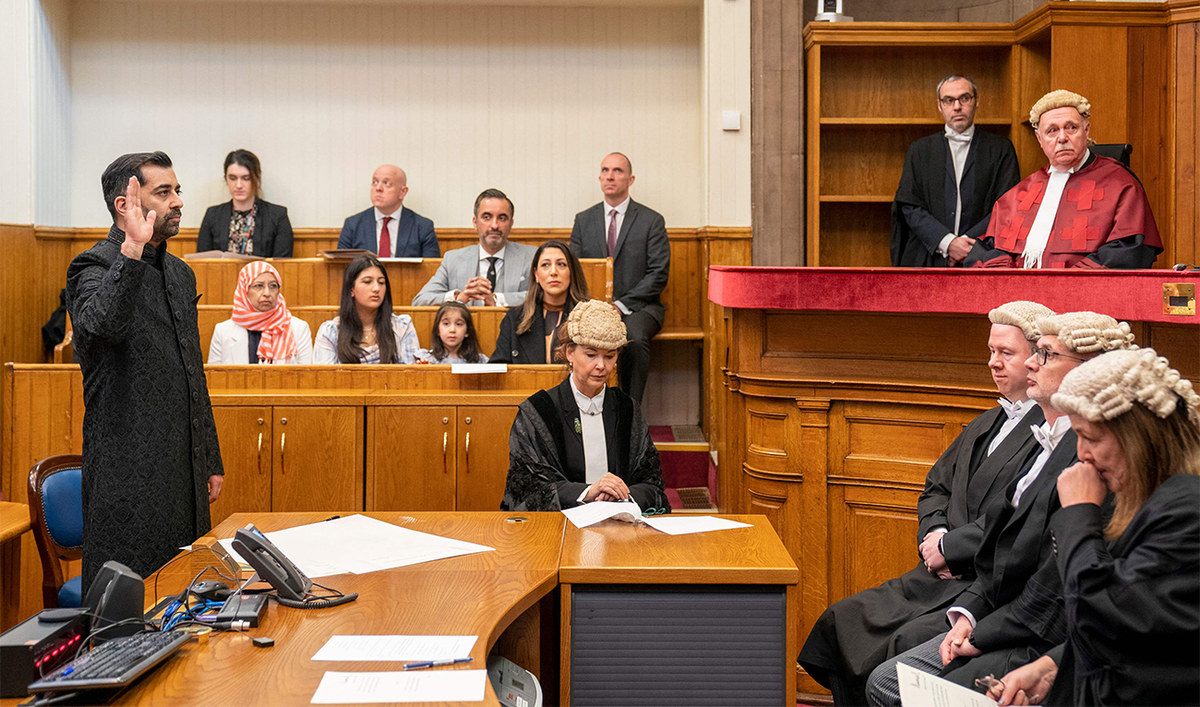
Leader of the Scottish National Party (SNP), Humza Yousaf (L), is sworn in as Scotland's First Minister at the Court of Session in Edinburgh on March 29, 2023. (AFP)
The UK has not always heeded that reminder: migrants have often experienced racism and hostility both covert and overt. That hostility remains government policy for people who arrived by unauthorized means: Sunak’s government plans to detain and deport anyone who crosses the English Channel in small boats, and wants to send some asylum-seekers on a one-way trip to Rwanda.
But British society and politics have grown markedly more diverse. About 18 percent of the population is non-white, and many people have roots in countries the British Empire once ruled, including India, Pakistan and Caribbean nations such as Jamaica.
Yousaf was born in Glasgow in 1985. His father’s family came from Pakistan, his mother’s from East Africa, part of an exodus of South Asian families who faced post-independence discrimination. One grandfather worked in a Singer sewing machine factory, while a grandmother was a Glasgow bus conductor.
At primary school, Yousaf later recalled, “there was only me and one other brown face.” He attended a private high school, then studied politics at the University of Glasgow — after breaking it to his parents, who had hoped he’d become a lawyer.
Yousaf joined the pro-independence SNP in 2005, inspired partly by its then-leader Alex Salmond’s opposition to the US-led invasion of Iraq, which the UK under Prime Minister Tony Blair had joined. Yousaf said he felt independence from the UK was the only way to ensure Scotland would not become embroiled in another illegal war.
Elected to the Scottish parliament in 2011, he has served in several government roles, most recently health. Opposition politicians are scathing about his political record, citing Scotland’s long waiting times for health care and serious drug-addiction problems.
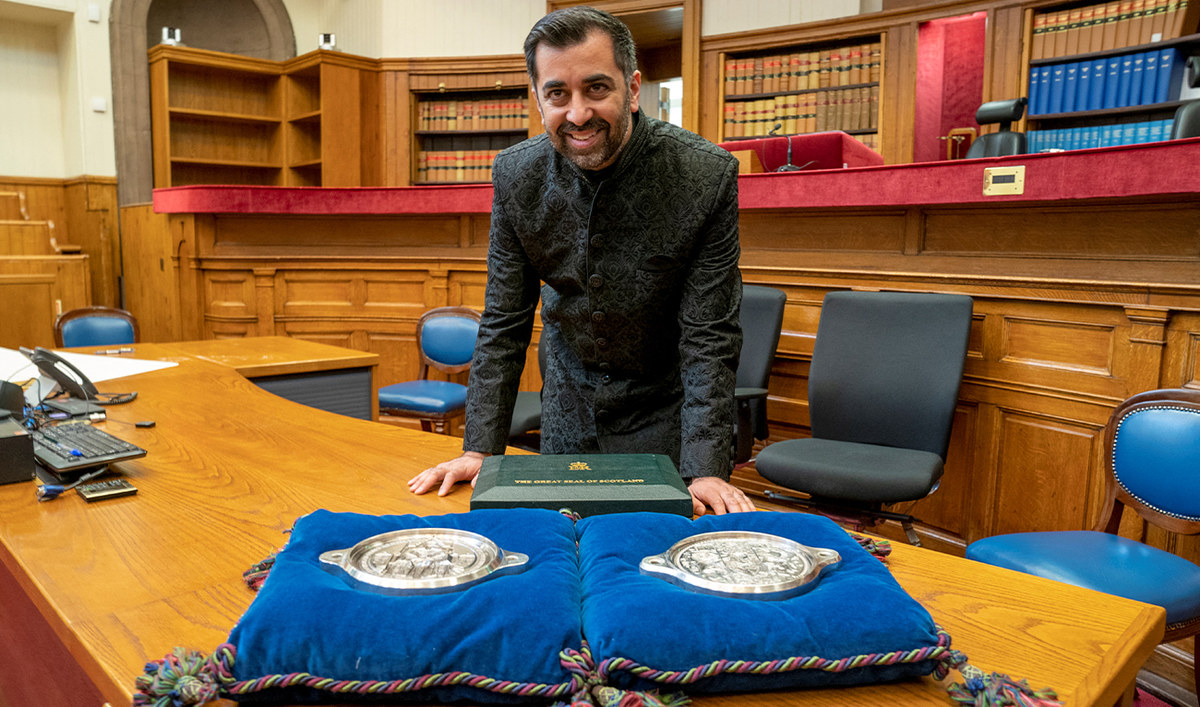
Humza Yousaf with the Great Seal of Scotland after being sworn in as First Minister of Scotland at the Court of Session, Edinburgh, on March 29, 2023. (REUTERS)
Still, Scottish Labour Party leader Anas Sarwar — also a Muslim Glaswegian — said that “regardless of your politics, this is a significant moment for Scotland.”
Yousaf has spoken of the strength he draws from religion, but his Muslim faith drew little comment during the SNP contest. Instead it was the faith of his opponent Kate Forbes, an evangelical Christian, that attracted attention. She was criticized after disclosing her opposition to same-sex marriage, which is legal in Scotland — and which Yousaf supports.
Britain is not the only European country whose politics are growing more diverse. Irish Prime Minister Leo Varadkar has an Indian father, and Portuguese leader Antonio Costa also has South Asian roots.
But Britain has seen rapid political change. Forty years ago there were no ethnic-minority lawmakers in the British Parliament. Now there are 65 – 10 percent of the total. The foreign secretary, home secretary and trade secretary in Sunak’s government are all people of color.
Katwala said a notable feature of the diversification is that “it’s happening in all parties” — Yousaf is a Scottish nationalist, Sunak a Conservative, Khan a Labour Party member.
“If you can have a prime minister who is Indian Hindu or a Scottish leader who is Asian Muslim, that must mean those groups are part of the ‘us’ and aren’t now facing the question, ‘Will they govern for their own group or will they govern for everybody?’” he said.
“There’s a confidence — among British ethnic minorities, but (also) reciprocated broadly – that politicians who are Black, Asian or white can represent everybody, not just their own group.”


