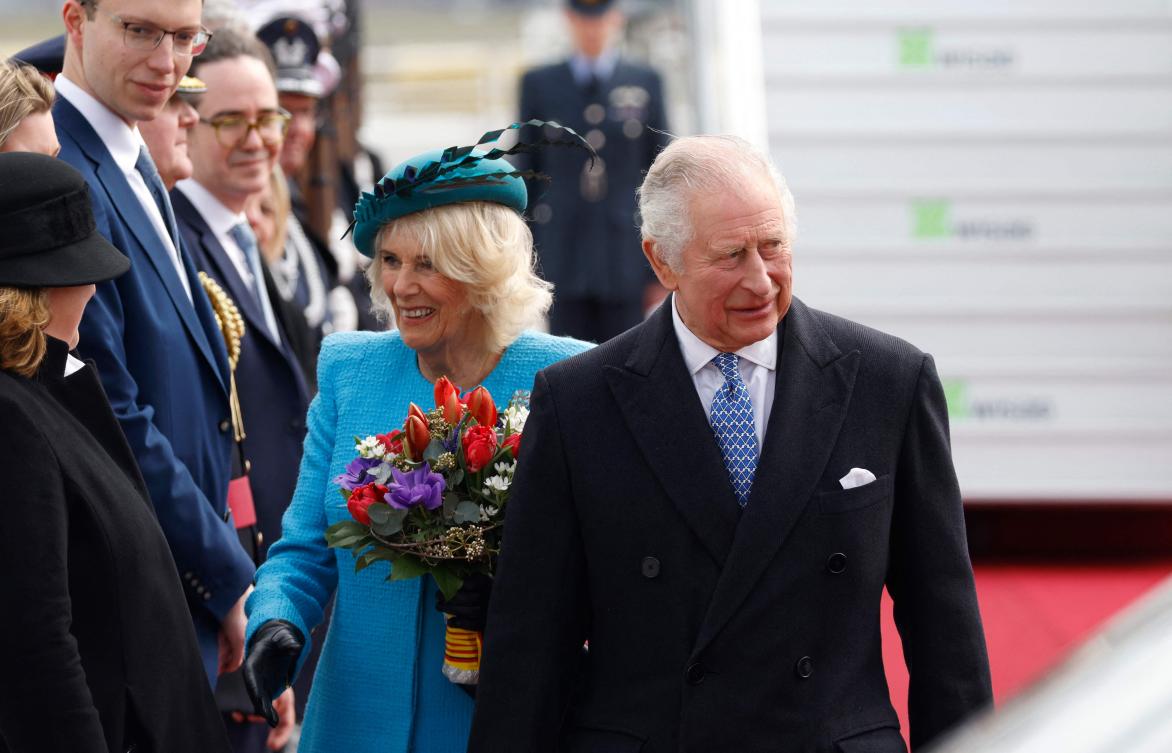
BERLIN: King Charles III arrived in Berlin on Wednesday for his first foreign trip as Britain’s monarch, hoping to improve the UK’s relations with the European Union and to show that he can win hearts and minds abroad, just as his mother did for seven decades.
Charles and Camilla, the queen consort, landed at Berlin’s government airport in the early afternoon. The king, dressed in a black coat, and his wife, in a light blue coat and a feather-trimmed teal hat worn at a jaunty angle, paused at the top of their plane’s stairs to receive a 21-gun salute as two military jets performed a flyover.
German President Frank-Walter Steinmeier was scheduled to welcome the royal couple with military honors at the German capital’s historic Brandenburg Gate.
Charles, 74, who ascended the throne after the death of Queen Elizabeth II in September, is set to be crowned on May 6. As Britain’s head of state, the king meets weekly with the prime minister and retains his mother’s role as leader of the Commonwealth.
He had initially planned to first visit France, but the first leg of his trip was canceled due to massive protests over planned pension changes there.
Billed as a multi-day tour of the European Union’s two biggest countries, the trip was designed to underscore British Prime Minister Rishi Sunak’s efforts to rebuild relations with the bloc after six years of arguments over Brexit and highlight the countries’ shared history as they work together to combat Russian aggression in Ukraine.
Now everything rests on Germany, where the king faces the first big test of whether he can be an effective conduit for the “soft power” the House of Windsor has traditionally wielded, helping Britain pursue its geopolitical goals through the glitz and glamor of a 1,000-year-old monarchy.
Charles, a former naval officer who is the first British monarch to earn a university degree, is expected to insert heft where his glamorous mother once wielded star power. His visit to Germany will give him an opportunity to highlight the causes he holds dear, like sustainability and the environment.
But there will also be a full dose of the pomp and circumstance that screams royal visit, starting with the ceremonial welcome at the Brandenburg Gate and a white tie dinner at Schloss Bellevue, the German president’s official residence, on Wednesday evening.
Royal fans started lining up early in the morning for security checks at the Brandenburg Gate, hoping to get a close view of Charles and Camilla. By noon, hundreds of fans awaited their arrival as police and sniffer dogs worked in the area. About 1,500 spectators were admitted to the cordoned-off area, German news agency dpa reported.
Christoph Muehlbach, 59, had traveled by train from Hamburg to see the British royals. He described himself as a supporter of the royal family for the last 20 years and said he had traveled to London in the past for weddings, anniversaries and the queen’s state funeral.
“I take great pleasure in the British royal family,” Muehlbach told dpa.
Gabriele Fluechter, 57, of Berlin, said she came “out of love for England,” where she had attended university. She said she had seen Elizabeth on one of the queen’s visits to Berlin, and also had spotted Charles and Camilla before.
“They walked along there very casually,” she said, adding that the long wait was no problem,
On Thursday, the king is scheduled to give a speech to the Bundestag, Germany’s parliament. He will also meet Chancellor Olaf Scholz, talk to Ukrainian refugees, and meet with British and Germany military personnel who are working together on joint projects. In the afternoon he will visit an organic farm outside of Berlin.
The royal couple plan to go to Hamburg on Friday, where they will visit the Kindertransport memorial for Jewish children who fled from Germany to Britain during the Third Reich, and attend a green energy event before returning to the UK
The king was urged to make the trip by Sunak, who during his first six months in office negotiated a settlement to the long-running dispute over post-Brexit trading rules for Northern Ireland and reached a deal with France to combat the people smugglers ferrying migrants across the English Channel in small boats. Sunak hopes goodwill created by a royal visit can help pave the way for progress on other issues, including Britain’s return to an EU program that funds scientific research across Europe.
Britain’s senior royals are among the most recognizable people on the planet. While their formal powers are strictly limited by law and tradition, they draw attention from the media and the public partly because of the historic ceremonies and regalia that accompany them — and also because the public is fascinated by their personal lives.
Elizabeth’s influence stemmed in part from the fact that she made more than 100 state visits during her 70 years on the throne, meeting presidents and prime ministers around the world in a reign that lasted from the Cold War to the information age.
Politicians were eager to meet the monarch for tea, if for no other reason than she’d been around so long.
King Charles III makes world debut as tour starts in Germany
Short Url
https://arab.news/jqcu5
King Charles III makes world debut as tour starts in Germany
- Charles and Camilla, the queen consort, landed at Berlin's government airport in the early afternoon
- His visit to Germany will give him an opportunity to highlight the causes he holds dear, like sustainability and the environment
New Trump strategy vows shift from global role to regional
WASHINGTON: President Donald Trump’s administration said in a long-awaited new strategy document Friday that the United States will shift from its historic global role toward increasing dominance in Latin America and vigorously fighting migration.
The national security paper, meant to flesh out Trump’s norms-shattering “America First” worldview, signals a sharp reorientation from longstanding US calls to refocus on Asia, although it still identifies China as a top competitor.
The strategy also brutally criticized allies in Europe and said that the United States will champion opponents to European Union-led values, including on immigration.
Breaking with decades of attempts to be the sole superpower, the strategy said that the “United States rejects the ill-fated concept of global domination for itself.”
It said that the United States would also prevent other powers from dominating but added: “This does not mean wasting blood and treasure to curtail the influence of all the world’s great and middle powers.”
The strategy called for a “readjustment of our global military presence to address urgent threats in our Hemisphere, and away from theaters whose relative import to American national security has declined in recent decades or years.”
The strategy speaks in bold terms of pressing US dominance in Latin America, where the Trump administration has been striking alleged drug traffickers at sea, intervening to bring down leftist leaders including in Venezuela, and loudly seeking to take charge of key resources such as the Panama Canal.
The strategy cast Trump as modernizing the two-century-old Monroe Doctrine, in which the then young United States declared Latin America off-limits to rival powers, then from Europe.
“We will assert and enforce a ‘Trump Corollary’ to the Monroe Doctrine,” it said.
- Championing Europe ‘resistance’ -
Trump has sharply reversed many longstanding US principles since returning to office in January.
He rose to political prominence demanding sweeping curbs on immigration to the United States, fanning fears that the white majority was losing its status, and since taking office has ordered drastic and high-profile raids to deport undocumented people.
“The era of mass migration must end. Border security is the primary element of national security,” the strategy said.
The strategy made clear that the United States under Trump would aggressively pursue similar objectives in Europe, in line with far-right parties that have made strong gains in much of the continent.
In extraordinary language in speaking of close allies, the strategy said: “Cultivating resistance to Europe’s current trajectory within European nations.”
Germany quickly hit back, saying that it does not need “outside advice.”
The strategy pointed to Europe’s lower share of the global economy — which is the result largely of the rise of China and other emerging powers — and said: “This economic decline is eclipsed by the real and more stark prospect of civilizational erasure.
“Should present trends continue, the continent will be unrecognizable in 20 years or less.”
As Trump seeks an end to the Ukraine war that would likely favor Russia gaining territory, the strategy accused Europeans of weakness and said the United States should focus on “ending the perception, and preventing the reality, of NATO as a perpetually expanding alliance.”
- Less on Middle East and Africa -
The strategy paid comparatively little attention to the Middle East, which has long consumed Washington.
Pointing to US efforts to increase energy supply at home and not in the oil-rich Gulf, the strategy said: “America’s historic reason for focusing on the Middle East will recede.”
The paper said it was a US priority for Israel to be secure, but stopped short of the fulsome language on Israel used even in the first Trump administration.
On China, the strategy repeated calls for a “free and open” Asia-Pacific region but focused more on the nation as an economic competitor.
After much speculation on whether Trump would budge on Taiwan, the self-ruling democracy claimed by Beijing, the strategy made clear that the United States supports the decades-old status quo, but called on allies Japan and South Korea to contribute more to ensure Taiwan’s defense from China.
The strategy predictably puts little focus on Africa, saying the United States should transition away from “liberal ideology” and an “aid-focused relationship” and emphasize goals such as securing critical minerals.
The national security paper, meant to flesh out Trump’s norms-shattering “America First” worldview, signals a sharp reorientation from longstanding US calls to refocus on Asia, although it still identifies China as a top competitor.
The strategy also brutally criticized allies in Europe and said that the United States will champion opponents to European Union-led values, including on immigration.
Breaking with decades of attempts to be the sole superpower, the strategy said that the “United States rejects the ill-fated concept of global domination for itself.”
It said that the United States would also prevent other powers from dominating but added: “This does not mean wasting blood and treasure to curtail the influence of all the world’s great and middle powers.”
The strategy called for a “readjustment of our global military presence to address urgent threats in our Hemisphere, and away from theaters whose relative import to American national security has declined in recent decades or years.”
The strategy speaks in bold terms of pressing US dominance in Latin America, where the Trump administration has been striking alleged drug traffickers at sea, intervening to bring down leftist leaders including in Venezuela, and loudly seeking to take charge of key resources such as the Panama Canal.
The strategy cast Trump as modernizing the two-century-old Monroe Doctrine, in which the then young United States declared Latin America off-limits to rival powers, then from Europe.
“We will assert and enforce a ‘Trump Corollary’ to the Monroe Doctrine,” it said.
- Championing Europe ‘resistance’ -
Trump has sharply reversed many longstanding US principles since returning to office in January.
He rose to political prominence demanding sweeping curbs on immigration to the United States, fanning fears that the white majority was losing its status, and since taking office has ordered drastic and high-profile raids to deport undocumented people.
“The era of mass migration must end. Border security is the primary element of national security,” the strategy said.
The strategy made clear that the United States under Trump would aggressively pursue similar objectives in Europe, in line with far-right parties that have made strong gains in much of the continent.
In extraordinary language in speaking of close allies, the strategy said: “Cultivating resistance to Europe’s current trajectory within European nations.”
Germany quickly hit back, saying that it does not need “outside advice.”
The strategy pointed to Europe’s lower share of the global economy — which is the result largely of the rise of China and other emerging powers — and said: “This economic decline is eclipsed by the real and more stark prospect of civilizational erasure.
“Should present trends continue, the continent will be unrecognizable in 20 years or less.”
As Trump seeks an end to the Ukraine war that would likely favor Russia gaining territory, the strategy accused Europeans of weakness and said the United States should focus on “ending the perception, and preventing the reality, of NATO as a perpetually expanding alliance.”
- Less on Middle East and Africa -
The strategy paid comparatively little attention to the Middle East, which has long consumed Washington.
Pointing to US efforts to increase energy supply at home and not in the oil-rich Gulf, the strategy said: “America’s historic reason for focusing on the Middle East will recede.”
The paper said it was a US priority for Israel to be secure, but stopped short of the fulsome language on Israel used even in the first Trump administration.
On China, the strategy repeated calls for a “free and open” Asia-Pacific region but focused more on the nation as an economic competitor.
After much speculation on whether Trump would budge on Taiwan, the self-ruling democracy claimed by Beijing, the strategy made clear that the United States supports the decades-old status quo, but called on allies Japan and South Korea to contribute more to ensure Taiwan’s defense from China.
The strategy predictably puts little focus on Africa, saying the United States should transition away from “liberal ideology” and an “aid-focused relationship” and emphasize goals such as securing critical minerals.
© 2025 SAUDI RESEARCH & PUBLISHING COMPANY, All Rights Reserved And subject to Terms of Use Agreement.