KARACHI: A local seminary in Pakistan’s southern Sindh province has set a new trend for religious schools in the country by cultivating large swathes of land to mitigate the impact of climate change and generate its own revenue.
The idea is unique since most South Asian seminaries rely on external donations to impart religious education to young children who mostly belong to low- and middle-income social segments.
Jamia-Tul-Uloom-il-Islamia has also been a trailblazer in other ways since it has made it mandatory for its students to receive modern-day education while enrolling female students as well.
Umar Farooq, who supervises the institute’s agricultural farms, said the seminary’s management decided to employ scientific methods to plant its own orchards after previously cultivating various crops on 300 acres of land.
“What’s happening due to climate change makes it essential for us to plant more and more trees to stop its adverse effects,” he told Arab News while mentioning periodic heatwaves and the recent monsoon floods in the country.

The picture taken on March 26, 2023, shows the entrance of Jamia-Tul-Uloom-il-Islamia in Hala, a village in Pakistan's Sindh province. (AN photo)
According to an international climate organization, Germanwatch, Pakistan is among the ten countries which are most vulnerable to erratic weather patterns, though it contributes less than one percent to global carbon emissions.
Last year, Pakistan’s Sindh province endured unprecedented heatwaves from April to June before one-third of the country was submerged by heavy monsoon rains and floods that claimed the lives of over 1,700 people and caused an estimated damage of $30 billion.
The floods also washed away the seminary’s cotton crop, though the institute has been relying on mangoes and other fruit plantations in recent years.
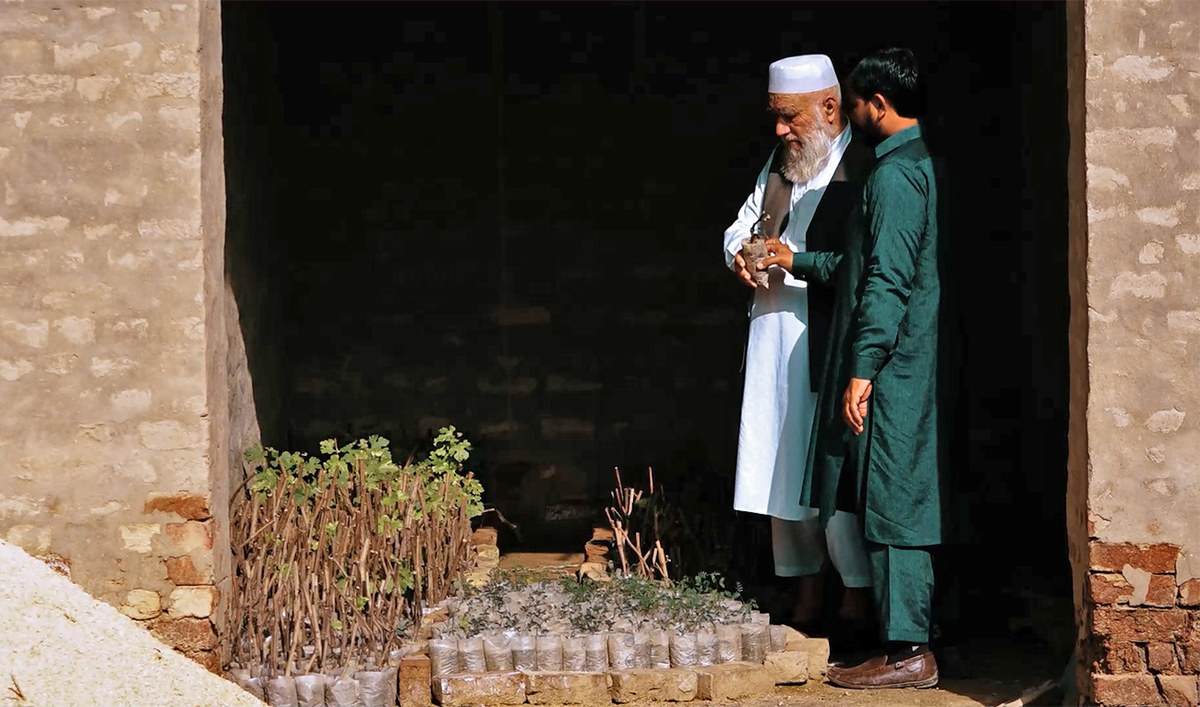
Lutfullah Bhutto (left), a member of the Idara Tameer-e-Milat board, which runs the seminary, gives a sapling to the supervisor of the agricultural farms in Hala, Sindh, on March 26, 2023. (AN photo)
Farooq said the school raised 8,500 trees in the last four years that produce different varieties of mangoes, including Sindhri, Chaunsa, and Anwar Ratol. Additionally, the farm has a lemon orchard and date plants which are collectively spread over 20 acres of land.
Lutfullah Bhutto, a member of the Idara Tameer-e-Milat board which runs the seminary, said the school got agricultural land from a religious scholar, Shafi Muhammad Nizamani, in the mid-1950s to grow crops and meet its administrative costs. However, the senior faculty recently decided to plant fruit trees instead.
“We realized that crops don’t yield as much income as one can earn from orchards, so the committee decided to pay attention to gardening,” he said.
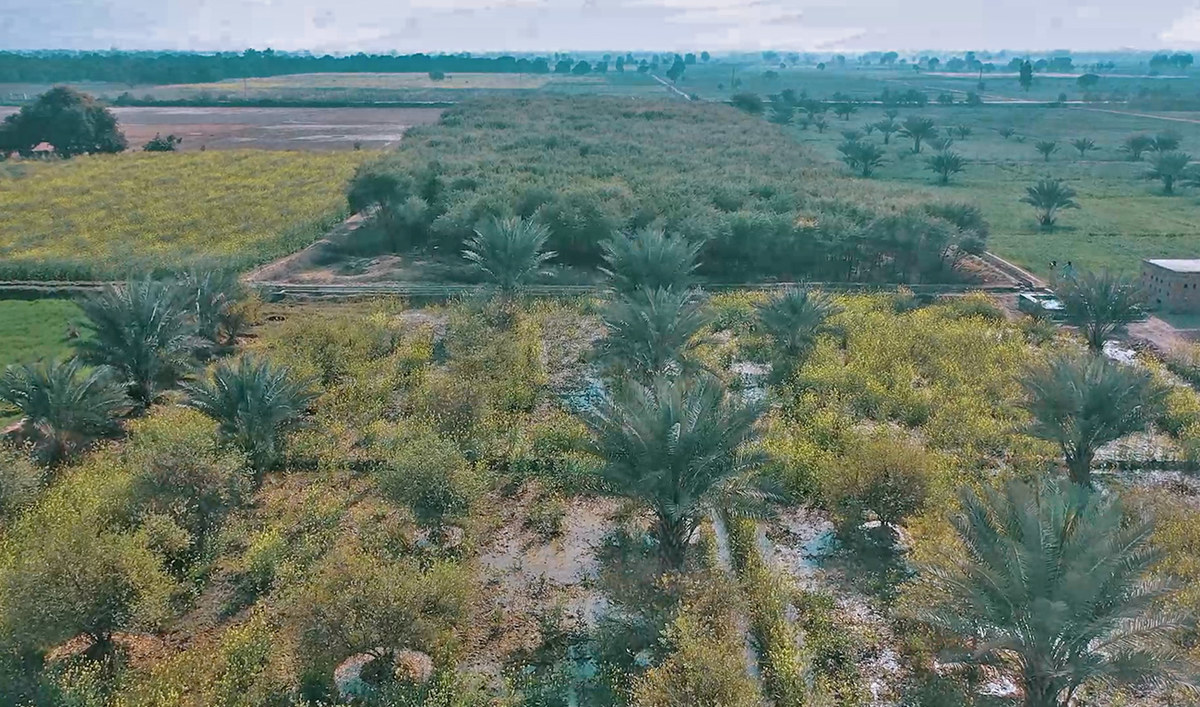
The aerial image taken on March 26, 2023, shows the plantation of the Islamic seminary, Jamia-Tul-Uloom-il-Islamia, in Hala, a village in Pakistan's southern Sindh province. (AN photo)
When the founders of the institute decided to establish the seminary in Hala village, he continued, they named the area after Mansurah, an ancient city which became a knowledge center in the region.
“Muhammad Bin Qasim came here to Brahmanabad, near Tando Adam,” he said. “He built a huge center of learning [at Mansurah]. This [village] was named Mansurah so it might also become a hub of knowledge like the one that existed in Brahmanabad [during the Arab rule].”

The picture taken on March 26, 2023, shows Ajwa date tree planted at Jamia-Tul-Uloom-il-Islamia seminary in Hala, a village in Pakistan's southern Sindh province. (AN photo)
Maulana Muhammad Ahsan Bhutto, the seminary’s administrator, told Arab News that students also received modern education along with religious knowledge at the school.
He expressed regret at tree cutting in different parts of Pakistan, saying it negatively impacts the environment.
However, he maintained that students of his seminary were doing their best to address the problem by planting and taking care of new trees.
Bhutto maintained the seminary’s tree plantation activity was an attempt address the climate situation and ensure its economic independence.
“We tell our children this thing that they have to plant trees in their area,” he said. “For this, we ask every child to plant one tree annually and look after it for the entire year.”