

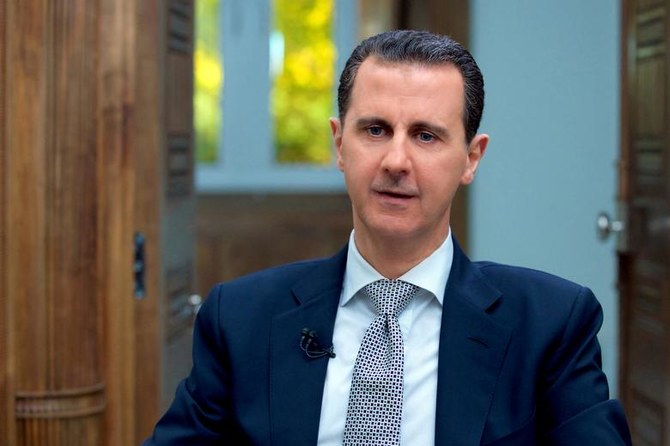

LONDON: A group of American former officials and experts on Syria have written to US President Joe Biden and Secretary of State Antony Blinken urging their administration to push back against any efforts to normalize the regime of Syrian President Bashar Assad.
The signatories to the letter include former US special envoys to Syria Frederic Hof, James Jeffrey and Joel Rayburn; Gen. Kenneth McKenzie, the former chief of US Central Command; John McLaughlin, a former acting director of the CIA; and William Roebuck, the former US deputy special envoy to the Global Coalition to Defeat Daesh.
The missive outlines their concerns about Biden’s strategy for Syria, where a brutal civil war raging since 2011 has left half a million people dead and millions displaced in one of the world’s worst refugee crises.
“Unconditional regime normalization is not inevitable,” according to the authors of the letter. “Opposing regime normalization in word only is not enough, as tacitly allowing it is short-sighted and damaging to any hope for regional security and stability.”
Biden has previously indicated that the US will not normalize the Syrian regime and will not encourage its partners or other nations to do so. It comes amid a growing sense among many that Assad is slowly being welcomed back into the fold by other leaders, regionally and globally.
“(The US) message is, ‘We will never normalize and we discourage normalization,’” said Charles Lister, a senior fellow at Middle East Institute and coordinator of the letter. “None of that is, ‘Don’t you dare normalize with the regime.’”
The letter also highlighted the need for a formal ceasefire in Syria, which the authors said would allow for a more efficient and coordinated aid effort and could ignite a political process. Any normalization of the Assad regime, they added, would erode the “international community’s capacity to shape a political process aimed at meaningfully resolving the crisis.”
They continued: “None of the issues that caused the Syria conflict have been resolved, most notably Assad regime atrocities, and inability or refusal to reform.
“Many of the conflict’s symptoms are worsening, from human suffering, industrial-scale drug trafficking, refugee flows, terrorism, geopolitical conflict and ethnic and sectarian hostilities.
“The Biden administration’s foreign-policy priorities of great-power competition, international and Middle East stability, human rights, humanitarianism, or combating food insecurity are insufficiently advanced through the current Syria policy.”
Lister said that regional moves to normalize relations with the Assad regime are inevitable because the US and its allies have been lackluster and are “nowhere to be seen” when it comes to the Syria crisis. If the West is not willing to push for accountability and justice over Assad’s atrocities, he asked, “why should regional states?”
The letter also includes a number of recommendations, including an alternative strategy for humanitarian aid to the Syrian people in the aftermath of the Feb. 6 earthquakes that hit the north of the country and neighboring Turkiye, and increased pressure on the governments of other countries to repatriate the thousands of their citizens who fought alongside Daesh and are now detained, with their families, in Syrian camps.
Prominent Emirati professor Abdulkhaleq Abdulla said he believes the regional approach to Syria, while differing from the US and European policy, will ultimately win out through a process of re-engagement with Damascus.
He said a rapprochement could benefit the region because “more Arab presence probably will translate into less Iranian presence” in the corridors of power in Damascus, the UK’s Guardian newspaper reported.


