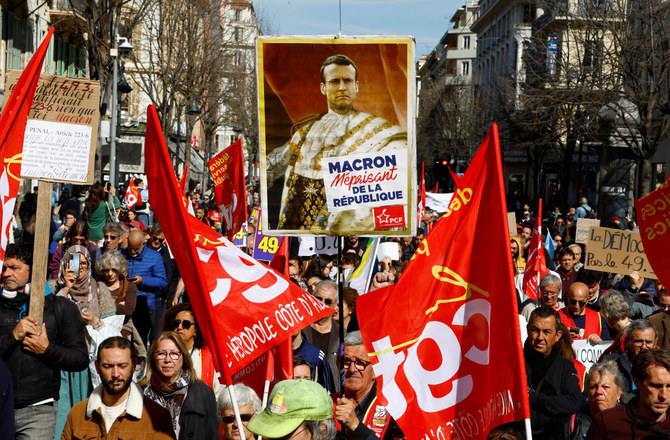
PARIS: Protests and strikes against unpopular pension reforms kicked off again Tuesday across France, with police security ramped up amid government warnings that radical demonstrators intended “to destroy, to injure and to kill.”
Concerns that violence could mar the demonstrations prompted what Interior Minister Gérald Darmanin described as an unprecedented deployment of 13,000 officers, nearly half of them concentrated in the French capital.
After months of upheaval, an exit from the firestorm of protest triggered by President Emmanuel Macron ‘s changes to France’s retirement system looked as far away as ever. Despite fresh union pleas hat the government pause its hotly contested push to raise France’s legal retirement age from 62 to 64, Macron seemingly remained wedded to it.
The French leader previously used a special constitutional power to ram the reform past legislators without allowing them a vote. His move this month further galvanized the protest movement. Violence has since flared and thousands of tons of stinking garbage have piled up on Paris’ streets as sanitation workers strike.
“Everybody is getting madder,” said Clément Saild, a train passenger at Paris’ Gare de Lyon railway station, where tracks were temporarily invaded and blocked Tuesday by protesting workers.
He said he supports the strikes despite their impact on transportation and other services.
“I am 26, and I wonder if I will ever retire,” he said.
Another passenger, Helene Cogan, 70, said: “French people are stubborn and things are getting out of hand.”
The wave of protests Tuesday marked the 10th time since January that unions have called on workers to walk out and for demonstrators to flood the nation’s streets against Macron’s retirement changes, which are a key priority of his second term as president.
His government argues that France’s pension system will dive into deficit without reform, because of the lower birth rates and longer life expectancy in many richer nations. Macron’s opponents say additional funding for pensions could come from other sources, without having to make workers retire later.
Demonstrations got underway peacefully Tuesday morning, with large crowds in multiple cities. But police braced for violence later in the day. The interior minister said more than 1,000 “radical” troublemakers, some from overseas, could latch on to marches in Paris and elsewhere.
“They come to destroy, to injure and to kill police officers and gendarmes. Their goals have nothing to do with the pension reform. Their goals are to destabilize our republican institutions and bring blood and fire down on France,” the minister said Monday in detailing the policing.
Some protesters, human rights campaigners and Macron’s political opponents allege that police officers have used excessive force against demonstrators. A police oversight body is investigating multiple claims of wrongdoing by officers.
The striking railway workers outside Gare de Lyon marched behind a banner that alleged: “The police mutilates. We don’t forgive!”
Macron’s opponents are urging him to cool tempers by backing down. Union leader Laurent Berger appealed Tuesday for a pause in implementing the retirement reform and for mediation.
“If we want to avoid tensions — and I want to avoid them — — what the trade unions are proposing is a gesture to calm things down,” he said. “It must be seized.”
But government spokesman Olivier Veran said mediation wasn’t needed for unions and the government to talk to each other.
The latest round of protests prompted Macron to indefinitely postpone a planned state visit this week by King Charles III.
Veran insisted, however, that France remains a welcoming place for all non-royal visitors.
“Life goes on,” he said.

France braces for violence in new wave of pension protests
https://arab.news/2ud8b
France braces for violence in new wave of pension protests
- Macron’s move this month further galvanized the protest movement
- Violence has since flared and thousands of tons of stinking garbage have piled up on Paris' streets as sanitation workers strike
What Bangladesh’s election means for India, China and Pakistan ties
- Bangladeshis will vote on Feb. 12, almost two years after the 2024 student-led uprising
- After nearly 2 years of tensions, experts expect a thaw with India under elected government
DHAKA: As Bangladesh prepares to hold its first elections since the 2024 ouster of Sheikh Hasina, its longest-serving prime minister, the outcome will define Dhaka’s relations with the most important regional powers — China, India, and Pakistan.
Nearly 128 million Bangladeshis will head to the polls on Feb. 12 to bring in new leadership after an 18-month rule of the current caretaker administration.
The interim government, led by Nobel laureate Muhammad Yunus, took control following a student-led uprising that ended 15 years in power of Hasina and her Awami League party.
The two main parties out of the 51 competing for power are the Bangladesh Nationalist Party and Jamaat-e-Islami. The Awami League, which for decades has had close ties with India, was excluded from the election ballot over its role in the deadly crackdown on the 2024 student-led protests, in which 1,400 people were killed.
While Bangladesh’s relationship India has deteriorated since the fall of Hasina, who has been in self-exile in New Delhi, the period of diplomatic strain is expected to ease when the new government takes office.
“Whoever comes to power in Bangladesh, due to domestic pressure in the country, relationships with India need a resetting,” Humayun Kabir, former ambassador to the US, told Arab News.
“It’s anticipated that India will also engage with the new government, but they will protect their interests, and we also have to do the same. It’s most likely that the India-Bangladesh relationship will be normalized under the new, elected, government.”
Since 2024, India has suspended key transshipment access that allowed Bangladeshi exports to go via Indian ports and airports. It also put on hold most normal visa services for Bangladeshis, who were among its largest groups of medical tourists.
From Hasina’s heavy pro-India orientation, the interim government has tried to rebalance Bangladesh’s foreign policy toward the two other key regional players — China and Pakistan — who at the same time are India’s main rivals.
If New Delhi regains its importance, it should not deal a blow to the newly expanded relations with Pakistan, with whom Bangladesh has recently increased exchanges, especially economic, and last month resumed direct flights — after a 14-year gap.
Since the relations have been expanded under the caretaker government, Prof. Delwar Hossain from the International Relations Department at Dhaka University forecast that they would only further improve, no matter who comes to power, and there is no likelihood of a sudden change.
“For Pakistan, any political coalition — whether BNP or Jamaat — will be positive. The BNP has a long history of having good relations with Pakistan during their rule ... Jamaat also has a strong and very positive influence in Pakistan,” he said.
“For Pakistan, the new regime or new government is not the issue. The issue is what the (India) policy of the new government would be and to what extent it would actually support Pakistan’s view.”
Both the BNP and Jamaat have repeatedly said they wanted friendly relations with India, and Hossain expected that they would, at the same time, continue the balanced approach introduced by the caretaker administration.
“India is a reality as a neighbor. At the same time, India is also showing interest in mending relations or adopting a more cooperative approach after the vote, with the government that will be elected ... I think there will be pragmatism from both sides,” he said.
“I don’t see there is a long-term threat to Bangladesh-India relations ... When China and Pakistan were trying to create a trilateral cooperative system or some kind of coalition — China, Bangladesh and Pakistan — we have seen that Bangladesh opted out. It seems that Bangladesh is going to continue its policy of maintaining a balance among these great powers.”
Bangladesh’s relations with China have not changed since the ouster of Hasina, whose government signed several economic agreements with Beijing. Yunus’s administration has continued this cooperation, and China was among the very few countries he officially visited during his term.
During the visit, he secured about $2.1 billion in Chinese investments, loans and grants, including funding for infrastructure like Mongla Port and a special economic zone in Chattogram — Bangladesh’s largest port. China has also eased visa rules for Bangladeshi businesspeople, medical travelers and tourists.
According to Munshi Faiz Ahmed, Bangladesh’s former ambassador to Beijing, China’s importance for Bangladesh cannot be substituted by any other country, especially as over the past few years it has emerged not only as its key investor, but also the largest trade partner.
In the fiscal year 2024-25, Bangladesh’s trade with China was over $21.3 billion, according to National Board of Revenue data. With India, it was about $11.5 billion.
The trade — especially import — dependence on Beijing started long before the regime change. In terms of trade volume, China overtook India already in 2018.
“Even when people thought that we had very close relations with India, our relations with China continued to grow in terms of trade and commerce ... Our trade with China has surpassed India’s, and China is a much bigger investor in Bangladesh’s development projects,” Ahmed said.
“Bangladesh will continue to cooperate with China for a long time to come because what China can provide, no other country can.”