

Opposition parties disrupt India’s parliament after ouster of Rahul Gandhi, fierce Modi critic

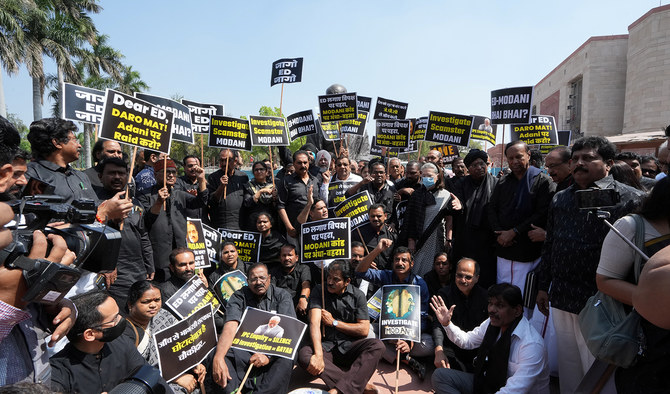
Indian lawmakers from various opposition parties wear black as they hold a protest after the opposition Congress party's leader Rahul Gandhi was disqualified as a lawmaker by India's parliament, inside the parliament premises in New Delhi, India, March 27, 2023. (REUTERS)
Short Url
Updated 27 March 2023
Follow

Opposition parties disrupt India’s parliament after ouster of Rahul Gandhi, fierce Modi critic

  • Hundreds of supporters of Gandhi demonstrated in New Delhi and dozens were detained by police, lawmakers from 18 opposition parties also protested outside Parliament
  • Gandhi’s expulsion from legislature on Friday came a day after a local court convicted him of defamation and sentenced him to two years in prison for mocking Modi’s surname

NEW DELHI: Members of opposition parties dressed in black disrupted India’s Parliament on Monday and protested in the capital, New Delhi, after Rahul Gandhi, a key opposition leader and fierce critic of Prime Minister Narendra Modi, was expelled from the legislature last week.

Hundreds of supporters of Gandhi’s Congress party demonstrated in the heart of New Delhi and dozens were detained by police. Lawmakers from 18 opposition parties also protested together outside Parliament, donning black clothes to symbolize mourning and waving posters that warned India’s democracy is in danger.

Gandhi’s expulsion on Friday came a day after a local court convicted him of defamation and sentenced him to two years in prison for mocking Modi’s surname in an election speech in 2019. The actions against Gandhi, the great-grandson of India’s first prime minister, were widely denounced by opponents of Modi as assaults against democracy and free speech by a government seeking to quash dissent. His removal from Parliament also delivered a major blow to the Congress party ahead of national elections next year.

“The government wants to suppress the opposition and their voice,” said Mallikarjun Kharge, president of the Congress party.

Over the weekend, Gandhi said he is being targeted for raising questions about Modi’s relationship to Gautam Adani, a coal tycoon who until recently was Asia’s richest man.

Hindenburg Research, a U.S. financial research firm, accused the Adani Group in January of stock price manipulation and fraud running into billions of dollars. Since then, Gandhi has pushed for an investigation into Adani’s sprawling businesses, whose market value has since plummeted by tens of billions of dollars. Modi’s Bharatiya Janata Party says he has no links to Adani.

The protesting opposition lawmakers backed Gandhi on Monday by renewing calls for a parliamentary probe into the Adani Group.

Gandhi said he was not bothered about losing his seat in Parliament. “My job is to defend the institutions of the country and the voice of people,” he said over the weekend.

A court in Modi’s home state of Gujarat convicted Gandhi last week over a 2019 speech in which he asked, “Why do all thieves have Modi as their surname?” Gandhi then referred to three well-known and unrelated Modis: a fugitive Indian diamond tycoon, a cricket executive banned from the Indian Premier League tournament and the prime minister.

Under Indian law, a criminal conviction and prison sentence of two years or more are grounds for expulsion from Parliament. Gandhi was granted bail for 30 days to allow him to appeal the decision, which Gandhi says he will do.


House votes to slap back Trump’s tariffs on Canada in rare bipartisan rebuke

Updated 12 February 2026
Follow

House votes to slap back Trump’s tariffs on Canada in rare bipartisan rebuke

WASHINGTON: The House voted Wednesday to slap back President Donald Trump’s tariffs on Canada, a rare if largely symbolic rebuke of the White House agenda as Republicans joined Democrats over the objections of GOP leadership.
The tally, 219-211, was among the first times the House, controlled by Republicans, has confronted the president over a signature policy, and drew instant recrimination from Trump himself. The resolution seeks to end the national emergency Trump declared to impose the tariffs, though actually undoing the policy would require support from the president, which is highly unlikely. It next goes to the Senate.
Trump believes in the power of tariffs to force US trade partners to the negotiating table. But lawmakers are facing unrest back home from businesses caught in the trade wars and constituents navigating pocketbook issues and high prices.
“Today’s vote is simple, very simple: Will you vote to lower the cost of living for the American family or will you keep prices high out of loyalty to one person — Donald J. Trump?” said Rep. Gregory Meeks of New York, the top Democrat on the House Foreign Affairs Committee, who authored the resolution.
Within minutes, as the gavel struck, Trump fired off a stern warning to those in the Republican Party who would dare to cross him.
“Any Republican, in the House or the Senate, that votes against TARIFFS will seriously suffer the consequences come Election time, and that includes Primaries!” the president posted on social media.
The high-stakes moment provides a snapshot of the House’s unease with the president’s direction, especially ahead of the midterm elections as economic issues resonate among voters. The Senate has already voted to reject Trump’s tariffs on Canada and other countries in a show of displeasure. But both chambers would have to approve the tariff rollbacks, and send the resolution to Trump for the president’s signature — or veto.
Six House Republicans voted for the resolution, and one Democrat voted against it.
From Canada, Ontario, Premier Doug Ford on social media called the vote “an important victory with more work ahead.” He thanked lawmakers from both parties “who stood up in support of free trade and economic growth between our two great countries. Let’s end the tariffs and together build a more prosperous and secure future.”
Trump recently threatened to impose a 100 percent tariff on goods imported from Canada over that country’s proposed China trade deal, intensifying a feud with the longtime US ally and Prime Minister Mark Carney.
GOP defections forced the vote
House Speaker Mike Johnson tried to prevent this showdown.
Johnson insisted lawmakers wait for a pending Supreme Court ruling in a lawsuit about the tariffs. He engineered a complicated rules change to prevent floor action. But Johnson’s strategy collapsed late Tuesday, as Republicans peeled off during a procedural vote to ensure the Democratic measure was able to advance.
“The president’s trade policies have been of great benefit,” Johnson, R-Louisiana, had said. “And I think the sentiment is that we allow a little more runway for this to be worked out between the executive branch and the judicial branch.”
Late Tuesday evening, Johnson could be seen speaking to holdout Republican lawmakers as the GOP leadership team struggled to shore up support during a lengthy procedural vote, but the numbers lined up against him.
“We’re disappointed,” Kevin Hassett, the director of the White House’s National Economic Council, told reporters at the White House on Wednesday morning. “The president will make sure they don’t repeal his tariffs.”
Terminating Trump’s emergency
The resolution put forward by Meeks would terminate the national emergency that Trump declared a year ago as one of his executive orders.
The administration claimed illicit drug flow from Canada constitutes an unusual and extraordinary threat that allows the president to slap tariffs on imported goods outside the terms of the US-Mexico-Canada trade agreement.
The Republican chairman of the House Foreign Affairs Committee, Rep. Brian Mast of Florida, said the flow of fentanyl into the US is a dire national emergency and the policy must be left in place.
“Let’s be clear again about what this resolution is and what it’s not. It’s not a debate about tariffs. You can talk about those, but that’s not really what it is,” Mast said. “This is Democrats trying to ignore that there is a fentanyl crisis.”
Experts say fentanyl produced by cartels in Mexico is largely smuggled into the US from land crossings in California and Arizona. Fentanyl is also made in Canada and smuggled into the US, but to a much lesser extent.
Torn between Trump and tariffs
Ahead of voting, some rank-and-file Republican lawmakers expressed unease over the choices ahead as Democrats — and a few renegade Republicans — impressed on their colleagues the need to flex their power as the legislative branch rather than ceding so much power to the president to take authority over trade and tariff policy.
Rep. Don Bacon, R-Nebraska, said he was unpersuaded by Johnson’s call to wait until the Supreme Court makes its decision about the legality of Trump’s tariffs. He voted for passage.
“Why doesn’t the Congress stand on its own two feet and say that we’re an independent branch?” Bacon said. “We should defend our authorities. I hope the Supreme Court does, but if we don’t do it, shame on us.”
Bacon, who is retiring rather than facing reelection, also argued that tariffs are bad economic policy.
Other Republicans had to swiftly make up their minds after Johnson’s gambit — which would have paused the calendar days to prevent the measure from coming forward — was turned back.
“At the end of the day, we’re going to have to support our president,” said Rep. Keith Self, R-Texas.
Rep. Darrell Issa, R-Calif., said he doesn’t want to tie the president’s hands on trade and would support the tariffs on Canada “at this time.”