

If Tunisia is not helped, Muslim Brotherhood may ‘create instability’: Italian FM

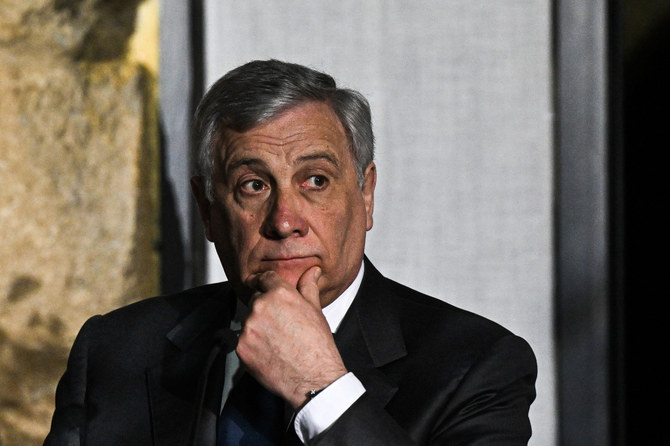
Italian Foreign Minister Antonio Tajani said his government has been working hard to ensure that IMF and World Bank help Tunisia. (File/AFP)
Short Url
Updated 28 March 2023
Follow

If Tunisia is not helped, Muslim Brotherhood may ‘create instability’: Italian FM

  • ‘We can’t afford the radicalization of the Mediterranean,’ Antonio Tajani tells conference attended by Arab News
  • Rome striving to ensure Tunisia ‘doesn’t become a failed state,’ pushing for IMF loan

ROME: The international community runs the risk of “having the Muslim Brotherhood create instability” in Tunisia if the country is not promptly granted “substantial financial help,” Italian Foreign Minister Antonio Tajani said at a conference attended by Arab News.

“We can’t afford the radicalization of the Mediterranean,” he added, saying Tunisia is on the verge of “economic collapse,” and negotiations for a loan of nearly $1.9 billion from the International Monetary Fund have “stalled” over President Kais Saied’s recent policies.

Elected in 2019, Saied dissolved Parliament in July 2021, reformed the country’s constitution to increase his presidential powers, and then held a referendum followed by parliamentary elections with a very low turnout.

At the beginning of this year he cracked down on dissent, arresting politicians, labor union members, judges and members of civil society.

The economic situation in Tunisia is dire, leading more and more people to try to reach Italy on small boats.

Tajani said Italy is “the most interested” in ensuring that “Tunisia solves its problems and doesn’t become a failed state.”

He added that the Italian government has been working hard to ensure that the IMF and the World Bank help Tunisia.

“But there’s a problem: The IMF, with the support of the US, says, ‘You first carry out reforms, and then we’ll give the money.’ On the other hand, the Tunisians say, ‘First the money and then the reforms’,” he said.

“This is why we propose that the IMF gives immediately a first tranche of money; the rest of the loan can be paid in line with the progress of reforms.”

Tajani said the international community “can’t afford to make the mistake of leaving Tunisia to the Muslim Brotherhood.”

Stefania Craxi, president of the Foreign Affairs and Defense Committee of the Italian Senate, told Arab News: “The Muslim Brotherhood will prosper if the grant doesn’t come and the economy keeps going down.”

She added: “It’s right for the IMF to ask for reforms, but they must grant the loan before the worst happens. That money must come now.”


US envoy calls for ceasefire deal in northeastern Syria to be maintained

Updated 27 January 2026
Follow

US envoy calls for ceasefire deal in northeastern Syria to be maintained

  • Tom Barrack, ambassador to Turkiye and special envoy for Syria, reiterates Washington’s support for Jan. 18 integration agreement between Syria’s government and Syrian Democratic Forces

LONDON: Tom Barrack, the US ambassador to Turkiye and special envoy for Syria, on Monday reiterated Washington’s desire to ensure the ceasefire agreement in northeastern Syria between Syria’s government and the Syrian Democratic Forces continues.

In a message posted on social media platform X, he wrote: “Productive phone call this evening with his excellency Masoud Barzani to discuss the situation in Syria and the importance of maintaining the ceasefire and ensuring humanitarian assistance to those in need, especially in Kobani.”

Barzani has been the leader of the Kurdistan Democratic Party since 1979, and served as president of Kurdistan region between 2005 and 2017.

The current present, Nechirvan Barzani, previously welcomed a recent decree by the Syrian president, Ahmad Al-Sharaa, officially recognizing the Kurdish population as an integral part of the country.

Barrack reiterated Washington’s support for efforts to advance the Jan. 18 agreement between Syria’s government and the SDF to integrate the latter into state institutions. The SDF is a Kurdish-led faction led by Mazloum Abdi that operates in northeastern Syria and recently clashed with government forces.

On Saturday, the Syrian Arab News Agency reported that the Syrian Ministry of Defense had announced a 15-day extension of the ceasefire deal.