NAIROBI: Police fired tear gas to disperse anti-government protests on Monday over the high cost of living, after the opposition vowed demonstrations would go ahead despite a police ban.
Security was tight, with riot police stationed at strategic points in Nairobi and patrolling the streets, while many shops were shut and train services from the capital’s outskirts into the central business district were suspended.
Veteran opposition leader Raila Odinga has urged people to take to the streets every Monday and Thursday, even after protests a week ago turned violent and paralyzed parts of Nairobi.
Police clashed with stone-throwing demonstrators in Nairobi’s largest slum Kibera, where protesters set tires on fire, defying a warning by the Inspector General of Police Japhet Koome who said Sunday that the rallies were “illegal” and would be banned.
The situation was calmer elsewhere in the city, with a heavy police presence in neighborhoods where protests had taken place last week.
During last Monday’s clashes in Nairobi and opposition strongholds in western Kenya, a university student was killed by police fire while 31 officers were injured as running battles erupted between riot police and demonstrators.
More than 200 people were arrested, including several senior opposition politicians, while protesters — as well as Odinga’s own motorcade — were hit with tear gas and water cannon.
It was the first major outbreak of political unrest since President William Ruto took office more than six months ago after defeating Odinga in an election his rival claims was “stolen.”
Despite the police ban, Odinga called Sunday on Kenyans to join what he has described as “the mother of all demonstrations.”
“I want to tell Mr.Ruto and the IG Koome that we are not going to be intimidated,” he said. “We are not going to fear tear gas and police.”
Odinga also accused Deputy President Rigathi Gachagua of orchestrating an operation to cause “mayhem” at Monday’s rallies.
Nairobi residents were wary after the previous violence.
“I may have to close too because I have seen most of my neighbors are closed,” said Mercy Wangare, an Mpesa (mobile money) kiosk attendant at an electronics shop.
“I am just weighing the situation before I decide because the sight of these policemen patrolling around is a sign that it may not end up well.”
The Communications Authority of Kenya has sought to prevent television stations from broadcasting the demonstrations live, but the move was blocked by the High Court.
Ruto, who is currently on a four-day trip to Germany and Belgium, has urged his rival to halt the action.
“I am telling Raila Odinga that if he has a problem with me, he should face me and stop terrorizing the country,” he said Thursday.
“Stop paralysing the businesses of mama mboga, matatu and other Kenyans,” he said, referring to women stallholders and private minibus operators.
Many Kenyans are struggling to put food on the table, battling high prices for basic goods as well as a plunging local currency and a record drought that has left millions hungry.
“If the leaders don’t talk, it is us who are affected. They are rich people, it is who will sleep hungry,” motorcycle taxi driver Collins Kibe told AFP.
During the election campaign, Ruto portrayed himself as champion of the downtrodden and vowed to improve the lot of ordinary Kenyans.
But critics say he has broken several campaign promises and has removed subsidies for fuel and maize flour — a dietary staple.
Demonstrators in Kibera, an Odinga stronghold, on Monday banged empty pots and pans as they faced off against police, chanting “we don’t have maize flour.”
Kenya’s energy regulatory body has also announced a hike in electricity prices from April, despite Ruto insisting in January there would be no such increase.
Last week’s protests proved costly, with Gachagua saying the country had lost at least $15 million.
Police said Friday they had launched a manhunt for suspects involved in last week’s riots, and published photographs showing people throwing rocks at police, burning tires and vandalising property.
But an AFP Fact Check investigation found that a number of the photographs were old and unrelated to Monday’s events.
And on Saturday, a red-faced Directorate of Criminal Investigations issued an apology on Twitter for what it said was a “mix-up of images.”


Police fire tear gas as fresh protests erupt in Kenya despite ban
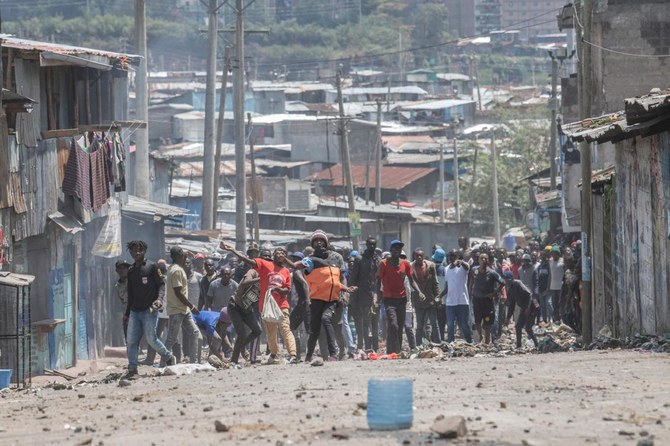
Police fire tear gas as fresh protests erupt in Kenya despite ban


Near record number of small boat migrants reach UK in 2025
- The second-highest annual number of migrants arrived on UK shores in small boats since records were started in 2018, the government was to confirm Thursday
LONDON: The second-highest annual number of migrants arrived on UK shores in small boats since records were started in 2018, the government was to confirm Thursday.
The tally comes as Brexit firebrand Nigel Farage’s anti-immigration party Reform UK surges in popularity ahead of bellwether local elections in May.
With Labour Prime Minister Keir Starmer increasingly under pressure over the thorny issue, his interior minister Shabana Mahmood has proposed a drastic reduction in protections for refugees and the ending of automatic benefits for asylum seekers.
Home Office data as of midday on Wednesday showed a total of 41,472 migrants landed on England’s southern coast in 2025 after making the perilous Channel crossing from northern France.
The record of 45,774 arrivals was recorded in 2022 under the last Conservative government.
The Home Office is due to confirm the final figure for 2025 later Thursday.
Former Tory prime minister Rishi Sunak vowed to “stop the boats” when he was in power.
Ousted by Starmer in July 2024, he later said he regretted the slogan because it was too “stark” and “binary” and lacked sufficient context “for exactly how challenging” the goal was.
Adopting his own “smash the gangs” slogan, Starmer pledged to tackle the problem by dismantling the people smuggling networks running the crossings but has so far had no more success than his predecessor.
Reform has led Starmer’s Labour Party by double-digit margins in opinion polls for most of 2025.
In a New Year message, Farage predicted that if Reform got things “right” at the forthcoming local elections “we will go on and win the general election” due in 2029 at the latest.
Without addressing the migrant issue directly, he added: “We will then absolutely have a chance of fundamentally changing the whole system of government in Britain.”
In his own New Year message, Starmer insisted his government would “defeat the decline and division offered by others.”
Conservative Party leader Kemi Badenoch, meanwhile, urged people not to let “politics of grievance tell you that we’re destined to stay the same.”
- Protests -
The small boat figures come after Home Secretary Mahmood in November said irregular migration was “tearing our country apart.”
In early December, an interior ministry spokesperson called the number of small boat crossings “shameful” and said Mahmood’s “sweeping reforms” would remove the incentives driving the arrivals.
A returns deal with France had so far resulted in 153 people being removed from the UK to France and 134 being brought to the UK from France, border security and asylum minister Alex Norris said.
“Our landmark one-in one-out scheme means we can now send those who arrive on small boats back to France,” he said.
The past year has seen multiple protests in UK towns over the housing of migrants in hotels.
Amid growing anti-immigrant sentiment, in September up to 150,000 massed in central London for one of the largest-ever far-right protests in Britain, organized by activist Tommy Robinson.
Asylum claims in Britain are at a record high, with around 111,000 applications made in the year to June 2025, according to official figures as of mid-November.
Labour is currently taking inspiration from Denmark’s coalition government — led by the center-left Social Democrats — which has implemented some of the strictest migration policies in Europe.
Senior British officials recently visited the Scandinavian country, where successful asylum claims are at a 40-year low.
But the government’s plans will likely face opposition from Labour’s more left-wing lawmakers, fearing that the party is losing voters to progressive alternatives such as the Greens.


