

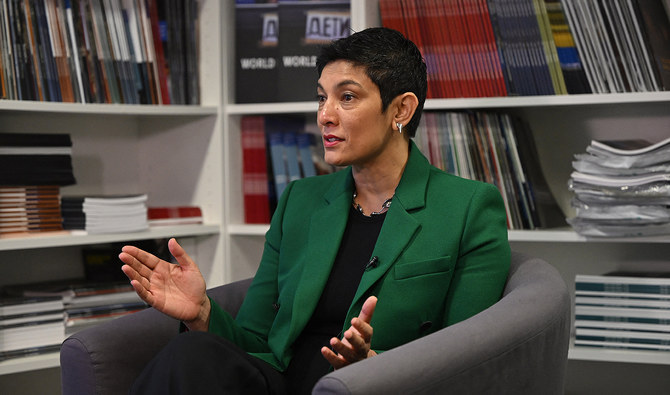

ISLAMABAD: Tirana Hassan, a lawyer and veteran human rights investigator of Pakistan origin who has documented rights abuses throughout crises and conflicts globally, has been named the next executive director of Human Rights Watch, the organization announced on Monday.
Hassan was previously the Human Rights Watch chief programs officer and had been serving as acting executive director since September 2022, following the departure of long-time leader Kenneth Roth.
“As new executive director of Human Rights Watch, Tirana Hassan brings impeccable credentials as a human rights practitioner and an ambitious vision for human rights solutions to the challenges the world is facing,” said Zeid Ra’ad Al Hussein, CEO and president of the International Peace Institute and the former United Nations High Commissioner for Human Rights.
“A hugely experienced activist, Tirana will be a formidable leader and very much a force to be reckoned with!”
Hassan was born in Singapore to a Pakistani father whose family left India during partition and a Malaysian-born Sri Lankan and Chinese mother. Her family resettled in Australia in the 1970s after her father’s academic research on Singapore’s housing policies triggered the ire of the government, which was cracking down on dissent. She has said family stories of racism, prejudice, and repression helped shape her world view and contributed to her decision to work on behalf of rights for dispossessed people. Hassan holds degrees from the University of South Australia, University of Adelaide and Oxford University.
With decades of experience in the human rights and humanitarian fields, Hassan, who began her career as a social worker and spent many years working with women and children in conflict and crisis situations, first joined Human Rights Watch in 2010, covering emergencies across Africa, Asia, and the Middle East. She went on to become Amnesty International’s director of crisis response before returning to Human Rights Watch as its chief programs officer in 2020, leading the organization’s research, advocacy, legal, and communications departments.
“Tirana has the rare combination of wide-ranging investigative experience, strategic creativity, and a deep commitment to human rights principle that Human Rights Watch needs to tackle the complex human rights challenges the world is facing,” said Kenneth Roth, former executive director at Human Rights Watch, who stepped down in August 2022. “I am thrilled that she will lead Human Rights Watch into the future.”
When she headed Amnesty International’s crisis team, Hassan oversaw the development of innovative uses of technology to advance human rights investigations in Myanmar, Syria, and other crisis areas. She brings a proven track record of developing ambitious programs to address critical human rights issues and will lead the Human Rights Watch’s work with activists, survivors, and civil society to head off the rising threats to human rights around the world.
“Tirana brings a powerful vision of innovation to this role – one that merges tried and true reporting methods with new and emerging technologies,” said Brad Samuels, director at SITU Research, a visual investigations practice that has worked with Human Rights Watch on several projects.
“She will be navigating a technology landscape filled with opportunities and hazards in equal measure, but her critical, collaborative, and rigorous approach will unlock powerful untapped investigative potential. This appointment is bad news for despots, autocratic regimes, and, especially, those who seek to evade accountability.”
One of Hassan’s priorities will be to call out government selective applications of human rights obligations. She will focus on using all possible levers to push governments to realize their legal obligations to victims everywhere, including in Afghanistan, Israel and Palestine, Ethiopia, and Iran.
“Tirana possesses the unique ability to be both a strong and an empathetic leader in calling out injustice without hesitation,” said Sherine Tadros, former correspondent for Sky News and current head of Amnesty International’s UN office and deputy director of advocacy who worked closely with Hassan over the years.
“Staff at Human Rights Watch are lucky to have her, and the human rights community as a whole is strengthened with her at the helm.”
After receiving a bachelor’s degree in social work from the University of South Australia, Hassan worked as a social worker in Los Angeles, London, and Adelaide, counseling homeless young people before obtaining a law degree from the University of Adelaide. During her last year of law school, she co-founded the Woomera Lawyers Group, a refugee advocacy organization that provided legal services to asylum seekers detained in Australia’s notorious desert detention center. She represented refugees and asylum seekers from Afghanistan, Iraq, and Iran who were detained in the remote facility and later went on to work in the humanitarian sector. Hassan also holds a master’s degree in international human rights law from Oxford University.
Hassan served as a specialist focusing on the need to provide protection for children and for survivors of sexual and gender-based violence in conflict areas and the natural disaster response across Asia and Africa, with Médecins Sans Frontières, United Nations International Children’s Emergency Fund, and Save the Children.
“I’m honored and humbled to lead this exceptional organization at a moment when the defense of human rights feels more urgent than ever,” Hassan said. “I look forward to building on Human Rights Watch’s formidable foundation to uplift the human rights defenders we work with and the communities we serve to put pressure on those in power to realize a rights-respecting future for us all.”


