Most unwanted? How sports treat the Russia problem

1 / 2
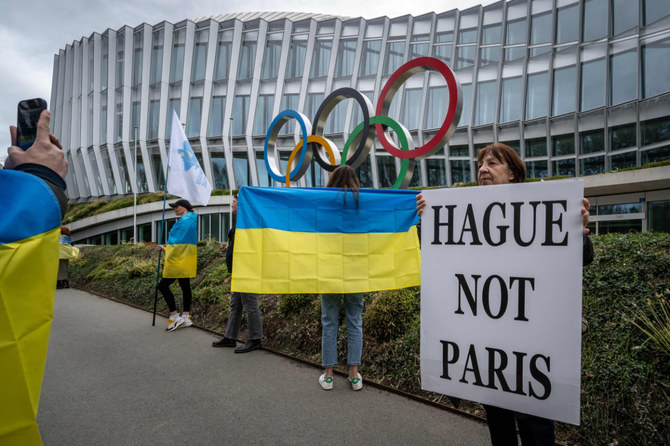
Ukrainians walk past the Olympic headquarters in Lausanne, Switzerland, on March 25, 2023 during a protest against the proposed IOC roadmap to organize the return to competition of Russian athletes under a neutral flag. (AFP)
2 / 2
Ukrainians protest in front of the Olympic headquarters in Lausanne, Switzerland, on March 25, 2023 against the proposed IOC roadmap to organize the return to competition of Russian athletes under a neutral flag. (AFP)
Short Url
Updated 27 March 2023
Follow

Most unwanted? How sports treat the Russia problem

  • IOC says it wants to continue its ban “on flag, anthem, colors or any other identifications” from the two countries but is seeking a pathway to let their athletes compete

PARIS: International sports bodies are taking wildly varying stances on allowing Russian and Belarusian athletes and teams to compete while the war in Ukraine continues.

With the Paris Olympics fewer than 500 days away, the International Olympic Committee (IOC) says it wants to continue its ban “on flag, anthem, colors or any other identifications” from the two countries but is seeking a pathway to let their athletes compete.

That strategy will be discussed again this coming week when the IOC executive board meets.

Here, AFP Sport looks at how sports are handling the dilemma.

While World Athletics on Thursday lifted the ban on the Russian track and field federation for state-sponsored doping, its athletes remain barred from competition while Moscow’s invasion of Ukraine continues. The body’s president Sebastian Coe said “the unprecedented sanctions” imposed on Russia and Belarus by countries around the world “appear to be the only peaceful way to disrupt and disable Russia’s current intentions and restore peace.”

Russian and Belarusian players are allowed to compete on the main ATP and WTA tours but not under their flags or country names. They are banned from the Davis Cup and BJK Cup tournaments. Players from Russia and Belarus were also banned from Wimbledon last year although Moscow-born Elena Rybakina, competing for Kazakhstan, won the women’s singles title.

Russia was thrown out of 2022 World Cup qualifying and are banned from Euro 2024 qualifying which started this week. Instead Russia played a friendly in Iran.
Belarus are not banned from Euro qualifying but they must play home games at neutral venues while their clubs are still allowed to enter European tournaments.
Denis Rogachev, the head of the Russian Football Union, said “negotiations are underway” to play in the Central Asian championship in June and that “a negotiation process is underway with UEFA and FIFA on a phased return.”

The sport has not yet lifted the ban on Russians and Belarusians, which means none have so far qualified for Paris or this year’s World Championships in October. The next opportunity for teams and individuals to book a place for the worlds, where Olympic places will be up for grabs, are the European Championships in Turkiye in April. Russians and Belarusians were not included in the European draw on Tuesday, the cutoff point for competing. Switching to Asia could offer an Olympic pathway to Russians.

Russian fighters were allowed to compete at the recent women’s world boxing championships in India, a move which prompted a boycott by countries including United States, Ukraine, Canada, Sweden and Britain.

Theoretically, drivers from Russia and Belarus can compete as “neutral” drivers in Formula One. But the only Russian driver, Nikita Mazepin, was dropped shortly before the start of the 2022 season by the Haas team. F1 also dropped the Sochi Grand Prix from its 2022 schedule, and canceled plans for annual races to be held in St. Petersburg starting this season.

Russia and the Soviet Union have won the annual ice hockey world championship seven times but on Thursday the International Ice Hockey Federation banned them for a second straight year saying that “it is not yet safe to reincorporate the Russian and Belarusian teams.”

With its Olympic qualifying process about to start, the International Fencing Federation decided on March 10 to allow Russian and Belarusian athletes to take part, although it said it was up to the IOC whether they could compete in Paris. The German, Finnish and Swedish fencing bodies responded by canceling events they were due to host.

Russians and Belarusians were banned from the world championships in Budapest last June and July. For now, aquatic sports are among those playing a waiting game. Governing body FINA told AFP in February: “At this time, there are no further updates regarding the participation of Russian and Belarusian athletes in World Aquatics competitions.” That means they are still banned from the world championships in Fukuoka in July, but the sport’s Olympic rules means swimmers have until late next June to match the qualifying times.


Pakistan will boycott T20 World Cup match against India. ICC says decision will damage cricket

Updated 9 sec ago
Follow

Pakistan will boycott T20 World Cup match against India. ICC says decision will damage cricket

  • No reason was given for Pakistan boycotting the game against India, but Pakistan Cricket Board (PCB) chairman Mohsin Naqvi had criticized governing body ICC for “double standards” by refusing to shift Bangladesh’s games to Sri Lanka

ISLAMABAD: Pakistan’s government says the national cricket team will be allowed to take part in the upcoming Twenty20 World Cup but must boycott its group game against arch rival India.
India and Sri Lanka are co-hosts for the 20-team tournament, which starts Saturday.
Pakistan will play all its games in Sri Lanka — including any in the knockout stage — because of political tensions with India. The two teams are scheduled to meet in a Group A game in Colombo on Feb. 15 in what is often a tournament highlight for fans, broadcasters and organizers alike.
That’s looking in doubt this time.
“The Government of the Islamic Republic of Pakistan grants approval to the Pakistan Cricket Team to participate in the ICC World T20 2026,” the government posted Sunday on its official X account. “However, the Pakistan Cricket Team shall not take the field in the match scheduled on 15th February 2026 against India.”
No reason was given for Pakistan boycotting the game against India, but Pakistan Cricket Board (PCB) chairman Mohsin Naqvi had criticized governing body ICC for “double standards” by refusing to shift Bangladesh’s games to Sri Lanka. Bangladesh was replaced by Scotland for the tournament.
Naqvi was vocal in Pakistan’s support for Bangladesh and left the decision of Pakistan’s participation in the T20 World Cup to the government when he briefed Pakistan’s prime minister, Shehbaz Sharif, on the issue.
ICC criticizes decision
The International Cricket Council said in a statement that it was waiting to receive an official communication from the PCB over the planned boycott, while warning against harming “the spirit and sanctity” of the global events.
“This position of selective participation is difficult to reconcile with the fundamental premise of a global sporting event where all qualified teams are expected to compete on equal terms per the event schedule,” the ICC said.
“While the ICC respects the roles of governments in matters of national policy, this decision is not in the interest of the global game or the welfare of fans worldwide, including millions in Pakistan.”
The ICC said its priority is to successfully organize the T20 World Cup and “expects the PCB to explore a mutually acceptable resolution, which protects the interests of all stakeholders.”
The ICC also said it “hopes that the PCB will consider the significant and long-term implications for cricket in its own country as this is likely to impact the global cricket ecosystem, which it is itself a member and beneficiary of.”
Pakistan’s first match is against the Netherlands on Saturday in the tournament opener in Colombo. It will then take on the US on Feb. 10 and Namibia on Feb. 18.
India would be set to receive two points if Pakistan forfeits their game.
A Pakistan vs. India tournament game attracts huge interest and is a significant source of income, through broadcasters and sponsors, for the ICC.
Pakistan and India have not played a bilateral cricket series for the last 14 years, but both nations have regularly been in the same group at ICC tournaments.
Pakistan captain Salman Ali Agha, who led the team to a 3-0 win in the three-match T20 series against Australia on Sunday in Lahore, said he will follow his government’s instructions.
“It’s (boycotting game against India) not our decision, we can’t do anything about it,” Agha said. “We will do whatever our government and the (PCB) chairman say.”
The strained political relations between the two countries spilled onto the cricket field last year when India’s players refused to shake hands with Pakistan’s players during three Asia Cup games, including the final, in the United Arab Emirates.