LVIV, Ukraine: At a historic military cemetery in the western Ukrainian city of Lviv, Valeriy Pushko lights up two cigarettes. One is for himself, the other for his son whose portrait is fixed to a cross planted in the ground.
“I smoke with my son,” said the grey-haired man.
“We used to take cigarette breaks together. It’s a bad habit but it makes things easier. I talk to him, think about him and that makes me feel better.”
Pushko said many others come here to smoke with their fallen husbands or sons.
Located in southeastern Lviv, the Lychakiv cemetery is one of the oldest graveyards in Europe and is often compared to the historic Père Lachaise in Paris, where dozens of celebrities are buried.
It is the resting place of prominent figures including the poet Ivan Franko and thousands of soldiers who perished during World War I and II.
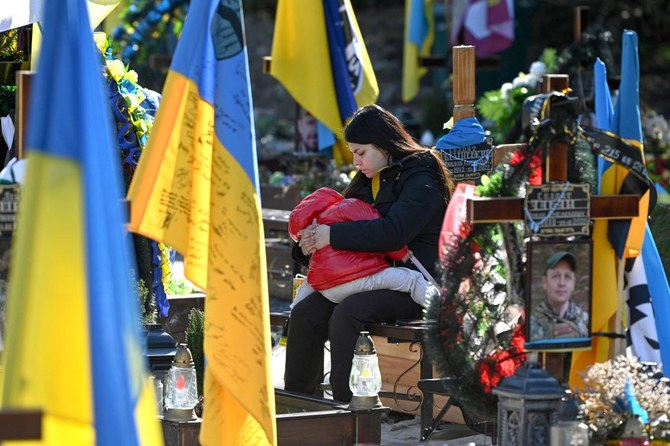
Since Russia invaded Ukraine over a year ago, rows of new graves have appeared. A sea of blue-and-yellow Ukrainian flags and red-and-black nationalist banners mark them.
Some mourners leave stuffed animals, cigarettes, and cups of coffee at the graves of their loved ones.
More unusual symbols of love and sorrow included children’s drawings, vinyl records, a golf ball, and a bottle of beer.
Shortly after the Russian invasion in February 2022, authorities began burying soldiers killed in fighting at the Lychakiv cemetery.
But the area initially designated for military burials quickly filled up, said city official Oleg Pidpysetsky.
The authorities then began laying Ukrainian servicemen to rest at a new site bordering Lychakiv.
Funerals are held nearly every day in the new burial ground. Called the Field of Mars, it now contains about 350 graves.
“No one knew how critical the situation was,” Pidpysetsky told AFP.
“Someone thought it would end in a month, two, three, six months. But, unfortunately, the war has only gotten bigger.”
Oleg, one of the mourners who came to visit a friend’s grave, called the losses “irreparable.”
“We will have our victory of course, but this is the price we pay. And that is not the end,” said the 55-year-old.
“These people gave their lives for us.”
Oleg mourns the loss of his 45-year-old friend also called Oleg.
He said the father of two volunteered to go to the front.
“Unfortunately, nothing can be done now. Thousands of Russians will not replace my Oleg,” he said bitterly.
Kyiv does not reveal the number of its military casualties but Western officials say more than 100,000 Ukrainians have been killed or wounded.
Olga, who came to visit her brother-in-law’s grave, says the mementos people leave “is all that’s left, the only connection with their heroes.”
Her sister comes to the cemetery every day, she added.
“That’s her second home now,” said Olga.
Vyacheslav Sabelnikov, who served in the infantry before receiving a serious injury, says several men he fought with are now buried at the cemetery.
“I came to visit a friend whose birthday is today,” said Sabelnikov, placing a candle in front of his portrait.
Sabelnikov said he lights up candles to remember his friends, saying it was important to “honor” their memory.
Anna Mikheyeva, a 44-year-old social worker, came to visit her son Mykhailo’s grave. He served in the 80th Parachute Brigade and was killed last year at the age of 25.
Mikheyeva says she often brings her son things “he liked” including Coca-Cola, sweets, and cigarettes.
“If I come in the morning, I buy a coffee for myself and also for him,” added the dark-haired woman.
She said she felt calm at the Field of Mars.
“There are only young people here. They are like sons and brothers to me.
“When I come I always say ‘Hi guys’. And I always, always thank them.”


![]()

Love, pain and loss at historic Ukraine cemetery
Short Url
https://arab.news/5btw5
Love, pain and loss at historic Ukraine cemetery
- Located in southeastern Lviv, the Lychakiv cemetery is one of the oldest graveyards in Europe
- It is the resting place of prominent figures including the poet Ivan Franko and thousands of soldiers who perished during World War I and II


Latest updates


© 2026 SAUDI RESEARCH & PUBLISHING COMPANY, All Rights Reserved And subject to Terms of Use Agreement.