Evacuated villagers tell how Spain’s forest fire forced them to leave animals

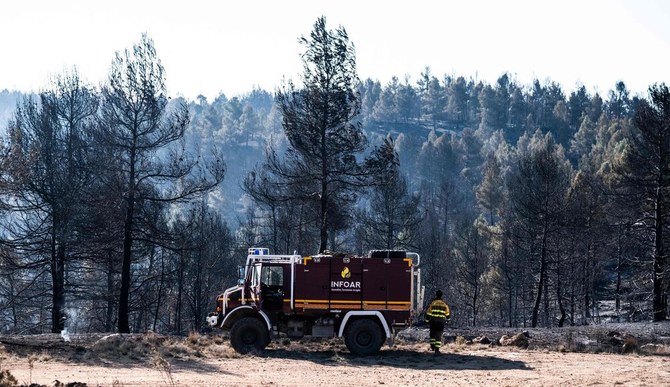
A fire truck is pictured in a forest area near the village of Los Peiros, on Mar. 25, 2023, affected by a wildfire that began on Mar. 23 near Villanueva de Viver, some 90 kilometres north of Valencia. (AFP)
Short Url
Updated 25 March 2023
Follow

Evacuated villagers tell how Spain’s forest fire forced them to leave animals

  • Residents recounted fleeing their houses and leaving animals behind
  • More than 500 firefighters supported by 20 planes and helicopters were working to bring the blaze under control near the village of Villanueva de Viver

BARRACAS, Spain: Spain’s first major wildfire of the year scorched more than 4,000 hectares (9,900 acres) of forest and forced 1,500 villagers to leave their homes in the Valencia region.
Residents recounted fleeing their houses and leaving animals behind.
“Bad, how am I supposed to feel? Your town is burning, your life is burning, Our animals were there and no one can tell us anything,” Antonio Zarzoso, 24, who had to leave the village of Puebla de Arenoso, told Reuters.
More than 500 firefighters supported by 20 planes and helicopters were working to bring the blaze under control near the village of Villanueva de Viver, emergency services said on Saturday.
However, they had managed to stop the fire spreading to other areas.
“The surrounding forest has been reached by fire and we don’t know how exactly the area looks,” Montse Boronat, from Los Calpes, told Reuters.
Ximo Puig, president of the Valencia region, told reporters the blaze was made more “voracious” by summer-like temperatures of about 30 Celsius (86 Fahrenheit).
Las Provincias, a regional newspaper, reported police believe that the blaze may have been started by a spark from a machine used to gather brushwood.
A Spanish Civil Guard spokeswoman said that an investigation was underway into the cause of the fire.
An unusually dry winter across parts of southern Europe has raised concern that there could be a repeat of last year’s devastating wildfires.
The weather will be drier and hotter than usual this spring along Spain’s northeastern Mediterranean coast, increasing the risk of fires, meteorological agency AEMET said last week.
Last year some 785,000 hectares were destroyed in Europe more than double the annual average for the past 16 years, according to European Commission (EC) statistics.
In Spain, 493 fires destroyed a record 307,000 hectares of land, according to the Commission’s European Forest Fire Information System.


Philippines signs free trade pact with UAE

Updated 4 sec ago
Follow

Philippines signs free trade pact with UAE

  • UAE deal is Philippines’ fourth free trade pact, after South Korea, Japan, and EFTA
  • Business body warns of uneven gains if domestic safeguard mechanisms insufficient

MANILLA: The Philippines signed on Tuesday a comprehensive economic partnership agreement with the UAE, its first such deal with a Middle Eastern nation.

The Philippines and the UAE first agreed to explore a free trade pact in February 2022 and formalized the process with terms of reference in late 2023. Negotiations started in May 2024 and were finalized in 2025.

The CEPA signing was witnessed by President Ferdinand R. Marcos Jr. who led the Philippine delegation to Abu Dhabi.

“The CEPA is the Philippines’ first free trade pact with a Middle Eastern country, marking a milestone in expanding the nation’s global trade footprint,” Marcos’s office said.

“The agreement aims to reduce tariffs, enhance market access for goods and services, increase investment flows, and create new opportunities for Filipino professionals and service providers in the UAE.”

The UAE is home to some 700,000 Filipinos, the second-largest Filipino diaspora after Saudi Arabia.

With bilateral trade worth about $1.8 billion, it is also a key trading partner of the Philippines in the Middle East, and accounted for almost 39 percent of Philippine exports to the region in 2024.

The Philippine Department of Trade and Industry earlier estimated it would lead to at least 90 percent liberalization in tariffs and give the Philippines wider access to the GCC region.

“Preliminary studies indicate the CEPA could boost Philippine exports to the UAE by 9.13 percent, generate consumer savings, and strengthen overall trade linkages with the Gulf region,” Marcos’s office said.

The Philippine Chamber of Commerce and Industry-Makati expects the pact to bring stronger trade flows, capital and technology for renewable energy, infrastructure, food, and water security projects as long as domestic policy supports it.

“CEPA can serve as a trade accelerator and investment catalyst for the Philippines,” Nunnatus Cortez, the chamber’s chairman, told Arab News.

The pact could result in “expanding exports, attracting capital, diversifying economic partners, upgrading industries, and supporting long-term growth — provided the country actively supports exporters and converts provisions into concrete commercial outcomes,” said Cortez.

“The main downside risk of CEPA lies in domestic readiness. Without strong industrial policy, MSME (Micro, Small and Medium Enterprises) support, safeguard mechanisms, and export development, CEPA could lead to import dominance, uneven gains, fiscal pressure, and limited structural transformation.”

The deal with the UAE is the Philippines’ fourth bilateral free trade pact, following agreements with South Korea, Japan, and the European Free Trade Association, which comprises Iceland, Liechtenstein, Norway, and Switzerland.