

Pakistan court sentences man to death for blasphemy

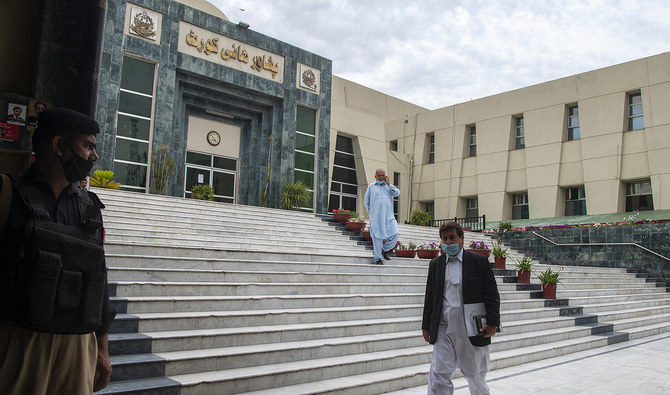
In this photograph taken on April 20, 2021, a lawyer walks past the High Court building in Peshawar. (Photo courtesy: AFP/File)
Short Url
Updated 25 March 2023
Follow

Pakistan court sentences man to death for blasphemy

  • Blasphemy is hugely sensitive issue in Muslim-majority Pakistan, where even unproven allegations can stir mobs, violence
  • Human rights group says in the last 20 years, 774 Muslims, 760 minority members were accused of blasphemy in country

PESHAWAR: An anti-terrorism court in northwest Pakistan has convicted and sentenced a Muslim man to death after he was accused of posting blasphemous content in a WhatsApp group.

Blasphemy is a hugely sensitive issue in Muslim-majority Pakistan, where even unproven allegations can stir mobs and violence.

Syed Muhammad Zeeshan was convicted under the Prevention of Electronic Crimes Act and Anti-Terrorist Act by the court in Peshawar on Friday.

“Accused Syed Muhammad Zeeshan, son of Syed Zakaullah in custody has been convicted and sentenced after being found guilty,” the court order said, a copy of which was obtained by AFP.

Zeeshan, who is a resident of the northwest city of Mardan, was also fined 1.2 million rupees ($4,300) and handed a total of 23 years imprisonment.

He has the right to appeal.

The case arose after Muhammad Saeed, a resident of Talagang in Punjab province filed an application with the Federal Investigation Agency two years ago accusing Zeeshan of posting blasphemous content in a WhatsApp group, Saeed’s counsel Ibrar Hussain told AFP.

The “FIA had confiscated Zeeshan’s cell phone and its forensic examination proved him guilty,” he said.

While Pakistan’s laws prohibiting blasphemy can carry a potential death sentence, so far it has never been enforced for the crime.

Although many cases involve Muslims accusing fellow Muslims, rights activists have warned that religious minorities — particularly Christians — are often caught in the crossfire, with blasphemy charges used to settle personal scores.

According to the National Commission of Justice and Peace, a human rights and legal aid group in Pakistan, 774 Muslims and 760 members of various minority religious groups were accused of blasphemy in the last 20 years.


Pakistan says EU notes progress on rights commitments during GSP+ compliance discussions

Updated 7 sec ago
Follow

Pakistan says EU notes progress on rights commitments during GSP+ compliance discussions

  • The review formed part of a wide-ranging EU-Pakistan Joint Commission meeting held in Brussels
  • The two sides also covered irregular migration, climate cooperation and safe Afghan refugee return

ISLAMABAD: The European Union reviewed Pakistan’s compliance with its preferential GSP+ trade scheme this week and welcomed progress on key human rights commitments, according to a statement on Saturday, as Islamabad seeks to protect access to European markets vital for its export-led growth strategy.

The EU’s Generalized Scheme of Preferences Plus (GSP+) grants duty-free access to most European markets for eligible developing countries in return for their commitment to implement 27 international conventions covering human rights, labor standards, environmental protection and good governance. Pakistan, which has benefited from the scheme since 2014, is one of the biggest beneficiaries, with the EU its second-largest trading partner and a destination for roughly a third of its exports.

Pakistan’s GSP+ status has come under scrutiny in the past after, in April 2021, the European Parliament adopted a resolution calling for an immediate review, citing concerns over violence against religious minorities, curbs on media freedom and broader human rights issues. The move followed widespread anti-France protests in Pakistan over the publication of anti-Islamic caricatures, which EU legislators said raised questions about Islamabad’s commitment to fundamental freedoms.

“Both sides reviewed Pakistan’s progress on the implementation of the 27 international conventions as required under the GSP+ framework,” the foreign office said in a statement circulated in Islamabad. “The EU welcomed progress made in bringing Pakistan’s application of the death penalty in line with international standards and encouraged further steps in this regard.”

“It also recognised important first steps against torture, as well as the creation of a Commission on Minorities,” it added.

IRREGULAR MIGRATION, CLIMATE COOPERATION

The discussions took place during the 15th meeting of the EU–Pakistan Joint Commission, held in Brussels on Dec. 17, where officials also addressed irregular migration, including cooperation on the return and readmission of migrants without legal status, and legal mobility pathways under the bloc’s broader migration framework.

The foreign office statement came just a day after Greek authorities said they rescued more than 500 migrants from a fishing boat in the Mediterranean, adding that the group included several Pakistani nationals, highlighting continued migration pressures despite tighter controls.

Climate cooperation was another focus, with both sides reviewing ongoing collaboration on climate resilience, disaster risk reduction and sustainable development, areas of growing importance for Pakistan after repeated climate-related shocks.

The meeting also touched on the situation of Afghan refugees.

The statement said the EU welcomed the ongoing discussions between Pakistan and the UN refugee agency “to identify and compile a list of vulnerable cases, to ensure their adequate protection.”

“The EU appreciated that Pakistan is hosting millions of Afghan nationals for over four decades,” it continued. “They emphasised that any return must be safe, dignified and in line with international standards.”

The two sides agreed to continue engagement under the EU–Pakistan Strategic Engagement Plan, a framework guiding cooperation on political dialogue, trade, development, security and people-to-people exchanges, with the next joint commission meeting scheduled to be held in Islamabad next year.