

Governor calls for Khyber Pakhtunkhwa provincial polls in Oct as political instability lingers 

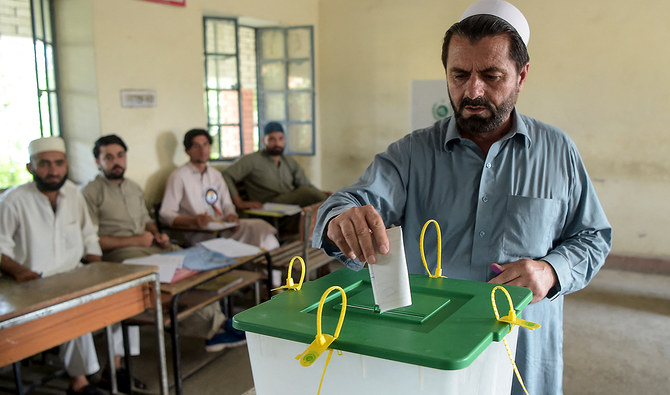
A tribesman ballot casts his vote in a polling station for the first provincial elections in Jamrud, a town of the Khyber Pakhtunkhwa province on July 20, 2019. (AFP/FILE)
Short Url
Updated 25 March 2023
Follow

Governor calls for Khyber Pakhtunkhwa provincial polls in Oct as political instability lingers 

  • Governor Hajji Ghulam Ali says elections cannot be held sooner due to a fresh wave of militancy 
  • Development comes days after election regulator postponed polls in Punjab province till October 8 

ISLAMABAD: The governor of Pakistan’s northwestern Khyber Pakhtunkhwa (KP) province has asked the country’s election regulator to hold the provincial assembly elections on October 8, the same date when polls will be held for the Punjab Assembly, in view of the rising “terrorist” incidents in the region and the ‘best interest” of people and the state. 

Former prime minister Imran Khan’s Pakistan Tehreek-e-Insaf (PTI) party dissolved the KP Assembly on January 18, shortly after the dissolution of the Punjab Assembly, in an effort to force early nationwide elections. The two provinces account for more than half of the country’s 220 million population. 

According to the Pakistani constitution, fresh polls for the two provincial assemblies should be held within 90 days of their dissolution. The PTI has been counting on the national government’s inability to afford to hold the provincial elections separately from a national election, which is otherwise due later this year. 

In a letter written to the ECP on Friday, a copy of which is available with Arab News, the governor suggested election be held in the province on October 8 after the election regulator announced on Wednesday that polls in the country’s most populous Punjab province would be postponed from April 30 to October 8. 

“Since ECP has postponed the election date for the general elections of Punjab province to 08 October 2023, therefore, it is also suggested that the same 08 October 2023 be proposed/appointed as the election date for General Elections of Khyber Pakhtunkhwa in the best public interest as well as in the interest of the state,” Governor Hajji Ghulam Ali said in his letter to the chief election commissioner. 

“Your good office must note that subsequent to my last letter, a fresh wave of terrorist activities had taken place in Khyber Pakhtunkhwa on daily basis.” 

He cited several incidents of militant violence as well as the killing of a high-ranking intelligence official in the province. 

“On 21 March 2023, a convoy was ambushed in South Waziristan resulting in the martyrdom of Brig. Mustafa Kamal Burki from the ISI (Inter-Services Intelligence) and injuring seven other ranks wherein two were critically injured,” the letter read. 

The election regulator this week postponed provincial assembly elections in Punjab, saying it was not possible to hold free and peaceful elections in April for several reasons, including the surge in militant attacks in the country. 

Khan’s PTI, however, has taken a strong exception to the decision and said it would challenge the decision in the Supreme Court, with a close Khan aide saying the “constitution and the Supreme Court have been practically abolished” under the Shehbaz-Sharif led government. 

Since Khan’s ouster in April last year, Pakistan has seen political instability rising in the country, with the former premier agitating against the central government, demanding nationwide elections. 

Khan and allies dissolved the two provincial legislatures with the same aim. 


Pakistan’s Mahnoor Omer named among TIME’s ‘Women of the Year’ for 2026

Updated 01 March 2026
Follow

Pakistan’s Mahnoor Omer named among TIME’s ‘Women of the Year’ for 2026

  • Omer moved a Pakistani court against the so-called ‘period tax’ in Sept. 2025 which has since sparked a national debate
  • Taxes on sanitary pads in Pakistan can add up to 40 percent to retail price, UNICEF says only around 12 percent women use such products

ISLAMABAD: Pakistani women’s rights activist Mahnoor Omer, who fought against taxes on menstrual products, has been named among the TIME magazine’s ‘Women of the Year’ for 2026.

Omer’s efforts have been recognized alongside 16 activists, artists, athletes and businesswomen in the TIME’s Women of the Year 2026 list, including Olympic gold medalist Sydney McLaughlin-Levrone and Oscar-nominated filmmaker Chloe Zhao.

Dissatisfied with the efforts to educate Pakistani girls about sexual violence, Omer founded the Noor Foundation at the age of 14 and held her own workshops with village girls about everything from climate change to menstruation, according to the TIME magazine.

Two years later, a conversation with a domestic worker about the price of pads made her realize that not everyone could afford these essentials. She moved a court against the so-called “period tax” in Sept. 2025 and the case has sparked a national debate on the subject, considered a taboo by many in Pakistan, since its first hearing late last year.

“A decade and one law degree after her interest in activism was sparked, Omer, now 25, is putting her passion and expertise to work in the name of gender equity,” TIME wrote about Omer on its website.

Taxes imposed on sanitary products in Pakistan can add up to 40 percent to the retail price. UNICEF estimates just 12 percent of women in the country use commercially produced pads or tampons. The alternative, using cloth, risks health impacts including rashes and infections, and can make it impossible for girls to attend school while menstruating.

Omer’s suit, which awaits the government response, has sparked a national discussion. She says she spoke about menstruation to her father and male cousins, who thanked her for standing up for their daughters.
The 25-year-old, who is currently enrolled in a master’s degree in gender, peace, and security at the London School of Economics, sees this case as just the first of many.

“I’m not free until every woman is free,” she was quoted as saying by TIME. “I want to leave no stones unturned in terms of what I can do with the next few decades, as a lawyer for the women in my country and gender minorities in general.”