

Pakistani professionals struggle with higher costs as economy teeters 

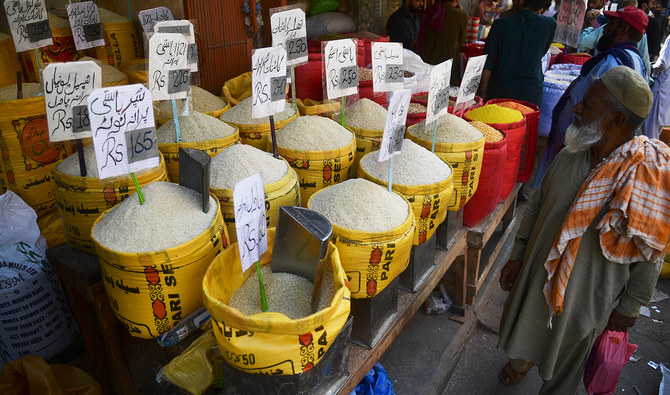
A man looks at rice prices at a market in Karachi on February 3, 2023. (AFP/FILE)
Short Url
Updated 24 March 2023
Follow

Pakistani professionals struggle with higher costs as economy teeters 

  • The minimum wage is about Rs25,000, but many who earn much more say their salaries do not last the month 
  • Economists say latest measures, which include higher taxes and fuel costs, are hurting educated professionals 

KARACHI: Naureen Ahsan earns more than twice the average wage in Pakistan, but the school administrator says she has no choice but to homeschool her daughters and delay their London-board certified final exams because she can’t afford their education. 

Like most people in the nation of 220 million, Ahsan and her husband, who owns a car servicing business, are struggling to cope with a surge in living costs triggered by the government’s devaluing the currency and removing subsidies to pave the way for the latest tranche of an International Monetary Fund (IMF) bailout needed to stave off economic collapse. 

Pakistan is no stranger to economic crises — this is its fifth IMF bailout since 1997 — but economists say the latest measures, which include higher taxes and fuel costs, are hurting educated professionals. Many say they are cutting down on necessities to make ends meet. 

“We don’t eat out any more,” Ahsan told Reuters. “We no longer buy meat, fish. I’ve cut down on tissue paper and detergent. We don’t see friends, we don’t give gifts. Occasionally, we scream at each other.” 

The government-mandated minimum wage is about 25,000 rupees, but with inflation at a record 31.5 percent in February, its highest rate in nearly 50 years, many people who earn much more than that say their salaries do not last the month. 

Abhi Salary, one of Pakistan’s biggest fintech firms, which allows its 200,000 or so subscribers to withdraw wages in advance, says transactions have increased by more than a fifth every month for the last three months. Most people spend two-thirds of the money on groceries as they rush to stock up before prices rise again, Abhi CEO Omair Ansari said. 

“Unfortunately the poor in Pakistan are left with nothing to lose,” said Abid Suleri, the Sustainable Development Policy Institute of Pakistan, an economic think tank. “Educated professionals... find their purchasing power and savings eroded, and daily consumption either unaffordable or out of reach.” 

Ramadan, which began this week, is likely to add to price pressures in Muslim-majority Pakistan. Analysts predict inflation to rise to at least 35 percent a month in March and April. 


People show their national identity cards to receive free bags of flour from a delivery truck at a distribution point ahead of the Muslim holy fasting month of Ramadan, in Lahore on March 20, 2023, following an announcement from Pakistan’s Prime Minister Shehbaz Sharif to provide free flour to the needy people during the Ramadan in the wake of country's soaring inflation. (AFP/FILE)

During the holy month, Muslims traditionally break their daylong fast with special foods and at large family gatherings, culminating in the Eid Al-Fitr festivities. This year, for many people, Ramadan means more belt tightening. 

“We’re cutting down on the number of meals and the food,” said Ahmed, a senior manager at a multinational company who declined to give his family name because he was worried about possible backlash from his employer. “It will be more difficult to buy sweets and gifts for Eid, which is a break from our family tradition.” 

The economic turmoil is driving some professionals out of the country. Khaliq, a doctor who also didn’t want to be give his full name because he was embarrassed by his financial situation, said he and his wife, who is also a doctor, work as much as they can to save up for exams to qualify them to work in Britain. 

“We think twice about eating out or using the car,” he said, adding that the weakening rupee was making the cost of their exam, which is in British pounds, higher by the day. “We plan to pass the exams and move out ASAP.” 


Pakistan, other Muslim states raise alarm over Gaza situation after heavy flooding

Updated 8 sec ago
Follow

Pakistan, other Muslim states raise alarm over Gaza situation after heavy flooding

  • Cold winter rains have repeatedly lashed the sprawling tent cities, turning Gaza’s dirt roads into mud and causing damaged buildings to collapse
  • The situation has been compounded by lack of sufficient humanitarian access, acute shortages of essential life-saving supplies and materials

ISLAMABAD: Foreign ministers of Pakistan, Saudi Arabia and other Muslim nations on Friday voiced concern over the situation in Gaza, following severe flooding triggered by heavy rains in the territory.

As 2026 begins, the shaky 12-week-old ceasefire between Israel and Hamas has largely ended large-scale Israeli bombardment of Gaza. But Palestinians are still being killed almost daily by Israeli fire, and the humanitarian crisis shows no signs of abating.

Cold winter rains have repeatedly lashed the sprawling tent cities over past weeks, turning Gaza’s dirt roads into mud and causing buildings damaged in Israeli bombardment to collapse. UNICEF says at least six children have now died of weather-related causes.

In a joint message, foreign ministers of Pakistan, Saudi Arabia, Egypt, Indonesia, Jordan, Qatar, Türkiye, the United Arab Emirates, expressed their “deepest concern” over the situation, compounded by lack of sufficient humanitarian access, acute shortages of essential life-saving supplies, and the slow pace of the entry of essential materials required for the rehabilitation of basic services.

“The ministers highlighted that the severe weather has laid bare the fragility of existing humanitarian conditions, particularly for almost 1.9 million people and displaced families living in inadequate shelters,” the Pakistani foreign ministry said in a joint statement.

“Flooded camps, damaged tents, the collapse of damaged buildings, and exposure to cold temperatures coupled with malnutrition, have significantly heightened risks to civilian lives, including due to disease outbreaks, especially among children, women, the elderly, and individuals with medical vulnerabilities.”

The statement came a day after UNICEF said a 7-year-old, Ata Mai, had drowned Saturday in severe flooding that engulfed his tent camp in Gaza City. Mai had been living with his younger siblings and family in a camp of around 40 tents.

They lost their mother earlier in the war, according to the UN agency.

Video from Civil Defense teams, shown on Al Jazeera, showed rescue workers trying to get Mai’s body out of what appeared to be a pit filled with muddy water surrounded by wreckage of bombed buildings. The men waded into the water, pulling at the boy’s ankle, the only part of his body visible. Later, the body is shown wrapped in a muddy cloth being loaded into an ambulance.

Foreign minister of Pakistan, Saudi Arabia and other states appreciated the efforts of all United Nations (UN) organizations and agencies as well as non-government organizations (NGOs) in continuing to assist Palestinian civilians and deliver humanitarian assistance under extremely difficult and complex circumstances.

“They demanded that Israel ensure the UN and international NGOs are able to operate in Gaza and the West Bank in a sustained, predictable, and unrestricted manner, given their integral role in the humanitarian response in the Strip. Any attempt to impede their ability to operate is unacceptable,” the statement read.

The foreign ministers reaffirmed support to President Donald Trump’s plan for Gaza, with a view to ensuring the sustainability of the ceasefire, bringing an end to the war in Gaza, to secure a dignified life for the Palestinian people who have endured prolonged humanitarian suffering, and leading to a credible pathway to Palestinian self-determination and statehood.

“In this context, they stressed the urgent need to immediately initiate and scale up early recovery efforts, including the provision of durable and dignified shelter to protect the population from the severe winter conditions,” the statement read further.

“The ministers called on the international community to uphold its legal and moral responsibilities and to pressure Israel, as the occupying power, to immediately lift constraints on the entry and distribution of essential supplies including tents, shelter materials, medical assistance, clean water, fuel, and sanitation support.”