

Oil Updates - Prices slides as US holds off refilling strategic reserve

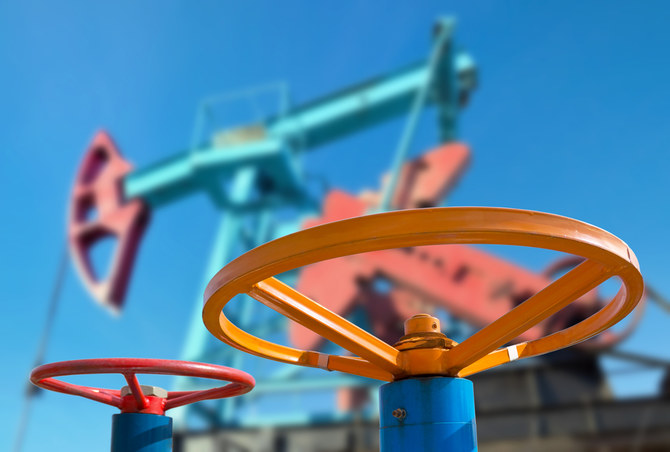
Brent crude fell $2.50, or 3.3 percent, to $73.41 a barrel by 1031 GMT (Shutterstock)
Short Url
Updated 24 March 2023
Follow

Oil Updates - Prices slides as US holds off refilling strategic reserve

LONDON: Oil prices fell sharply on Friday amid declining European banking shares and after US Energy Secretary Jennifer Granholm said refilling the country’s Strategic Petroleum Reserve (SPR) may take several years, dampening demand prospects.

Brent crude fell $2.50, or 3.3 percent, to $73.41 a barrel by 1031 GMT, while West Texas Intermediate US crude futures dived $2.47, 3.5 percent, to $67.49 a barrel.

Both benchmarks, which fell about 1 percent on Thursday, were on track to end the week slightly higher, after posting their biggest weekly declines in months last week due to banking sector turmoil and worries about a possible recession.

Banking stocks slid in Europe with Deutsche Bank and UBS Group hit hard by worries that the worst problems in the sector since the 2008 financial crisis have not yet been contained.

A stronger dollar, which rose 0.6 percent against other currencies on Friday, also fueled the sell-off. A stronger greenback makes crude more expensive to holders of other currencies.

“The lack of crude buying for the SPR represents a major blow to the oil demand outlook,” PVM Oil analyst Stephen Brennock said.

“If anything, it will heap even more pressure on China to do the heavy lifting on the demand side over the coming months,” he added..

The White House said in October it would buy back oil for the SPR when prices were at or below about $67-$72 per barrel.

Granholm told lawmakers that it would be difficult to take advantage of low prices this year to add to stockpiles, which are currently at their lowest level since 1983 following sales directed by President Joe Biden last year.

Strong demand expectations from China capped decreases, with Goldman Sachs saying commodities demand was surging in China, the world’s biggest oil importer, with oil demand topping 16 million bpd.

Meanwhile, Russian Deputy Prime Minister Alexander Novak said a previously announced cut of 500,000 barrels per day (bpd) in Russia’s oil production would be from an output level of 10.2 million bpd in February, the RIA Novosti news agency reported.

That would mean Russia is aiming to produce 9.7 million bpd between March and June, according to Novak, which would be a much smaller output cut than Moscow previously indicated. 


Saudi minister at Davos urges collaboration on minerals

Global collaboration on minerals essential to ease geopolitical tensions and secure supply, WEF hears. (Supplied)
Updated 20 January 2026
Follow

Saudi minister at Davos urges collaboration on minerals

  • The reason of the tension of geopolitics is actually the criticality of the minerals

LONDON: Countries need to collaborate on mining and resources to help avoid geopolitical tensions, Saudi Arabia’s minister of industry and mineral resources told the World Economic Forum on Tuesday.

“The reason of the tension of geopolitics is actually the criticality of the minerals, the concentration in different areas of the world,” Bandar Alkhorayef told a panel discussion on the geopolitics of materials.

“The rational thing to do is to collaborate, and that’s what we are doing,” he added. “We are creating a platform of collaboration in Saudi Arabia.”

Bandar Alkhorayef, Saudi Minister of Industry and Mineral Resources 

The Kingdom last week hosted the Future Minerals Forum in Riyadh. Alkhorayef said the platform was launched by the government in 2022 as a contribution to the global community. “It’s very important to have a global movement, and that’s why we launched the Future Minerals Forum,” he said. “It is the most important platform of global mining leaders.”

The Kingdom has made mining one of the key pillars of its economy, rapidly expanding the sector under the Vision 2030 reform program with an eye on diversification. Saudi Arabia has an estimated $2.5 trillion in mineral wealth and the ramping up of extraction comes at a time of intense global competition for resources to drive technological development in areas like AI and renewables.

“We realized that unlocking the value that we have in our natural resources, of the different minerals that we have, will definitely help our economy to grow to diversify,” Alkhorayef said. The Kingdom has worked to reduce the timelines required to set up mines while also protecting local communities, he added. Obtaining mining permits in Saudi Arabia has been reduced to just 30 to 90 days compared to the many years required in other countries, Alkhorayef said.

“We learned very, very early that permitting is a bottleneck in the system,” he added. “We all know, and we have to be very, very frank about this, that mining doesn’t have a good reputation globally.

“We are trying to change this and cutting down the licensing process doesn’t only solve it. You need also to show the communities the impact of the mining on their lives.”

Saudi Arabia’s new mining investment laws have placed great emphasis on the development of society and local communities, along with protecting the environment and incorporating new technologies, Alkhorayef said. “We want to build the future mines; we don’t want to build old mines.”