

Prince William thanks Poland for generosity to Ukrainians

1 / 3
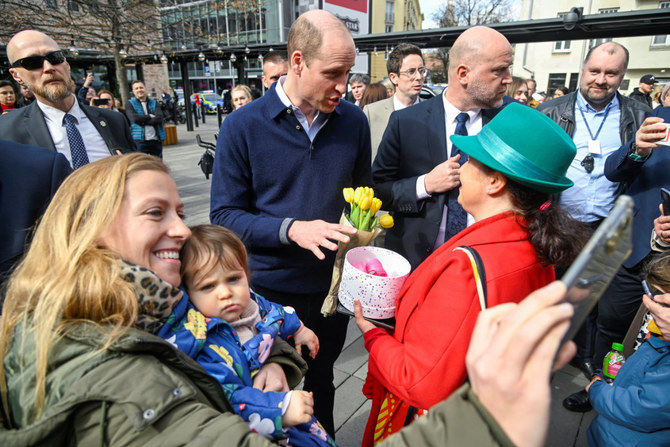
Britain's Prince William is greeted by well-wishers as he arrives to meet Ukrainian refugees at the Hala Koszyki Food Hall in Warsaw on March 23, 2023. (REUTERS/Toby Melville)
2 / 3
Britain's William meets with Poland's President Andrzej Duda in Warsaw on March 23, 2023. (Ian Vogler/Pool via REUTERS)
3 / 3
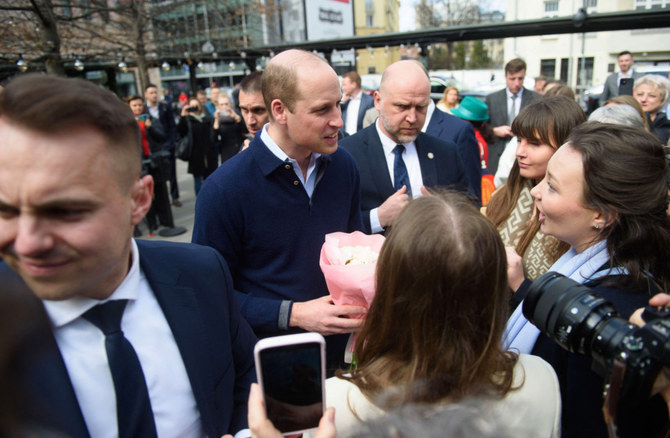
Britain's Prince William arrives for a meeting with a group of Ukrainian refugees during his visit on March 23, 2023 in Warsaw, Poland. (Zbyszek Kaczmarek / AFP)
Short Url
Updated 24 March 2023
Follow

Prince William thanks Poland for generosity to Ukrainians

  • The heir to the throne’s visit to Poland underscores Britain’s support for both Ukraine and Poland
  • The UK has been one of the most outspoken supporters of bolstering NATO’s eastern flank in the face of Russia’s aggression


WARSAW, Poland: Britain’s Prince William paid tribute on Thursday to Poles who lost their lives in past wars, and expressed gratitude to the nation for what it is doing today to provide humanitarian and military support to Ukraine.
The heir to the throne’s visit to Poland underscores Britain’s support for both Ukraine and Poland, an ally on the front line of efforts to help refugees displaced by Russia’s war and to assist the Ukrainian military in fighting off the invasion.
William laid a wreath in Poland’s national colors, white and red, at the Tomb of the Unknown Soldier, and bowed his head solemnly. The memorial honors Poles who lost their lives in wars including World War II, when Polish and British soldiers were allies.
A note on the wreath that he left read: “In memory of those who made the ultimate sacrifice.”
He later headed to the presidential palace for a meeting with President Andrzej Duda, who has been a prominent ally of Ukrainian President Volodymyr Zelensky since Russia’s full-scale invasion of Ukraine more than a year ago. Duda’s office said their talks focused on humanitarian aid for Ukraine.
“The Prince of Wales thanked the Poles for their generosity and hospitality,” Duda’s office said.
In the final stop on his two-day visit, the prince then went to a trendy food hall where he met with young Ukrainians working or continuing their studies in Poland.
William began his surprise visit Wednesday by meeting with British and Polish troops in Rzeszow, a city of 200,000 people in southeastern Poland that has become a hub for shipments of military and humanitarian aid bound for Ukraine.
“I just wanted to come here in person to say thank you for all that you’re doing, keeping everyone safe out here and keeping an eye on what’s going on,″ William said as he spoke to the troops.
He later traveled to a center in Warsaw that houses about 300 recent arrivals from Ukraine, meeting Ukrainians and playing table tennis with children.
The UK has been one of the most outspoken supporters of bolstering NATO’s eastern flank in the face of Russia’s aggression. The country sent troops to Poland and the Baltic states and provided more than 2.3 billion pounds ($2.8 billion) of military aid to Ukraine. It also has pledged 220 million pounds ($269 million) of humanitarian assistance.
Deploying the popular 40-year-old prince, a military veteran who also worked as a civilian air-sea rescue pilot, offers a more personal touch. While British political leaders have visited Poland regularly to trumpet their support for NATO and the Ukrainian cause, a senior royal like William is a symbol of the nation who can thank military personnel for their service without the baggage of party politics.


’Made in Europe’ or ‘Made with Europe’? Buy European push splits bloc

Updated 3 sec ago
Follow

’Made in Europe’ or ‘Made with Europe’? Buy European push splits bloc

  • Everyone in Europe agrees the EU needs to rescue its industry but the bloc is split over how far it should push a ‘Buy European’ approach in order to do so
BRUSSELS: Everyone in Europe agrees the EU needs to rescue its industry but the bloc is split over how far it should push a ‘Buy European’ approach in order to do so.
The European Commission, the EU’s executive arm, will next week propose new rules that are expected to include a requirement for companies in strategic sectors to produce in Europe if they want to receive public money.
But the definition of “European preference” has triggered debate, with calls especially from France for more “Made in Europe,” while other EU states such as Germany call for “Made with Europe.”
- Protecting Europe or European protectionism? -
French President Emmanuel Macron insisted the new rules would be about “protecting our industry” without “being protectionist,” by defending “certain strategic sectors, such as cleantech, chemicals, steel, cars or defense.”
Otherwise, he warned, “Europeans will be swept aside.”
But other EU countries, which are proponents of free trade, oppose the plans.
Swedish Prime Minister Ulf Kristersson said Europe should compete based on quality and innovation, not because it wanted to protect European markets.
“We do not want to protect European businesses that are basically not competitive,” Kristersson told the Financial Times newspaper last week.
But EU leaders during talks Thursday appeared to reach a consensus on the issue, pushing for the measure in certain specific sectors since they say Europe faces unfair competition from China and other countries.
“We are in favor of open markets,” German Finance Minister Lars Klingbeil said Monday. “But I also want to be very clear: if China changes the rules of the game, if we are confronted with overcapacity, subsidies, and the fact that markets in Europe are flooded, then Europe must defend itself.”
- In Europe or with Europe? -
Supporters want “Made in Europe” to be strictly defined, and only for industrial goods made from components manufactured in the European Economic Area, made of the EU’s 27 states as well as Iceland, Liechtenstein and Norway.
Critics say this definition would be too restrictive and instead call for a more flexible measure, like Germany’s Merz, who calls for “Made with Europe” not “Made in Europe.”
They also argue it would be difficult to apply in practice and risks destabilising European supply chains.
“Typically, even a vehicle assembled in Europe incorporates hundreds of specialized components sourced from all over the world. Many critical inputs cannot be competitively produced at scale in Europe,” Japanese carmaker Honda said.
Britain and Turkiye, for whom the EU is an important trading partner, have also privately expressed concern to Brussels about keeping their countries out.
Some EU capitals are worried about potential retaliatory measures from supplier countries, which would drag Europe into showdowns at a moment when it needs to strengthen its exports.
- What will the rules look like? -
The EU executive insists it has balanced the need to be open and protect firms.
The measure will be “targeted in three ways,” said the office of EU industry chief Stephane Sejourne — who is spearheading the push.
It will affect:
-- a limited number of critical components
-- a limited number of strategic sectors
-- only when public funding is involved.
The final proposal, which will be announced on February 25, could end up only touching a handful of sectors: the auto industry and those playing an essential role in the green transition and confronted by what the EU says unfair Chinese competition, such as solar panels, wind turbines and batteries.
Sejourne’s office insisted companies producing in the EU would be considered European and there will be “reciprocal commitments” with trusted partners.
A draft document seen by AFP says products made in countries outside the EU with rules similar to the bloc will be treated like those made in Europe.
Non-EU countries however remain watchful until the real proposal lands.
For example, there are still many unknowns including what the percentages of European or equivalent components will be required from manufacturers if they wish to continue accessing public money.