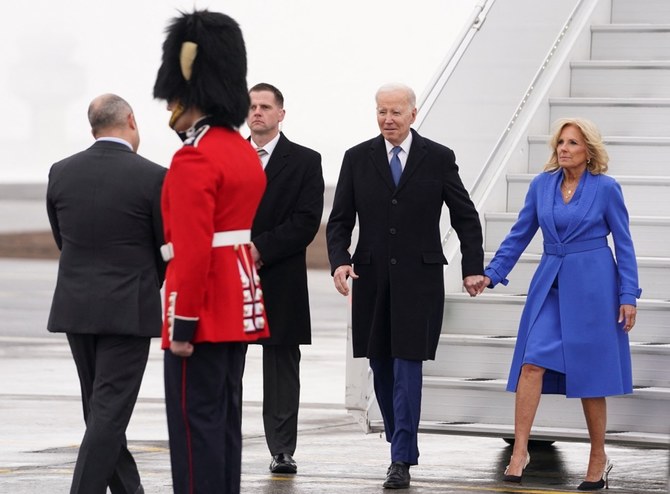
Biden arrives in Canada to discuss trade, migration challenges

U.S. President Joe Biden and U.S. first lady Jill Biden disembark from Air Force One at MacDonald-Cartier International Airport in Ottawa, Ontario. (Reuters)
Short Url
Updated 24 March 2023
Follow

Biden arrives in Canada to discuss trade, migration challenges

OTTAWA: US President Joe Biden arrived Thursday in Canada where he will meet Prime Minister Justin Trudeau and address parliament, with reports that a deal has been struck on managing undocumented migration across the neighbors’ long border.
Trade, Canada’s anemic defense spending, and a potential international force to stabilize troubled Haiti are expected to be on the agenda in the events set largely for Friday.
As Biden flew north, there were reports that another hot button issue in the otherwise smooth relationship had been resolved through a deal to clamp down on undocumented migration by asylum seekers passing through the United States into Canada.
According to The New York Times and the Los Angeles Times, Canada will be able to stop illegal migrants at the Roxham Road crossing point on the frontier between New York state and Quebec.
The flow of migrants there has been a source of irritation in domestic Canadian politics, much as it is in Washington concerning illegal entries across the US-Mexico border.
The reports said that Canada has agreed in return to take in some 15,000 asylum seekers from Latin America through legal channels, a move that will ease the pressure on the southern US border.
Press Secretary Karine Jean-Pierre would not confirm the news but said “we will hear more about it from the president and the prime minister tomorrow.”
Ahead of the visit, the two sides stressed their close integration.
“I think that’s going to be the theme of this visit, that we are there making each other stronger and better,” Canada’s ambassador to the United States, Kirsten Hillman, told CBC.
But only modest, if any, progress is expected on tensions over Biden’s Inflation Reduction Act — a massive program to subsidize and kick start US-based development of electric vehicles and other clean energy products.
“We are looking for more inclusion in exactly those things,” a senior Canadian government official told reporters.
“We want a North America that is globally competitive, so that our two economies which are already so integrated, where so many businesses and jobs and supply chains rely on each other, can compete with the world and can be successful together.”
Another expected item on the agenda is the financing of the neighbors’ mutual defense pacts, both as members of NATO and their joint air defense system for North America, named NORAD.
The US government has been pressuring Canada to increase its defense spending, which in 2022 was just 1.33 percent of GDP. This is scheduled to rise to 1.59 percent from 2026 but that’s still well below the NATO alliance requirement of minimum two percent of GDP spending.
Jean-Pierre praised Canada’s contributions to the Western alliance helping Ukraine to fend off Russian invasion but said regarding the budget, “I’m sure that conversation will come up.”
Earlier Thursday, US Secretary of State Antony Blinken said that Biden and Trudeau would discuss pleas from Haiti’s leaders for an international force to bring order to the impoverished Caribbean nation, where the authorities are unable to subdue armed gangs.


ICE agents can’t make warrantless arrests in Oregon unless there’s a risk of escape, US judge rules

Updated 2 sec ago
Follow

ICE agents can’t make warrantless arrests in Oregon unless there’s a risk of escape, US judge rules

  • US District Judge Mustafa Kasubhai issued a preliminary injunction in a proposed class-action lawsuit
  • Case targets Department of Homeland Security’s practice of arresting immigrants they happen to come across
PORTLAND, Oregon: US immigration agents in Oregon must stop arresting people without warrants unless there’s a likelihood of escape, a federal judge ruled Wednesday.
US District Judge Mustafa Kasubhai issued a preliminary injunction in a proposed class-action lawsuit targeting the Department of Homeland Security’s practice of arresting immigrants they happen to come across while conducting ramped-up enforcement operations — which critics have described as “arrest first, justify later.”
The department, which is named as a defendant in the suit, did not immediately comment in response to a request from The Associated Press.
Similar actions, including immigration agents entering private property without a warrant issued by a court, have drawn concern from civil rights groups across the country amid President Donald Trump’s mass deportation efforts.
Courts in Colorado and Washington, D.C., have issued rulings like Kasubhai’s, and the government has appealed them.
In a memo last week, Todd Lyons, the acting head of US Immigration and Customs Enforcement, emphasized that agents should not make an arrest without an administrative arrest warrant issued by a supervisor unless they develop probable cause to believe that the person is in the US illegally and likely to escape from the scene before a warrant can be obtained.
But the judge heard evidence that agents in Oregon have arrested people in immigration sweeps without such warrants or determining escape was likely.
The daylong hearing included testimony from one plaintiff, Victor Cruz Gamez, a 56-year-old grandfather who has been in the US since 1999. He told the court he was arrested and held in an immigration detention facility for three weeks even though he has a valid work permit and a pending visa application.
Cruz Gamez testified that he was driving home from work in October when he was pulled over by immigration agents. Despite showing his driver’s license and work permit, he was detained and taken to the ICE building in Portland before being sent to an immigration detention center in Tacoma, Washington. After three weeks there, he was set to be deported until a lawyer secured his release, he said.
He teared up as he recounted how the arrest impacted his family, especially his wife. Once he was home they did not open the door for three weeks out of fear and one of his grandchildren did not want to go to school, he said through a Spanish interpreter.
Afterward a lawyer for the federal government told Cruz Gamez he was sorry about what he went through and the effect it had on them.
Kasubhai said the actions of agents in Oregon — including drawing guns on people while detaining them for civil immigration violations — have been “violent and brutal,” and he was concerned about the administration denying due process to those swept up in immigration raids.
“Due process calls for those who have great power to exercise great restraint,” he said. “That is the bedrock of a democratic republic founded on this great constitution. I think we’re losing that.”
The lawsuit was brought by the nonprofit law firm Innovation Law Lab, whose executive director, Stephen Manning, said he was confident the case will be a “catalyst for change here in Oregon.”
“That is fundamentally what this case is about: asking the government to follow the law,” he said during the hearing.
The preliminary injunction will remain in effect while the lawsuit proceeds.