Chronicle of a Ukrainian woman’s journey from administration to military training

1 / 11
Ukrainian civilian Natalia Sentsova, 49, with 3 children and a grandson, received military training after Russia invaded. (Supplied)
2 / 11
(AN photo by Ammar Abd Rabbo)
3 / 11
(AN photo by Ammar Abd Rabbo)
4 / 11
(AN photo by Ammar Abd Rabbo)
5 / 11
(AN photo by Ammar Abd Rabbo)
6 / 11
(AN photo by Ammar Abd Rabbo)
7 / 11
(AN photo by Ammar Abd Rabbo)
8 / 11
(Supplied)
9 / 11
(Supplied)
10 / 11
(Supplied)
11 / 11
(Supplied)
Short Url
Updated 23 March 2023
Follow

Chronicle of a Ukrainian woman’s journey from administration to military training

  • When the war began, Natalia Sensova faced a tough choice: To leave the country or defend her home and children
  • Dedication to protecting her country has made Sentsova a role model for many other Ukrainian women

KYIV, Ukraine: Natalia Sentsova, a mother, wife and grandmother from Ukraine, lived a relatively ordinary life before the sudden escalation of the Russia-Ukraine war on Feb. 22, 2022.

She was just an employee of the Ukraine administration with a keen interest in guns. But everything changed when Russian bombing targeted her neighborhood in the capital, Kyiv. Like many other Ukrainians, she faced a difficult choice: To leave the country or stay and defend her home and children.

Initially, Senstova left for another city but felt that she had to return and protect her loved ones. She learned about the existence of a center for training civilians on weapons and combat since the tumultuous events of 2014 at Maidan Square in Kyiv.



Natalia Sintsova, with her grandson. (Supplied)

However, since spring of last year, she has been closely linked to the Military Training Center, where she completed her training and helped train others who wished to obtain the same skills.

Sentova’s decision to become a part of the military training center surprised and astonished her relatives and friends. Soon, she started training her children on the basics of using weapons and first aid.


RELATED

Special report: Testimonies of freed Ukrainians reveal horrors of war and captivity


Many of her friends followed her lead, and they, in turn, completed the military exercise. Natalia’s dedication to protecting her country has made her a role model for many women who aspire to defend their homes and children.
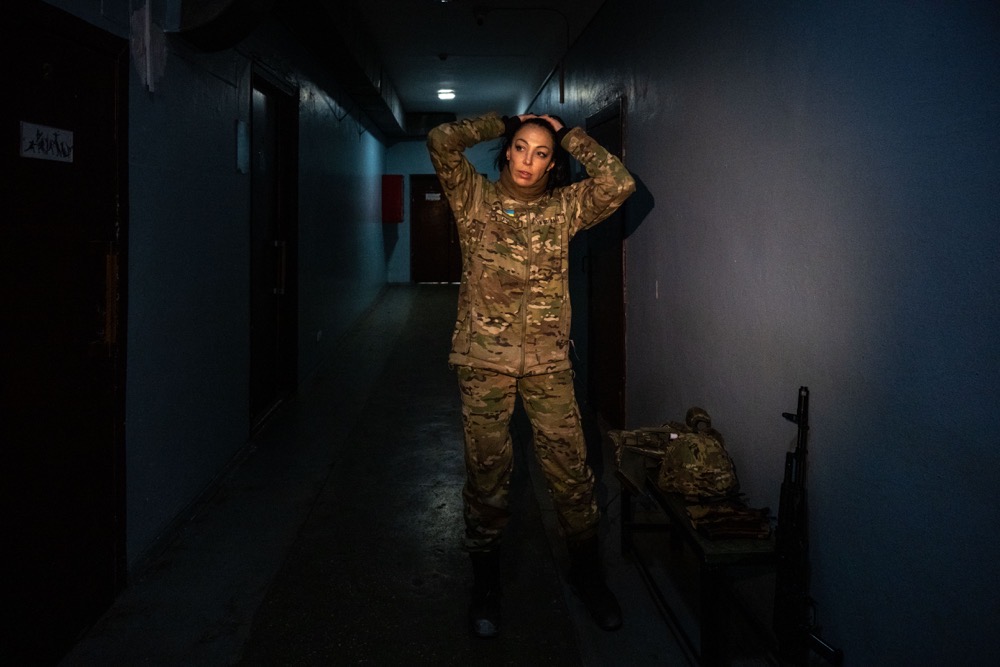


Sentsova’s story exemplifies the bravery and strength of Ukrainian women who have had to defend their homes and families. (AN photo by Ammar Abd Rabbo)

These days, she spends most of her days at the military training center and has developed a passion for using guns. Before the war, she was interested in guns, but since the war, the gun has become as basic as a toothbrush. She has no qualms about killing if necessary to protect her family and Ukraine. She says she will not go to the front lines, but will not hesitate to kill enemy soldiers if the need arises.

Sentsova’s story exemplifies the bravery and strength of Ukrainian women who have had to defend their homes and families. Natalia has not let the war change her feminine nature and approach. Despite the ongoing conflict and uncertainty about the future, Senstova says she remains committed to defending her country and preserving its independence.
Japan reaffirms no-nukes pledge after senior official suggests acquiring weapons

Updated 3 sec ago
Follow

Japan reaffirms no-nukes pledge after senior official suggests acquiring weapons

  • The unnamed official said Japan needed nuclear weapons because of a worsening security environment
  • At a regular press briefing in Tokyo, Chief Cabinet Secretary Minoru Kihara said Japan’s nuclear policy had ‌not changed
TOKYO: Japan reaffirmed its decades-old pledge never to possess nuclear weapons on Friday after local media reported that a senior security official suggested the country should ​acquire them to deter potential aggressors. The unnamed official said Japan needed nuclear weapons because of a worsening security environment but acknowledged that such a move would be politically difficult, public broadcaster NHK and other outlets reported, describing the official as being from Prime Minister Sanae Takaichi’s office.
At a regular press briefing in Tokyo, Chief Cabinet Secretary Minoru Kihara said Japan’s nuclear policy had ‌not changed, but declined ‌to comment on the remarks or ‌to ⁠say whether ​the ‌person would remain in government. There is a growing political and public willingness in Japan to loosen its three non-nuclear principles not to possess, develop or allow nuclear weapons, a Reuters investigation published in August found.
This is driven in part by doubts over the reliability of US security guarantees under President Donald Trump and growing threats from nuclear-armed ⁠China, Russia and North Korea.
Japan hosts the largest overseas concentration of US military forces ‌and has maintained a security alliance with Washington ‍for decades.
Some lawmakers within Takaichi’s ‍ruling Liberal Democratic Party have said the United States should ‍be allowed to bring nuclear weapons into Japan on submarines or other platforms to reinforce deterrence. Takaichi last month stirred debate on her own stance by declining to say whether there would be any changes to the ​three principles when her administration formulates a new defense strategy next year.
“Putting these trial balloons out creates an opportunity ⁠to start to build consensus around the direction to move on changes in security policy,” said Stephen Nagy, professor at the department of politics and international studies at the International Christian University in Tokyo.
Beijing’s assertiveness and growing missile cooperation between Moscow and Pyongyang are “creating the momentum to really change Japan’s thinking about security,” he added.
Discussions about acquiring or hosting nuclear weapons are highly sensitive in the only country to have suffered atomic bombings, and risk unsettling neighboring countries, including China.
Ties between Tokyo and Beijing worsened last month after Takaichi said a ‌Chinese attack on Taiwan that also threatened Japan could constitute a “survival-threatening situation” and trigger a military response.