

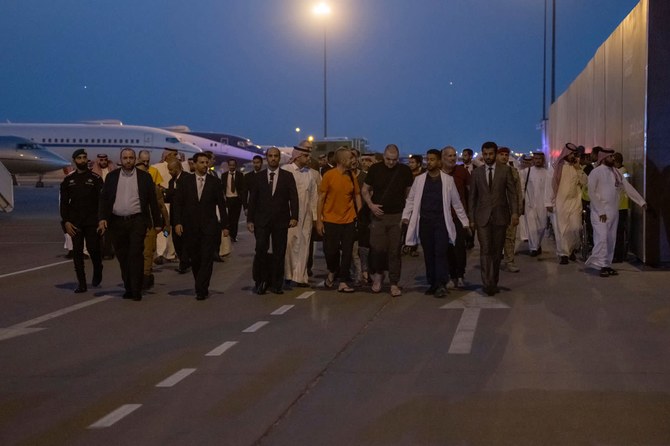


RIYADH: Saudi Arabia’s Crown Prince Mohammed bin Salman on Wednesday held successful mediation sessions to release ten prisoners from various countries as part of a prisoner exchange process between Russia and Ukraine.
The Kingdom’s Ministry of Foreign Affairs said in a statement the move was based on the support of Prince Mohammed and in continuation of his efforts to adopt humanitarian initiatives toward the Russian-Ukrainian crisis.
The Saudi crown prince, who has continuously worked with global countries to mitigate the repercussions of the war, held successful mediations in releasing prisoners from Morocco, the US, UK, Sweden, and Croatia, where their release was part of a prisoner exchange between Russia and Ukraine, it added.
“The relevant Saudi authorities received and transferred them from Russia to the Kingdom, and are facilitating procedures for their safe return to their respective countries,” the ministry added.
The ministry also expressed thanks and appreciation that the Russian and Ukrainian governments were able to cooperate with the Saudi government in facilitating and responding to the Saudi crown prince’s efforts to release the prisoners.
Saudi FM Prince Faisal bin Farhan said that the Crown Prince’s successful mediation efforts demonstrates the Kingdom’s commitment to global peace and security, and its belief in the importance of dialogue.
He said in a tweet that “The Kingdom is grateful for the cooperation and good-will shown by Ukraine and Russia towards the Crown Prince’s mediation efforts to secure the release of POW’s from five nations.”
He added that constructive dialogue is the best path forward to ending this conflict.
British Prime Minister Liz Truss welcomed the release and transfer to Riyadh of five UK prisoners.
The prime minister, who is in New York, tweeted: “Hugely welcome news that five British nationals held by Russian-backed proxies in eastern Ukraine are being safely returned, ending months of uncertainty and suffering for them and their families.”
She thanked Ukrainian President Volodymyr Zelensky and Saudi Arabia for helping free the detainees.
Newly-appointed British foreign minister James Cleverly said he welcomed the safe return of Ukrainian prisoners of war and one civilian, including 5 British nationals, and said: “I'd like to express my gratitude to President Zelensky and HRH Crown Prince of Saudi Arabia Mohammed bin Salman for their efforts and assistance.”
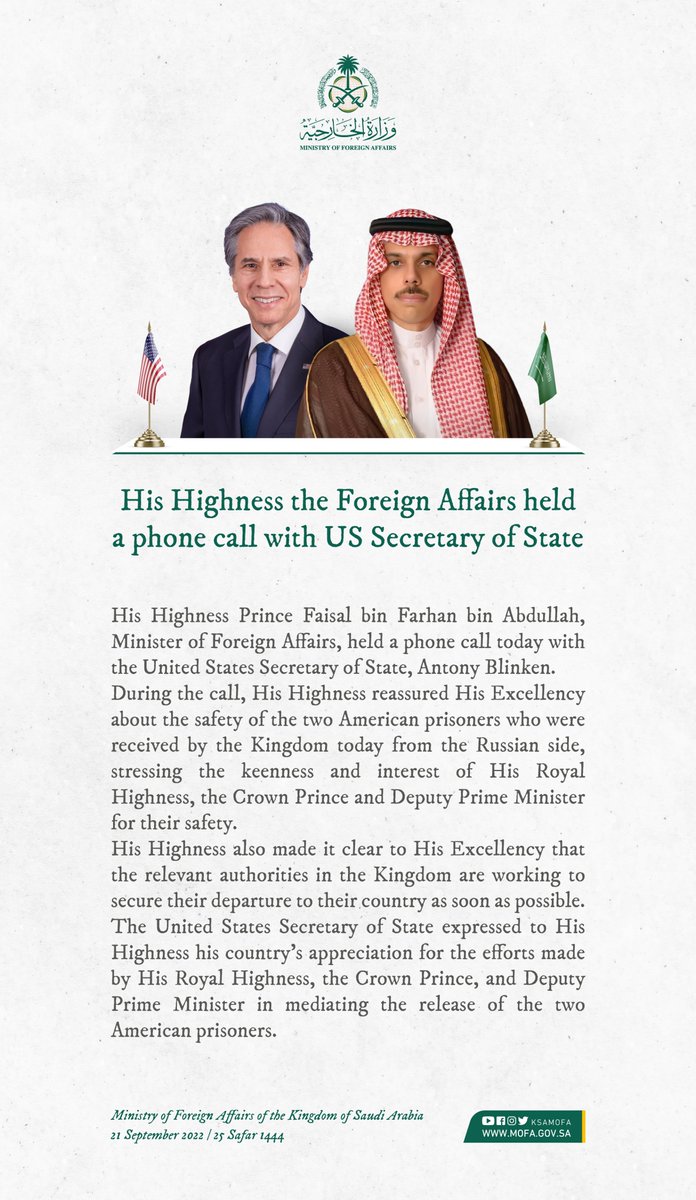
US Secretary of State Antony Blinken held a phone call with Prince Faisal bin Farhan, who reassured the US offical of the safety of the two American prisoners received from Russia, and stressed the Crown Prince's keenness on preserving their safety.
Swedish Foreign Minister Ann Linde also said on Twitter that the Swedish citizen, held in Donetsk, "has now been detained and is well". She, too, thanked Ukraine and Saudi Arabia.
Croatian Prime Minister Andrej Plenkovic thanked Saudi and Ukrainian authorities for their efforts and cooperation.
He also said on Twitter that he spoke with the released Croatian prisoner, adding that they look forward to his return to Croatia.
British MP Robert Jenrick said Twitter that one of the British detainees, Aiden Aslin, was one of his constituents — Aslin had been sentenced to death in June after being captured by pro-Russian separatists.
Jenrick said the British detainees were “on their way back to the UK” and that Aslin’s family “could finally be at peace.”
Bahrain early on Thursday welcomed the Saudi mediation effort.
Bahrain’s foreign ministry commended the move as “one of the leading diplomatic and humanitarian initiatives of Prince Mohammed bin Salman Al-Saud in ensuring the settlement of regional and international conflicts by diplomatic means, and supporting efforts to establish regional and global peace and stability.”
Ukraine has launched a counteroffensive and recaptured land taken by Russia in northeast and southern Ukraine in the past week, including the towns of Izyum and Kupiansk and around Kharkiv.
On Wednesday, Russian president Vladimir Putin ordered a partial mobilization, with Russia’s Defense Minister Sergei Shoigu saying 300,000 reservists would be called up to protect what the Kremlin claims are its lands.
On Tuesday, Prince Mohammed met with a special envoy of Zelensky, during which he “affirmed the Kingdom’s keenness and support for all international efforts aimed at resolving the crisis politically and its continuation of its efforts to contribute to alleviating the humanitarian effects resulting from it.”


