

Situation in Lebanon is ‘very dangerous,’ International Monetary Fund warns

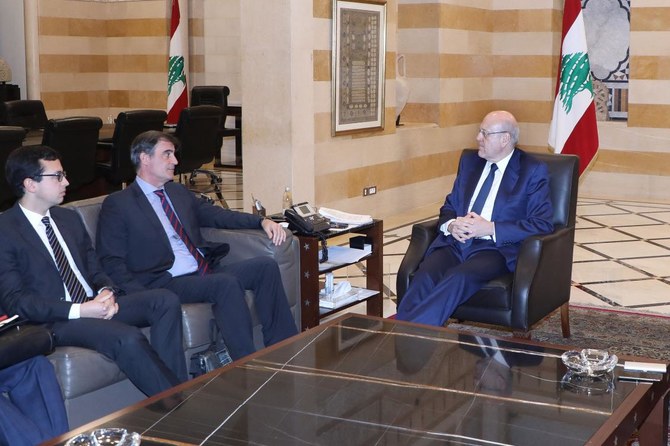
A handout picture provided by the Lebanese photo agency Dalati and Nohra on March 23, 2023 shows Lebanese caretaker prime minister Najib Mikati meeting with a delegation from the Ineternational Monetary Fund (IMF) at the governmental palace in Beirut on March 23, 2023. (AFP)
Short Url
Updated 12 April 2023
Follow

Situation in Lebanon is ‘very dangerous,’ International Monetary Fund warns

  • A year after Lebanese authorities committed to reforms ‘one would have expected more in terms of implementation and approval,’ says IMF mission chief

BEIRUT: “Lebanon is in a very dangerous situation,” the International Monetary Fund warned on Thursday, a year after authorities in the country committed to a program of reforms they have failed to implement.

The financial agency urged “the Lebanese government to halt borrowing from the central bank.” And the IMF’s mission chief to Lebanon, Ernesto Rigo, said during a news conference in Beirut that authorities must accelerate their efforts to meet the conditions required for a $3 billion bailout plan.

“One would have expected more in terms of implementation and approval of the legislation” relating to economic reforms, he said, noting that progress has been “very slow.”

Members of the IMF mission have spent nearly a month in Lebanon, during which they met many Lebanese officials and diplomats in an attempt to persuade them to step up efforts to introduce the reforms they had promised.

“We were expecting more in terms of adopting and implementing legislation aimed at reforming Lebanon’s financial system,” said Rigo. “The final draft of the Capital Control Law does not meet the objectives and needs to be amended.”

Lebanon signed an agreement with the IMF nearly a year ago but has yet to meet the conditions necessary to secure the full financial assistance program that is widely viewed as crucial to the country’s recovery from one of the worst economic crises the world has ever seen.

The economy has been crippled by the collapse of the nation’s currency, which has lost about 98 percent of its value against the US dollar since 2019, resulting in triple-digit inflation, soaring levels of poverty, and a massive wave of emigration.

Caretaker Prime Minister Najib Mikati was among the Lebanese officials who met the IMF team. “The mission presented the outcome of the consultations it carried out in Lebanon,” his office said.

During a meeting with Nabih Berri, the speaker of the Lebanese parliament, on Thursday, Mikati stressed the need for swift emergency action to save the country.

“The government cannot play its role amid a presidential vacuum and a dysfunctional parliament,” Mikati said. Politicians have been unable to agree on a replacement for President Michel Aoun, whose term ended on Oct. 31.

The Lebanese public took to the streets again on Wednesday to protest against the continuing deterioration in their finances and living conditions. Retired soldiers, who staged demonstrations this week because their pensions are no longer worth enough for them to live on, said they will resume their protests on Monday if their demands for assistance are not met.

On Thursday, employees of state-owned telecoms company Ogero decided to strike, raising fears that communications services and the internet could be crippled in the country.

After a meeting with Sheikh Abdel Latif Derian, Lebanon’s Grand Mufti, Prime Minister Mikati said: “We are fully aware of the difficult living situation that all of Lebanon is experiencing. We sent all draft laws to parliament for approval to initiate a practical workshop and major reforms in order to restore the active economic movement so that we can save what we can still save despite these difficult circumstances.”

However, the political squabbling continues over the election of a new president and other issues.

MP Ziad Hawat appeared on Thursday before First Investigative Judge Nicolas Mansour, after Mount Lebanon Public Prosecutor Judge Ghada Aoun accused Hawat of libeling, defaming and threatening a judge.

Hawat said he was waiving his parliamentary immunity to “challenge the politicized judiciary at its own game.”

In February, he accused Judge Aoun of violations he said could destroy the country’s banking institutions. “The entire banking system cannot be at the mercy of a judge’s mood,” Hawat said at the time, stressing his support for a fair and impartial judicial investigation into the operation of the country’s banks.


Israel’s Somaliland gambit: what’s at risk for the region?

Updated 28 December 2025
Follow

Israel’s Somaliland gambit: what’s at risk for the region?

  • Somaliland’s strategic location near the Bab Al-Mandab raises fears an Israeli security presence could turn the Red Sea into a powder keg
  • Critics argue the decision revives Israel’s “periphery” strategy, encouraging fragmentation of Arab and Muslim states for strategic advantage

RIYADH: It perhaps comes as no surprise to seasoned regional observers that Israel has become the first and only UN member state to formally recognize the Republic of Somaliland as an independent and sovereign nation.

On Dec. 26, Israel’s Prime Minister Benjamin Netanyahu and Foreign Minister Gideon Sa’ar signed a joint declaration of mutual recognition alongside Somaliland’s President Abdirahman Mohamed Abdullahi.

For a region that has existed in a state of diplomatic limbo since declaring independence from Somalia in 1991, this development is, as Abdullahi described it, “a historic moment.” But beneath the surface lies a calculated and high-stakes geopolitical gamble.

While several nations, including the UK, Ethiopia, Turkiye, and the UAE, have maintained liaison offices in the capital of Hargeisa, none had been willing to cross the Rubicon of formal state recognition.

Israel’s Prime Minister Benjamin Netanyahu, assisted by Foreign Minister Gideon Sa’ar, signs the document formally recognizing Somalia's breakaway Somaliland region on Dec. 26, 2025. (AFP)

Israel’s decision to break this decades-long international consensus is a deliberate departure from the status quo.

By taking this step, Israel has positioned itself as the primary benefactor of a state that has long sought a seat at the international table. As Dya-Eddine Said Bamakhrama, the ambassador of Djibouti to Saudi Arabia, told Arab News, such a move is deeply disruptive.

“A unilateral declaration of separation is neither a purely legal nor an isolated political act. Rather, it carries profound structural consequences, foremost among them the deepening of internal divisions and rivalries among citizens of the same nation, the erosion of the social and political fabric of the state, and the opening of the door to protracted conflicts,” he said.

Critics argue that Israel has long lobbied for the further carving up of the region under various guises.

This recognition of Somaliland is seen by many in the Arab world as a continuation of a strategy aimed at weakening centralized Arab and Muslim states by encouraging peripheral secessionist movements.

Somaliland’s President Abdirahman Mohamed Abdullahi. (AFP file photo)

In the Somali context, this path is perceived not as a humanitarian gesture, but as a method to undermine the national understandings reached within the framework of a federal Somalia.

According to Ambassador Bamakhrama, the international community has historically resisted such moves to prioritize regional stability over “separatist tendencies whose dangers and high costs history has repeatedly demonstrated.”

By ignoring this precedent, Israel is accused of using recognition as a tool to fragment regional cohesion.

In the past, Israel has often framed its support for non-state actors or separatist groups under the pretext of protecting vulnerable minorities — such as the Druze in the Levant or Maronites in Lebanon.

This “Periphery Doctrine” served a dual purpose: it created regional allies and supported Israel’s own claim of being a Jewish state by validating the idea of ethnic or religious self-determination.

However, in the case of Somaliland, the gloves are off completely. The argument here is not about protecting a religious minority, as Somaliland is a staunchly Muslim-majority territory. Instead, the rationale is nakedly geopolitical.

Israel appears to be seeking strategic depth in a region where it has historically been isolated. Netanyahu explicitly linked the move to “the spirit of the Abraham Accords,” signaling that the primary drivers are security, maritime control, and intelligence gathering rather than the internal demographics of the Horn of Africa.

The first major win for Israel in this maneuver is the expansion of its diplomatic orbit. It could be argued that the refusal of the federal government in Mogadishu to join the Abraham Accords was an artificial barrier.

The evidence for this claim, from the Israeli perspective, is that Somaliland — a territory with a population of nearly six million and its own functioning democratic institutions — was eager to join.

Abdullahi said Somaliland would join the Abraham Accords as a “step toward regional and global peace.” Yet, this peace comes with a clear quid pro quo — formal recognition.

Residents wave Somaliland flags as they gather in downtown Hargeisa on December 26, 2025, to celebrate Israel's announcement recognizing Somaliland's statehood. (AFP)

Israel can now argue that the “Somaliland model” proves that many other Arab and Muslim entities are willing to normalize relations if their specific political or territorial interests are met.

This challenges the unified stance of the Arab League and the Organization of Islamic Cooperation, which maintain that normalization must be tied to the resolution of the Palestinian conflict.

The second major gain for Israel is the potential for a military presence in the Horn of Africa. Somaliland’s strategic position on the Gulf of Aden, near the Bab Al-Mandab Strait, makes it a prime location for monitoring maritime traffic.

This is a ticking time bomb given that just across the narrow sea lies Yemen, where the Houthi movement — whose slogan includes “Death to Israel” — controls significant territory.

Israel may claim that a military or intelligence presence in Somaliland will boost regional security by countering Houthi threats to shipping. However, regional neighbors fear it will likely inflame tensions.

Ambassador Bamakhrama warned that an Israeli military presence would “effectively turn the region into a powder keg.”

Ambassador Dya-Eddine Said Bamakhrama, Djibouti's envoy to Saudi Arabia. (Supplied)

“Should Israel proceed with establishing a military base in a geopolitically sensitive location... such a move would be perceived in Tel Aviv as a strategic gain directed against the Arab states bordering the Red Sea — namely Egypt, Saudi Arabia, Somalia, Yemen, Sudan, and Djibouti,” he said.

The Red Sea is a “vital international maritime corridor,” and any shift in its geopolitical balance would have “repercussions extending far beyond the region,” he added.

The recognition is also a clear violation of international law and the principle of territorial integrity as enshrined in the UN Charter.

While proponents point to exceptions like South Sudan or Kosovo, those cases involved vastly different circumstances, including prolonged genocidal conflicts and extensive UN-led transitions.

In contrast, the African Union has been firm that Somaliland remains an integral part of Somalia.

The backlash has been swift and severe. The Arab League, the Gulf Cooperation Council, and the OIC have all decried the move. Even US President Donald Trump, despite his role in the original Abraham Accords, has not endorsed Israel’s decision.

When asked whether Washington would follow suit, Trump replied with a blunt “no,” adding, “Does anyone know what Somaliland is, really?”

This lack of support from Washington highlights the isolation of Israel’s position. The OIC and the foreign ministers of 21 countries have issued a joint statement warning of “serious repercussions” and rejecting any potential link between this recognition and reported plans to displace Palestinians from Gaza to the African region.

Israel’s recognition of Somaliland appears to be a calculated gamble to trade diplomatic norms for strategic advantage.

While Hargeisa celebrates a long-awaited milestone, the rest of the world sees a dangerous precedent that threatens to destabilize one of the world’s most volatile corridors.

As Ambassador Bamakhrama says, the establishment of such ties “would render (Israel) the first and only state to break with the international consensus” — a move that prioritizes “narrow strategic calculations” over the stability of the international system.