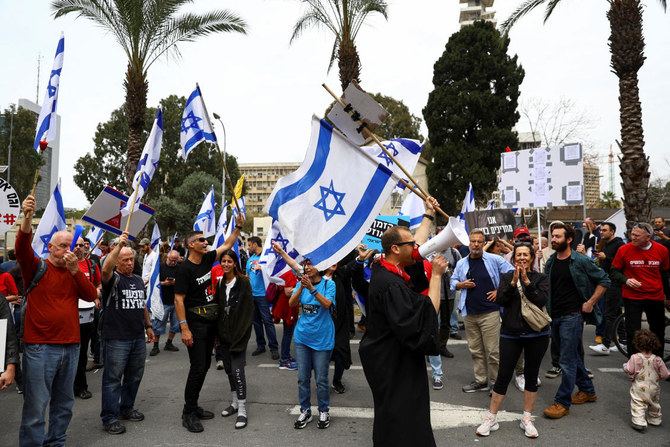
TEL AVIV/JERUSALEM: Israelis took to the streets en masse on Thursday in protest against the government’s overhaul of the court system, blocking roadways across the country and intensifying a months-long campaign decrying the move.
Thousands of people waving flags and blaring horns marched on a Tel Aviv thoroughfare stopping traffic in the middle of the workday. Police sprayed a water cannon and carried some away as they tried to clear the highway.
A small group burned tires in the street outside a seaport, briefly blocking trucks. Police forced demonstrators from the road in front of a conference center in central Israel.
Police detained dozens of protesters for public disturbance across the country.
The protests have escalated since the start of the year when Prime Minister Benjamin Netanyahu’s hard-right government introduced new legislation that would limit the authority of the Supreme Court.
The plan has stirred concern for Israel’s democratic health at home and abroad. Military reservists have joined the protests and senior officials in the Finance Ministry warned this week of an economic backlash.
In Jerusalem, crowds gathered along the walls of the Old City from which they hung a huge replica of the country’s declaration of independence.
“What we are doing here is we are fighting for our lives. We are fighting for our lives as a Jewish people together in the state that we have been building for 75 years,” said Avidan Friedman, who was wearing a Jewish prayer shawl over his head.
“We are fighting because we feel like what’s going on now is tearing us apart and we are calling on the government to stop.”
Netanyahu in the meantime pushed ahead with the legislation, which includes bills to give the government decisive sway in electing judges and to limit the court’s power to strike down laws. On Thursday a law was ratified limiting the circumstances in which a prime minister can be removed.
Netanyahu — on trial for corruption charges he denies — says the judicial overhaul is needed to restore balance between the branches of government. Critics say it will weaken Israel’s democracy and hand uncontrolled powers to the government of the day.

Thousands of Israelis block streets in protest of judicial overhaul
Short Url
https://arab.news/jhnh6
Thousands of Israelis block streets in protest of judicial overhaul
- Thousands of people carrying flags and signs marched on a Tel Aviv thoroughfare stopping traffic
- Benjamin Netanyahu’s plan has stirred concern for Israel’s democratic health at home and abroad
France to rally aid for Lebanon as it warns truce gains remain fragile
France said on Friday that Lebanon’s recovery remains precarious despite positive signs following a ceasefire and government transition, and it stood ready to support the country’s reconstruction if it continues with reforms.
French Minister for Europe and Foreign Affairs Jean-Noel Barrot, addressing reporters after meetings in Beirut with Lebanese President Joseph Aoun and other top officials, said France was prepared to host a dedicated conference in Paris on reconstruction, but only if reforms continue, legislation is passed and decisions are implemented.
While Lebanon has adopted banking secrecy and bank resolution laws, it must still complete restructuring, reach an IMF agreement and pass a loss-sharing law, Barrot said. He also urged swift action on Hezbollah disarmament and national reconciliation.
Barrot said Lebanon had reached a crucial juncture in implementing the November 2024 truce with Israel, as well as restoring state authority over weapons and stabilising a shattered financial system.
France, the country’s former colonial power, plans to mobilize international backing for the Lebanese armed forces and internal security forces at a separate conference scheduled for March 5 in Paris.
“Lebanon must work to restore confidence — that of its citizens, businesses, depositors, and the diaspora,” Barrot said.
France’s immediate focus was ensuring respect for the ceasefire, which he emphasized “implies that Israel withdraws from Lebanese territory, in accordance with its commitments, and that civilians are protected from strikes,” alongside implementation by Lebanese authorities of an agreed-upon arms monopoly plan.
Lebanon has pledged to bring all arms in the country under state control, in line with the 2024 agreement that ended a devastating war between Hezbollah and Israel, and has asserted control over areas of the country closest to the border with Israel. But Hezbollah has warned the government that pressing on with efforts to disarm the group throughout the country would trigger chaos and possibly civil war.
French Minister for Europe and Foreign Affairs Jean-Noel Barrot, addressing reporters after meetings in Beirut with Lebanese President Joseph Aoun and other top officials, said France was prepared to host a dedicated conference in Paris on reconstruction, but only if reforms continue, legislation is passed and decisions are implemented.
While Lebanon has adopted banking secrecy and bank resolution laws, it must still complete restructuring, reach an IMF agreement and pass a loss-sharing law, Barrot said. He also urged swift action on Hezbollah disarmament and national reconciliation.
Barrot said Lebanon had reached a crucial juncture in implementing the November 2024 truce with Israel, as well as restoring state authority over weapons and stabilising a shattered financial system.
France, the country’s former colonial power, plans to mobilize international backing for the Lebanese armed forces and internal security forces at a separate conference scheduled for March 5 in Paris.
“Lebanon must work to restore confidence — that of its citizens, businesses, depositors, and the diaspora,” Barrot said.
France’s immediate focus was ensuring respect for the ceasefire, which he emphasized “implies that Israel withdraws from Lebanese territory, in accordance with its commitments, and that civilians are protected from strikes,” alongside implementation by Lebanese authorities of an agreed-upon arms monopoly plan.
Lebanon has pledged to bring all arms in the country under state control, in line with the 2024 agreement that ended a devastating war between Hezbollah and Israel, and has asserted control over areas of the country closest to the border with Israel. But Hezbollah has warned the government that pressing on with efforts to disarm the group throughout the country would trigger chaos and possibly civil war.
© 2026 SAUDI RESEARCH & PUBLISHING COMPANY, All Rights Reserved And subject to Terms of Use Agreement.


