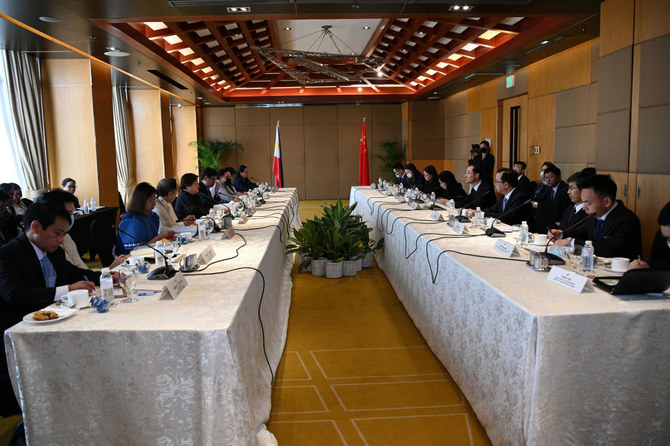
MANILA: Senior Chinese and Filipino diplomats were meeting in Manila on Thursday to review their relations amid thorny issues, including Beijing’s alarm over a Philippine decision to allow the US military to expand its presence to a northern region facing the Taiwan Strait and escalating spats in the disputed South China Sea.
Chinese Vice Foreign Minister Sun Weidong and Philippine Foreign Undersecretary Theresa Lazaro were leading the talks aimed at assessing overall relations on Thursday. The discussions would focus on the long-seething territorial spats in the disputed waterway on Friday, the Department of Foreign Affairs in Manila said.
The back-to-back meetings are the first under President Ferdinand Marcos Jr., who took office in June last year. He met Chinese President Xi Jinping in a state visit to Beijing in January where both agreed to expand ties, pursue talks on potential joint oil and gas explorations and manage territorial disputes amicably.
But the territorial conflicts have persisted as a major irritant in relations early in the six-year term of Marcos, whose administration has filed at least 77 of more than 200 diplomatic protests by the Philippines against China’s increasingly assertive actions in the disputed waters since last year alone.
That included a February 6 incident when a Chinese coast guard ship aimed a military-grade laser that briefly blinded some crew members of a Philippine patrol vessel off a disputed shoal. Marcos summoned the Chinese ambassador to Manila to express concern over the incident, but Beijing said the Philippine vessel intruded into Chinese territorial waters and its coast guard used a harmless laser gadget to monitor the vessel’s movement.
Early last month, the Marcos administration announced it would allow rotating batches of American forces to indefinitely station in four more Philippine military camps. Those are in addition to five local bases earlier designated under a 2014 defense pact between the longtime treaty allies.
Marcos said Wednesday the four new military sites would include areas in the northern Philippines. That location has infuriated Chinese officials because it would provide US forces a staging ground close to southern China and Taiwan.
The Americans would also have access to military areas on the western Philippine island province of Palawan, Marcos said, adding that the US military presence under the 2014 Enhanced Defense Cooperation Agreement was aimed at boosting coastal defense.
Palawan faces the South China Sea, a key passage for global trade that Beijing claims virtually in its entirety but a United Nations-backed arbitration tribunal ruled in 2016 that historical claim had no legal basis under the 1982 UN Convention on the Law of the Seas.
China had dismissed the ruling, which Washington and other Western governments recognize, and continues to defy it.
When asked to react to the Philippine decision, Chinese Foreign Ministry spokesperson Wang Wenbin told a news briefing in Beijing on Wednesday that defense cooperation between countries “needs to be conducive to regional peace and stability and not targeted at or harmful to the interests of any third party.”
Wang warned countries in the region “to remain vigilant and avoid being coerced or used by the US” without naming the Philippines.
A recent statement issued by the Chinese Embassy in Manila was more blunt and warned that the Manila government’s security cooperation with Washington “will drag the Philippines into the abyss of geopolitical strife and damage its economic development at the end of the day.”
The Biden administration has been strengthening an arc of military alliances in the Indo-Pacific to better counter China, including in any future confrontation over Taiwan. The US moves dovetail with Philippine efforts to shore up its territorial defense amid its disputes with China in the South China Sea.
Two senior Filipino officials said that the Philippine government would extend the Enhanced Defense Cooperation Agreement, which allows the temporary presence of US forces and their defense equipment in the country. The Philippine Constitution prohibits the permanent basing of foreign troops in the country and their involvement in local combat.
The agreement, signed in 2014, would initially be effective for 10 years and would remain in force automatically unless terminated by either side with a one-year advance written notice.
The two officials spoke to the AP on condition of anonymity because they lack authority to discuss the issue publicly.


![]()

China, Philippines assess ties amid escalating sea disputes
China, Philippines assess ties amid escalating sea disputes
- Discussions would focus on the long-seething territorial spats in the disputed South China Sea
- Marcos administration has filed at least 77 of more than 200 diplomatic protests against China’s increasingly assertive actions
Latest updates


© 2026 SAUDI RESEARCH & PUBLISHING COMPANY, All Rights Reserved And subject to Terms of Use Agreement.