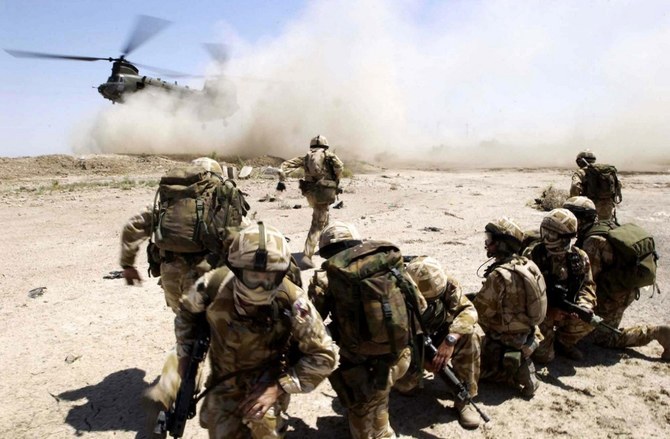
UK opens inquiry into unlawful killing claims in Afghanistan

Britain's government ordered the inquiry after lawyers brought legal challenges on behalf of the families of eight Afghans allegedly killed by British special forces during nighttime raids in 2011 and 2012. (AFP/File)
Short Url
Updated 22 March 2023
Follow

UK opens inquiry into unlawful killing claims in Afghanistan

  • Britain's government ordered the inquiry after lawyers brought legal challenges on behalf of the families of eight Afghans
  • Senior judge Charles Haddon-Cave said: "This is critical, both for the reputation of the armed forces and the country"

LONDON: A senior judge launched an independent inquiry Wednesday to investigate whether UK military police covered up or did not properly probe allegations of unlawful killings by British armed forces in Afghanistan from 2010 to 2013.
Britain’s government ordered the inquiry after lawyers brought legal challenges on behalf of the families of eight Afghans who were allegedly killed by British special forces during nighttime raids in 2011 and 2012.
Senior judge Charles Haddon-Cave said his team would “get to the bottom” of whether investigations carried out by the Royal Military Police were adequate.
“It is clearly important that anyone who has broken the law is referred to the relevant authorities for investigation. Equally, those who have done nothing wrong should rightly have the cloud of suspicion lifted from them,” Haddon-Cave said Wednesday. “This is critical, both for the reputation of the armed forces and the country.”
The inquiry into two separate incidents will also review whether the deaths “formed part of a wider pattern of extra-judicial killings by British armed forces in Afghanistan at the time.”
Thousands of British troops were deployed to Afghanistan as part of a two-decade-long NATO-led campaign in the country following the September 11, 2001 terrorist attacks in the United States. Many British soldiers engaged in heavy fighting with insurgents in southern Helmand province.
Britain ended all combat operations in Afghanistan in 2014, although a small number of troops stayed to train Afghan security forces until 2021, when the international coalition withdrew from the country.
Haddon-Cave said many hearings would have to be held behind closed doors for national security reasons.
Leigh Day, the law firm representing the families, said Ministry of Defense documents showed officers had widespread knowledge about unlawful killings by UK special forces in Afghanistan but did not report the information to military police.


Skyrocketing rents threaten Greece’s economic rebound 

Updated 2 sec ago
Follow

Skyrocketing rents threaten Greece’s economic rebound 

  • Rents in Athens surged over 50 percent between 2019 and 2024
ATHENS: Last year, Eirini Syntihaki was renting an apartment she loved in central Athens near friends, work and the city’s many streetside cafes.
Then a few months ​ago, her flatmate moved out and lawyers representing the apartment’s Chinese owners said they planned to raise the rent, which was already 700 euros — nearly Syntihaki’s entire earnings. “With pain in my heart, I’m leaving a home I really love, the area, the house itself, the memories,” the 28-year-old criminologist said as she packed her belongings before moving in with her sister. “I knew I had to leave to survive.”
Greece’s economy is rebounding sharply from its 2009-2018 financial crisis. Growth outstrips the EU average, the country is repaying its bailout loans ahead of schedule and tourist visits are at a record high.
Amid the recovery, however, many Greeks are being left behind as rents soar and earnings fail to keep pace, forcing them to spend less on items ‌such as heating, ‌entertainment or dining and take on more debt. That is creating a drag ​on Greece’s ‌economic ⁠recovery, experts ​said.
“Income ⁠adequacy is at a record low, with six out of ten households reporting that their monthly income does not reach the end of the month,” Greece’s Small Enterprise Institute (IME), a confederation of small businesses, said in a report.
“Economic difficulties are no longer limited to low incomes, but are also extending to the middle classes,” it said.
DEBT CRISIS CAUSED HOUSING SHORTAGE Many of the problems stem from the crisis years, when housing construction froze. According to a Piraeus Bank report last year, there is a shortage of 180,000 houses for rent or sale in big Greek cities.
The offer of golden visas available since 2014 for foreigners who buy property has ⁠exacerbated that shortage. Since the mid-2010s, 20,000 properties, mainly in Athens, have been sold to ‌foreigners according to Migration Ministry data. Another 150,000 have been converted to short-term ‌rentals for tourists.
Themistocles Bakas, president of E-Real Estate Network which has offices across ​Greece, says that rental demand is so high that hundreds ‌of people appear for one rental viewing.
It is “like people waiting in line at a grocery store in the 1940s. ‌Back then, they queued for food, oil, bread. Today, Greece appears to be waiting in line for a home.”
Owning a home is also getting out of reach for many Greeks, with home ownership sinking below 70 percent in 2024, the lowest ever, from about 77 percent in 2009.
GREECE HOUSING CRISIS STANDS OUT
Rising rents plague many European countries, but Greece stands out. From 2019 to 2024, as Greece emerged from years ‌of painful austerity, rents surged more than 50 percent on average in Athens, according to E-Real Estate. At the same time, average two-bedroom rents rose 26 percent in Madrid and 14 percent in ⁠Paris.
Average Greek salaries are up ⁠about 27 percent over that period and Eurostat data shows Greeks spend more on housing as a proportion of their incomes than any other EU nation.
The government is subsidising rents for some low earners, but renters say that has had little impact. More than 83 percent of Greeks say they cannot save money, and 40 percent spent less on restaurants and movies last year than in 2024, according to a survey conducted by IME.
“The situation is already very bad and ... it is expected to get even worse,” said Nikos Kourahanis, professor at Panteion University in Athens.
As new foreign owners move in, many Greeks find themselves forced out of their old neighborhoods.
Fifty-two-year-old kindergarten teacher Ioanna Tzaka said that just a few days before Christmas she received a notice to leave her apartment in an upscale neighborhood of central Athens.
A Lebanese couple had bought the place and gave her 30 days to move out. She looked for something similar in the area, but rents were now starting at 2,000 euros, rather ​than 1,300 she used to pay, so she moved ​to the suburbs with her husband and their 14-year-old son where they rent an apartment for 1,500 euros per month.
“It feels like an uprooting for me and my family,” she said. “I grew up here. All my child’s friends live here.”