

UK Defense Ministry offers independent inquiry into handling of SAS killing claims

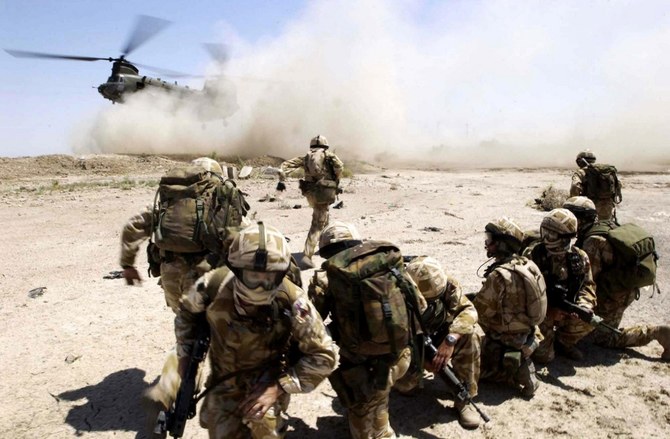
The Royal Military Police investigated allegations that a single Special Air Service unit in 2010-2011 unlawfully executed 54 Afghans. (AFP file photo)
Short Url
Updated 27 July 2022
Follow

UK Defense Ministry offers independent inquiry into handling of SAS killing claims

  • Court filings show Royal Military Police officer tasked with probe was ‘close friend’ of SAS officer
  • Deputy faced ‘political pressure’ to avoid investigating elite unit, court hears

LONDON: The UK Defense Ministry has offered to launch an independent inquiry into its handling of claims that Britain’s elite Special Air Service killed unarmed civilians during the war in Afghanistan, BBC News reported.

Amid a legal case brought against Defense Minister Ben Wallace, court filings suggest that there were significant flaws in the ministry’s initial investigation, led by the Royal Military Police.

The RMP investigated allegations that a single SAS unit in 2010-2011 unlawfully executed 54 Afghans.

But documents show that the senior officer in charge of the RMP probe, Brig. David Neal, was suspected of attempting to shut down investigations.

Neal was reportedly a “close friend” of the SAS officer in charge of the unit at the center of the claims.

The RMP official allegedly shut down investigations into eight separate cases of potential unlawful execution.

Neal’s deputy claimed, according to court documents, that he was placed under “political pressure” to avoid progressing investigations into senior SAS members involved in the unit.

The Defense Ministry’s legal chief, Peter Ryan, said in 2020 that the SAS’ explanations over the killings were “highly questionable, if not actually implausible.”

He warned that the RMP investigation was “unduly narrowly focused given the strength of insider concerns.

“Only a proportion of the large-scale shooting incidents over the six-month period in 2010-2011 were investigated in any detail.

“And there have been no investigations of earlier special forces deployments, during at least some of which even more Afghans were killed, again with relatively few weapons being recovered.”

Relatives of four men killed in a 2011 raid in Afghanistan reject the findings of the RMP probe and are engaged in a legal case against Wallace.

The ministry’s proposed new investigation into the way the allegations were handled would be led by a senior judge.

It would only examine the handling of the subsequent claims, however, as opposed to the legality of the killings, the ministry said, noting that the initial investigation had failed to find grounds for prosecution.

If prior investigations are found to be flawed, it could pave the way for the reopening of an investigation into the killings.

John Healey, UK shadow defense secretary, said that the proposed fresh inquiry was a “welcome first step.”

He added: “Australian special forces were investigated fully by a properly resourced inquiry backed by privacy and military expertise. There is no reason why this shouldn’t be possible in Britain.”

However, Tessa Gregory, who is representing an Afghan family in the case against Wallace, described the ministry’s proposed review as “so limited in what it can look at that it cannot bring the truth to light.

“Our clients desperately need answers to why their loved ones died and any investigation must fearlessly examine the underlying allegations of extrajudicial killings.”

A Defense Ministry spokesperson said: “The defense minister has decided to propose an independent review to be led by a senior judge into issues arising from the handling of allegations of misconduct that are the subject of these proceedings.

“The review will consider what lessons can be learned and make any recommendations for the future.”


Barcelona train crash kills 1 in Spain's second deadly rail accident in days

Updated 7 sec ago
Follow

Barcelona train crash kills 1 in Spain's second deadly rail accident in days

  • The northeastern region's Interior Minister, Nuria Parlon, told local media the crash killed one person and injured 37
BARCELONA: A commuter train near Barcelona ploughed into the rubble of a collapsed wall on Tuesday, killing one and injuring dozens in Spain's second deadly rail accident in days.
The latest incident is likely to raise more questions about Spanish transport safety, coming two days after the collision of two high-speed trains in the southern region of Andalusia killed 42 people -- the country's deadliest rail accident in more than a decade.
On Tuesday, "a retaining wall collapsed onto the tracks, causing an accident involving a passenger train" in the municipality of Gelida, around 40 kilometres (25 miles) west of Barcelona, the Catalonia region's civil protection agency posted on social media.
The northeastern region's Interior Minister, Nuria Parlon, told local media the crash killed one person and injured 37 -- several seriously.
"We regret to announce the death of one of the passengers on the train," said Parlon, adding authorities had not yet completed the identification process of the deceased.
"Of the total number of people treated, five are in serious condition," she added.
Emergency workers used torches to survey the wreckage of the derailed train carriage, which had turned into a mass of crumpled metal, an AFP reporter saw on Tuesday night.
Spanish rail infrastructure operator Adif said a storm caused a wall to fall, creating the rubble that the train slammed into. Catalan commuter trains would remain suspended, it added.
Earlier on Tuesday, Spain's king and queen visited the site where two high-speed trains collided on Sunday as well as survivors of the accident that injured more than 120 people, 37 of whom are still in hospital.
The country's deadliest rail accident in more than 12 years took place when a train operated by rail company Iryo, travelling from Malaga to Madrid, derailed near Adamuz in the southern Andalusia region.
It crossed onto the other track, where it crashed into an oncoming train heading to the southern city of Huelva, which also derailed.
Dressed in dark clothing, King Felipe VI and Queen Letizia shook hands with emergency services workers near the spot where the mangled wreckage of the trains lay.
They then visited a hospital in the nearby city of Cordoba, where some of the injured are being treated.
Speaking to reporters after leaving the hospital, Felipe said he wanted to "convey the affection of the entire country" to the victims.
Santiago Salvador, a Portuguese national who broke a leg in the accident, said he felt lucky to be alive.
"I was thrown through the carriage; it felt like being on a carousel," Salvador, his face covered in cuts, told Portuguese state television RTP.
"It looked like hell. There were people who were very seriously injured."
- Crack on tracks -
Sunday's derailment was Spain's deadliest rail accident since 2013, when 80 people were killed after a train veered off a curved section of track outside the northwestern city of Santiago de Compostela.
Flags flew at half-mast on public buildings, television anchors wore black, and cabinet ministers curtailed public appearances as Spain observed the first of three days of national mourning.
The government has vowed a full and transparent investigation into the cause of the accident.
Unlike the 2013 disaster, the derailment occurred on a straight section of track, and the trains were travelling within the speed limit of 250 kilometres (155 miles) for the area concerned, officials said.
Spanish media report that the probe is focusing on a crack more than 30 centimetres (12 inches) long in the track at the site of the accident.
The crack may have resulted from "a poor weld or a weld that deteriorated due to train traffic or weather", daily newspaper El Mundo reported, citing unidentified technicians with access to the inquiry.
Transport Minister Oscar Puente said investigators were looking to see if a broken section of rail was "the cause or the result" of the derailment.
He said the Iryo train was "practically new" and the section of track where the disaster happened had been recently renovated, making the accident "extremely strange".
- Sabotage ruled out -
Interior Minister Fernando Grande-Marlaska said "the possibility of sabotage was never considered" and that "there has never been any element suggesting otherwise."
The head of state rail operator Renfe, Alvaro Fernandez Heredia, said human error has "been practically ruled out".
Rail operator Adif on Tuesday also imposed a temporary 160 kph speed limit on parts of the high-speed line between Madrid and Barcelona after train drivers reported bumps.
Maintenance crews will inspect the tracks overnight, and the restriction is expected to be lifted if no issues are found, the company added.