

Pakistani tribesmen announce mourning in native town of army brigadier killed in militant ambush

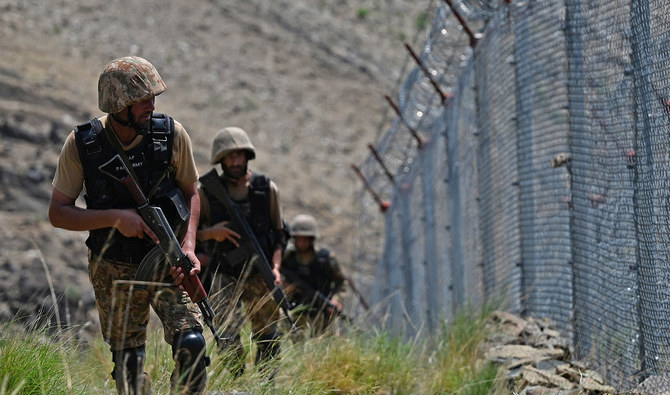
Pakistani troops patrol along Pakistan-Afghanistan border fence at Big Ben post in the Khyber district of the Khyber Pakhtunkhwa province on August 3, 2021. (AFP/FILE)
Short Url
Updated 22 March 2023
Follow

Pakistani tribesmen announce mourning in native town of army brigadier killed in militant ambush

  • Brig. Mustafa Kamal Barki lost his life in a shootout with militants near the frontier region of Angoor Adda on Tuesday
  • His tribal community describes his killing as an ‘irreparable’ loss amid rising number of militant attacks in recent months

PESHAWAR: Local tribesmen in the native town of a senior Inter-Services Intelligence (ISI) spy agency official announced three days of mourning on Wednesday after a group of militants killed him in an attack near the country’s border with Afghanistan the day before.

According to a statement issued by the army, Brig. Mustafa Kamal Barki was driving to Wana, the headquarters of South Waziristan tribal district, when his caravan came under attack near the frontier region of Angoor Adda. The ensuing shootout killed Barki and left seven troops injured.

So far, no group has claimed responsibility for the attack, which was described by his community members as a major loss.

“I really don’t have words to express how big a loss this is for the nation,” Malik Irfan Barki, a tribal elder and the slain official’s close neighbor, told Arab News. “What we have suffered as his community members is simply irreparable.”

“The demise of Mustafa Barki has shattered us and sent shockwaves through the Kaniguram valley,” he continued. “I called a grand jirga [tribal gathering] of Barki elders which announced three-day mourning over his tragic demise.”

Kaniguram, a picturesque town at the heart of South Waziristan district, is home to a small community of about 14,000 people.

The attack on Barki was launched amid a surge in militant violence in Pakistan since a proscribed militant faction, Tehreek-e-Taliban Pakistan (TTP), called off a fragile cease-fire with the government in November.

TTP militants have since targeted police and security forces in the country’s Khyber Pakhtunkhwa and Balochistan provinces located next to Afghanistan.

Nisar Barki, a cousin of the slain official, described his relative as a “caring person.”

He said Barki received his early education from a local school in his hometown before getting admission to an education institute in Tank.

“We studied together until the 12th grade and were even together at Cadet College Razmak in North Waziristan,” he added. “After completing his education there, Mustafa was selected by a medical college and Pakistan’s military academy, but he preferred to join the army.”

“He was a bold, courageous, and very caring person as a relative,” he continued.

He also said that his cousin joined the Frontier Force Regiment in 1995 and served in various capacities. He was also posted abroad to work with different Pakistani diplomatic missions.

The slain official was a graduate of the National Defense University and Command and Staff College Quetta. Apart from that, he also participated in the Kargil war and suffered injuries.

“My late cousin used to tell me to forgive and forget,” Barki said. “He was a genius and a deep-thinking man.”


Pakistan reports current account surplus in Jan. owing to improved trade, remittances

Updated 17 February 2026
Follow

Pakistan reports current account surplus in Jan. owing to improved trade, remittances

  • Pakistan’s exports crossed the $3 billion mark in Jan. as the country received $3.5 billion in remittances
  • Last month, IMF urged Pakistan to accelerate pace of structural reforms to strengthen economic growth

ISLAMABAD: Pakistan recorded a current account surplus of more than $120 million in January, the country’s finance adviser said on Tuesday, attributing it to improved trade balance and remittance inflows.

Pakistan’s exports rebounded in January 2026 after five months of weak performance, rising 3.73 percent year on year and surging 34.96 percent month on month, according to data released by the country’s statistics bureau.

Exports crossed the $3 billion mark for the first time in January to reach $3.061 billion, compared to $2.27 billion in Dec. 2025. The country received $3.5 billion in foreign remittances in Jan. 2026.

Khurram Schehzad, an adviser to the finance minister, said Pakistan reported a current account surplus of $121 million in Jan., compared to a current account deficit of $393 million in the same month last year.

“Improved trade balance in January 2026, strong remittance inflows, and sustained momentum in services exports (IT/Tech) continue to reinforce the country’s external account position,” he said on X.

Pakistan has undergone a difficult period of stabilization, marked by inflation, currency depreciation and financing gaps, and international rating agencies have acknowledged improvements after Islamabad began implementing reforms such as privatizing loss-making, state-owned enterprises (SOEs) and ending subsidies as part of a $7 billion International Monetary Fund (IMF) loan program.

Late last month, the IMF urged Pakistan to accelerate the pace of these structural reforms to strengthen economic growth.

Responding to questions from Arab News at a virtual media roundtable on emerging markets’ resilience, IMF’s director of the Middle East and Central Asia Jihad Azour said Islamabad’s implementation of the IMF requirements had been “strong” despite devastating floods that killed more than 1,000 people and devastated farmland, forcing the government to revise its 4.2 percent growth target to 3.9 percent.

“What is important going forward in order to strengthen growth and to maintain the level of macroeconomic stability is to accelerate the structural reforms,” he said at the meeting.

Azour underlined Pakistan’s plans to privatize some of the SOEs and improve financial management of important public entities, particularly power companies, as an important way for the country to boost its capacity to cater to the economy for additional exports.

“This comes in addition to the effort that the authorities have made in order to reform their tariffs, which will allow the private sector of Pakistan to become more competitive,” the IMF official said.