

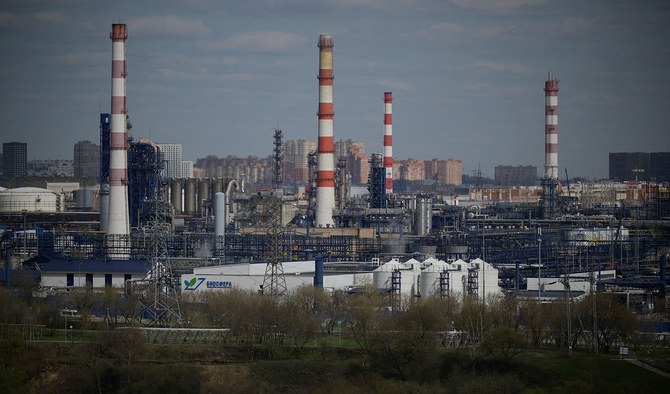

KARACHI: Officials of the Pakistani and Russian state-owned oil companies on Tuesday held a meeting in Karachi to negotiate a deal under which Islamabad will acquire cheaper energy imports from Russia, an official with direct knowledge of the talks said.
Russia this year conceptually agreed to supply crude oil and oil products to cash-strapped Pakistan at cheaper rates and signed several memoranda of understanding with Pakistan’s energy ministry.
After the inter-governmental meeting in January, Pakistan’s state minister for petroleum Musadik Malik said his country wanted to import 35 percent of its total crude oil requirement from Russia.
“Talks to negotiate government-to-government level deal were held in Karachi today,” the official, who is privy to details of the talks, confirmed to Arab News, adding that parlays were still underway and a deal may be signed “soon.”
He added that the details would be shared after the deal was sealed.
In the talks, officials of the Pakistan State Oil (PSO) are representing the country, while the Russian side is being represented by a team of Operational Services Center, a Russian state-owned company.
Malik didn’t respond to Arab News' request for a comment on the matter.
The current price of Brent crude has come down to $73 per barrel whereas the Russian crude oil price remained at $52 in February, which has further lowered between $42-48 in the international market, according to Pakistani media reports.
“They [oil industry] urged Pakistan refineries to purchase Russian oil on their own in compliance with the G7 countries’ regulations,” Pakistan's Geo News channel reported.
"However, the government is trying to secure a G2G (government-to-government) deal below the $60/barrel price cap imposed by G7 countries."
Under the G2G deal, Pakistan's Petroleum Division wants to lock the deal at close to $50/barrel, according to the report. The G7 countries imposed the price cap on Russian oil in the wake of Moscow's invasion of Ukraine.
Malik recently said that Pakistan would receive its first consignment of crude oil from Russia in the first week of April.
“The first consignment of crude oil from Russia will arrive in the first week of April,” the state-run Radio Pakistan broadcaster reported on March 17, citing the state minister.
Pakistani officials last year visited Russia to negotiate the oil deal at a discounted rate. Islamabad and Moscow then agreed that the oil and gas trade transaction would be structured to ensure mutual economic benefit.
In October last year, Russia's consul general in Karachi, Andrey Viktorovich Fedorov, said that sanctions imposed by Western countries on Moscow had impacted economic cooperation between Pakistan and Russia. The sanctions came in response to Russia’s invasion of Ukraine in February last year.
Former prime minister Imran Khan, who arrived in Russia the day it launched a full-scale invasion, has previously said that Russia was willing to offer oil at cheaper rates to Pakistan.
Miftah Ismail, who has now been replaced by Ishaq Dar as the finance minister, had rubbished Khan’s claims, saying Islamabad would be willing to buy oil at cheaper rates from Russia provided Moscow made the offer and Islamabad would not have to face sanctions on the deal.


