Pakistan denies IMF linked bailout loan deal to nuclear program

The International Monetary Fund (IMF) headquarters building is seen in Washington DC, United States on May 15, 2011. (AFP/File)
Short Url
Updated 20 March 2023
Follow

Pakistan denies IMF linked bailout loan deal to nuclear program

  • Finance minister says delay in reaching staff level agreement with IMF “purely due to technical reasons”
  • Dar says last week’s comments about Pakistan’s nuclear program should not be linked to ongoing IMF negotiations

KARACHI: Pakistani Finance Minister Ishaq Dar said on Monday neither the International Monetary Fund (IMF), nor any foreign country, had raised issues related to the country’s nuclear program, and a delay in signing a bailout deal with the IMF was due to "technical reasons."

Dar was addressing his own remarks from last week in the upper house of parliament when he said no country or institution had a right to tell Pakistan” what range of missiles or what nuclear weapons it can have, we have to have our own deterrence.”

The remarks were widely linked to a months-long delay in signing a staff level agreement with the International Monetary Fund for a bailout package of $1.1 billion, that has been delayed since November mainly over issues related to fiscal policy adjustments.

In a statement issued by the ministry of finance on Monday evening, Dar said his comments on Pakistan’s nuclear program were being “quoted out of context.”

“My comments with regards to Pakistan’s Nuclear Program was in response to a colleague Senator’s specific question, wherein, I emphasized that Pakistan has sovereign right to develop its nuclear program, as it best suits our national interests, without any external dictation, which, by no means should in any way whatsoever be linked with the ongoing negotiations with the IMF,” the finance minister said.
 
“It is clarified that neither IMF nor any other country has attached any conditionality or made any demand from Pakistan with regard to our nuclear capability … The delay in IMF staff level agreement is purely due to technical reasons, for which we are continuously engaged with the IMF in order to conclude it at the earliest.”

On Sunday, the IMF country representative also denied any link with past or current IMF supported programs and decisions by any Pakistani government over its nuclear program.

Last week, Dar said an assurance from "friendly countries" to fund a balance of payment gap was the last hurdle in securing the IMF deal, which will offer a critical lifeline to avert an economic meltdown.

The latest tranche of funds are part of a $6.5 billion bailout package the IMF approved in 2019.

The latest deal will also unlock other bilateral and multilateral financing avenues for Pakistan to shore up its foreign exchange reserves, which have fallen to four weeks worth of import cover.

The IMF wants Pakistan to get the assurance for up to $7 billion to fund this fiscal year's balance of payments gap. Dar has been saying it should be around $5 billion.
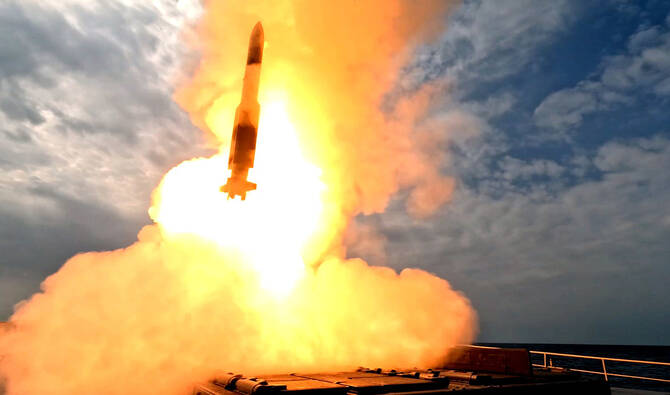

Pakistan Navy tests missile, loitering munitions and unmanned vessel at Arabian Sea

Updated 5 sec ago
Follow

Pakistan Navy tests missile, loitering munitions and unmanned vessel at Arabian Sea

  • The exercise reflects growing focus on air defense and autonomous systems in modern warfare

ISLAMABAD: Pakistan’s navy conducted live firing of a surface-to-air missile, tested loitering munitions and carried out open-sea trials of an unmanned surface vessel during a major exercise in the North Arabian Sea on Saturday, highlighting a growing focus on air defense and unmanned warfare amid evolving regional security dynamics.

The exercise, which demonstrated both conventional and autonomous capabilities, comes at a time when Pakistan is increasingly emphasizing advanced technology and multi-domain operations following last year’s four-day conflict with nuclear-armed India, which reinforced the importance of air defense, surveillance and precision strike systems.

“Pakistan Navy demonstrated its operational readiness and combat preparedness through a comprehensive exercise in the North Arabian Sea, showcasing both conventional and unmanned capabilities, as per dictates of evolving naval warfare,” the Navy’s Directorate General Public Relations said in a statement.

“The exercise included the successful live firing of LY-80(N) Surface to Air Missile (SAM) from Vertical Launching System at extended range, validating the long-range capabilities of Pakistan Navy’s modern air defense systems,” it added. “LY-80(N) SAM successfully engaged and neutralized an aerial target, demonstrating Pakistan Navy’s robust air defense capabilities.”

The statement said the exercise also featured the successful engagement of surface targets using a loitering munition, which it said demonstrated the navy’s precision strike capability.

“Successful open-sea trials of Unmanned Surface Vessel (USV) were also conducted, marking a significant leap in autonomous naval technology,” it continued. “The trials validated the platform’s ability to combine high-speed performance with mission-critical durability.”

Pakistan’s armed forces routinely hold large-scale exercises to enhance operational readiness, but recent drills have placed greater emphasis on emerging technologies, reflecting lessons drawn from modern conflicts.

Key capabilities demonstrated during the exercise included extreme maneuverability, precision navigation and weather resilience.

Chief of the Naval Staff Admiral Naveed Ashraf commended officers and men of the Pakistan Navy for their professionalism and operational competence, reiterating the navy’s resolve to ensure the seaward defense of the country and safeguard its maritime interests.