NAIROBI: Kenyan riot police fired tear gas and water cannon Monday against demonstrators joining a day of action called by the opposition to protest a punishing cost-of-living crisis.
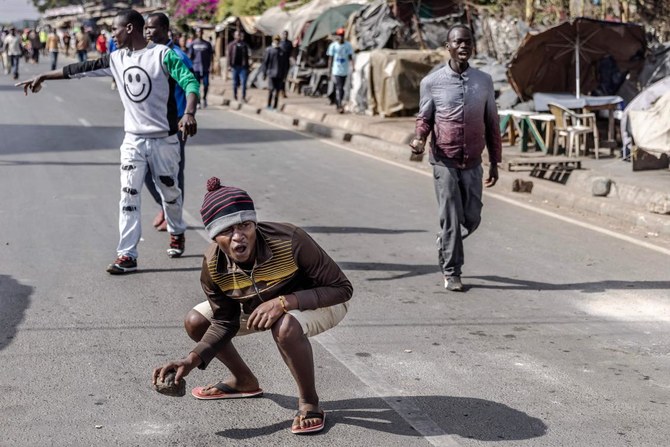
Running battles erupted between stone-throwing demonstrators and police in parts of Nairobi and at least one other city, in the first major unrest since President William Ruto became president last year, correspondents said.
Ruto’s government has vowed to take a tough stance over the protests, which opposition leader Raila Odinga insisted would go ahead despite not receiving police authorization.
“I want Kenyans to come out in large numbers and show the displeasure of what is happening in our country,” Odinga, who narrowly lost last year’s election to Ruto, told supporters on Sunday.
Police used tear gas against protesters gathered at a site near government offices in the heart of the capital Nairobi, where the major rally was scheduled to take place, and several other areas of the city.
“We came here peacefully but they tear gassed us,” said Charles Oduor, 21, who joined the large crowds in downtown Nairobi.
“They lie to us everyday. Where is the cheap maize flour they promised? Where are the jobs for the youth they promised? All they do is hire their friends.”
Kenyans are suffering from surging prices for basic necessities, as well as a sharp drop in the shilling against the US dollar and a record drought that has left millions hungry.
Odinga said he had called the rallies to protest the “skyrocketing” cost of living but also the “stolen” election last August.
In Nairobi’s biggest slum Kibera, a bastion of Odinga support, people also set tires ablaze while police used water cannon to disperse protesters.
Demonstrators and police also clashed in the lakeside city of Kisumu in western Kenya, another Odinga stronghold.
“Our victory was stolen and we are determined to get it back, we can’t sit back and watch as life becomes more difficult by the day. We want Raila in State House,” said Kevin Ojwang in Kisumu.
Nairobi police chief Adamson Bungei said on Sunday that police received requests to hold two demonstrations only late Saturday and early Sunday, when normally three days’ notice is required.
“For public safety, neither has been granted,” he said.
Interior Minister Kithure Kindiki warned on Sunday that anyone inciting public disorder or disturbing the peace would be prosecuted.
Many businesses in Nairobi were shut ahead of the demonstrations, with some employers telling their staff to work from home.
“We are here trying to fight for our rights. Life is so hard. If you see, these young men and women, we don’t have jobs, people are losing their jobs. So that’s why we’re talking about our rights,” said shoeshiner Henry Juma, 26.
Odinga, the leader of the Azimio la Umoja party, who described Monday as a “day of destiny,” continues to claim that Ruto’s August election win was fraudulent and denounces his government as illegitimate.
According to official results, Odinga — who was making his fifth bid for the presidency — lost to Ruto by around 233,000 votes, one of the slenderest margins in Kenya’s history.
The Supreme Court dismissed his appeals, with its judges giving a unanimous ruling in favor of Ruto, finding there was no evidence for Odinga’s accusations.
Ruto has declared that he would not be intimidated by the demonstrations, saying: “You are not going to threaten us with ultimatums and chaos and impunity.”
“We will not allow that,” he said, calling on Odinga to act in a “legal and constitutional manner.”


Tear gas, arrests as Kenya opposition stages protests
https://arab.news/8rshf
Tear gas, arrests as Kenya opposition stages protests

- Kenyans are suffering from surging prices for basic necessities, as well as a sharp drop in the shilling against the US dollar
- Many businesses in Nairobi were shut ahead of the demonstrations, with some employers telling their staff to work from home


‘Unofficial’ talks on plastic pollution treaty to begin in Japan
- “Plastic pollution is a planetary problem that affects everyone: every country, every community and every individual,” Cordano warned after being elected
TOKYO: Delegates from around 20 countries will hold three days of “informal” talks in Japan from Sunday aimed at salvaging efforts toward a landmark global treaty on plastic pollution.
Supposedly final talks in South Korea in 2024 toward an agreement failed, and a renewed effort in Geneva last August likewise collapsed in overtime.
A Japanese Environment Ministry official said that the “informal” closed-door meeting among “working-level officials” through Tuesday was not expected to result in any official announcement.
If we don’t take concerted action, it will get much worse in the coming decades. A treaty is urgently needed.
Julio Cordano, Chile’s chief climate negotiator
“Japan is in a position of pushing for progress on the issue, and so is hosting the meeting,” the official told AFP without wishing to be named.
She added that “little progress” has been made since August, other than the election in early February of Chile’s chief climate negotiator Julio Cordano as chairman.
“Plastic pollution is a planetary problem that affects everyone: every country, every community and every individual,” Cordano warned after being elected.
“If we don’t take concerted action, it will get much worse in the coming decades. A treaty is urgently needed,” he said.
More than 400 million tonnes of plastic are produced globally each year, with half for single-use items.
A large bloc of states wants bold action such as curbing plastic production, while a smaller clutch of oil-producing states wants to focus more narrowly on waste management.
Countries expected to be present in Tokyo include big oil producers like Saudi Arabia, Russia and the United States as well as islands states Antigua and Barbuda and Palau, plus China, India and the European Union.
The UN’s environment chief told AFP in an interview in October that a global treaty remains “totally doable.”
“No one has walked away and said, ‘this is just too hopeless, we’re giving up’,” United Nations Environment Programme executive director Inger Andersen said.


