

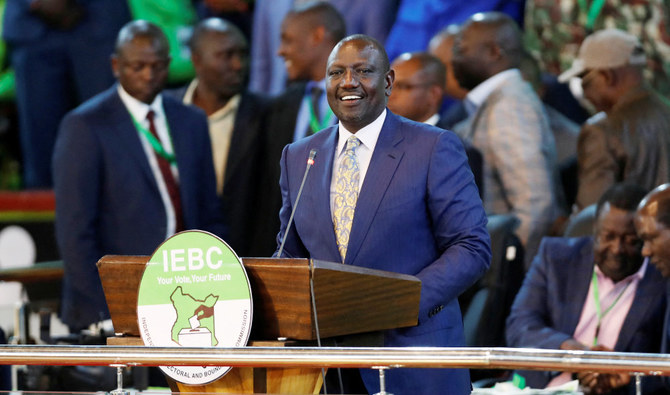

NAIROBI: William Ruto was declared the winner of Kenya’s close-fought presidential poll on a day of high drama Monday, with violent protests in his defeated rival’s strongholds, claims of rigging and a split in the commission that oversaw the vote.
As tensions ran high after his narrow victory in the August 9 race against Raila Odinga, the 55-year-old president-elect issued a conciliatory message, vowing to work with “all leaders.”
“There is no room for vengeance,” said Ruto, who will become Kenya’s fifth president since independence from Britain in 1963. “I am acutely aware that our country is at a stage where we need all hands on deck.”
The dispute will test Kenya’s stability after previous elections in the East African political and economic powerhouse were blighted by claims of rigging and vicious bouts of deadly violence.
Ruto secured 50.49 percent of the vote in his first-ever attempt at the top job, just ahead of Odinga on 48.85 percent, Independent Electoral and Boundaries Commission head Wafula Chebukati said after an anxious days-long wait for results.
He will succeed his estranged boss President Uhuru Kenyatta, 60, the son of Kenya’s first post-independence leader, who has served two terms and could not run again.
But it was yet another bruising defeat for 77-year-old Odinga, the veteran opposition leader who had hoped it would be fifth time lucky as he ran with the support of former foe Kenyatta and the weight of the ruling party machinery behind him.
Odinga was nowhere to be seen on Monday, but his party agent described the election as “shambolic,” saying it had been marred by irregularities and mismanagement.
Odinga has accused his opponents of cheating him out of victory in the 2007, 2013 and 2017 presidential elections, and analysts say it is likely he will appeal to the Supreme Court over this year’s results.
“It is not over till it is over,” Odinga’s running mate Martha Karua said on Twitter.
Chaos erupted at the IEBC’s national tallying center in Nairobi before the results were announced, with chairs hurled and scuffles between party rivals.
Four of the IEBC’s seven commissioners disowned the results, saying the process was “opaque” but without elaborating.
In Odinga’s lakeside stronghold of Kisumu, angry supporters took to the streets, hurling stones, setting fire to tires and building roadblocks, with police responding with tear gas.
“We were cheated,” Isaac Onyango, 24, said on a street sealed off by two large bonfires and broken rock.
Protests also erupted in slums in Nairobi where Odinga is popular, with police firing live rounds, although no casualties were reported.
Several African leaders offered their congratulations to Ruto, while the US embassy in Kenya reserved its plaudits instead for the people of Kenya and the IEBC.
It called on party leaders to urge their supporters to refrain from violence, and for any concerns about the election to be resolved through “existing dispute resolution mechanisms.”
The row over the results is likely however to further dent the IEBC’s reputation after it had faced stinging criticism over its handling of the 2017 election which was annulled by Kenya’s top court in a historic first for Africa.
Chebukati, who was also in charge of the IEBC in 2017, insisted he had carried out his duties according to the law of the land despite facing “intimidation and harassment.”
Despite a divisive campaign and swirling disinformation, polling day had passed off generally peacefully.
But turnout was historically low at around 65 percent of the 22 million registered voters, with disillusionment over corruption by power-hungry elites prompting many Kenyans to stay home.
Power transfers can be fraught in Kenya, and any challenge to the Supreme Court will leave the country of about 50 million people facing weeks of political uncertainty.
It is already struggling with soaring prices, a crippling drought, endemic corruption and growing disenchantment with the political elite.
Ruto, a shadowy rags-to-riches businessman, had characterised the vote as a battle between ordinary “hustlers” and the Kenyatta and Odinga “dynasties” who have dominated Kenyan politics since independence from Britain in 1963.
With memories of previous post-poll violence still fresh, Odinga and Ruto had pledged to accept the outcome of a free and fair election, and air their grievances in court rather than on the streets.
If there is no court petition, Ruto will take the oath of office in two weeks’ time.
But no presidential ballot has gone uncontested in Kenya since 2002.
Any challenge must be made within seven days to the Supreme Court. The country’s highest judicial body has a 14-day deadline to issue a ruling, and if it orders an annulment, a new vote must be held within 60 days.
In August 2017, the Supreme Court annulled the election after Odinga rejected the results that gave Kenyatta victory, with dozens of people killed by police in the protests that followed.
Kenyatta went on to win the re-run after an opposition boycott.
The worst electoral violence in Kenya’s history occurred after a disputed vote in 2007, when more than 1,100 people were killed in bloodletting between rival tribes.


