BANGKOK: Thailand’s King Maha Vajiralongkorn has endorsed a decree to dissolve parliament, according to an announcement in the Royal Gazette on Monday, paving the way for elections in May.
An election must be held 45 to 60 days after the house dissolution, which takes effect immediately.
“This is a return of political decision-making power to the people swiftly to continue democratic government with the King as head of state,” said the decree published on Monday.
An election date has yet to be announced but deputy prime minister Wissanu Krea-ngam earlier in the day said it would likely be held on May 14, if the house were dissolved on Monday.
Thailand’s election is expected to showcase a long-running political battle between the billionaire Shinawatra family and the country’s conservative pro-military establishment.
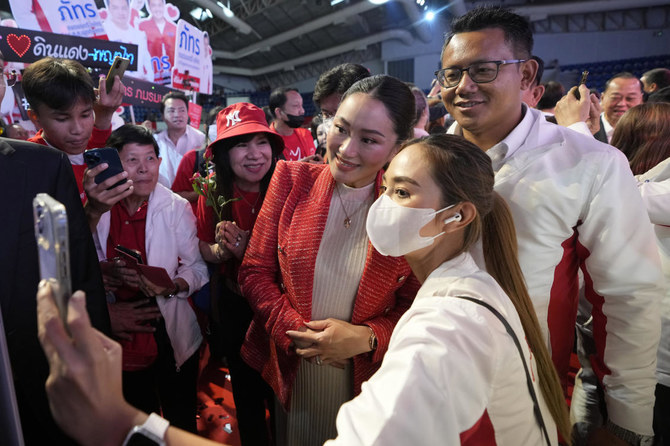
Paetongtarn Shinawatra, the daughter and niece respectively of ousted former premiers Thaksin and Yingluck Shinawatra, is the frontrunner to be prime minister in opinion surveys, with her support jumping 10 points to 38.2 percent in a poll released at the weekend.
The poll by the National Institute of Development Administration put Prime Minister Prayuth Chan-ocha, who has been in power since a 2014 coup against the Pheu Thai government, in third place with 15.65 percent.
Paetongtarn on Friday said she was confident of winning the election by a landslide, with the aim of averting any political maneuvering against her party, which has previously been removed from office by judicial rulings and military coups.


Thailand dissolves parliament for election
https://arab.news/6zkrk
Thailand dissolves parliament for election

- An election must be held 45 to 60 days after the house dissolution, which takes effect immediately


After nearly 7 weeks and many rumors, Bolivia’s ex-leader reappears in his stronghold
- Morales was Bolivia’s first Indigenous president who served from 2006 until his fraught 2019 ouster and subsequent self-exile
- He dismissed rumors fueled by local politicians and fanned by social media that he would try to flee the country
LA PAZ: Bolivia’s long-serving socialist former leader, Evo Morales, reappeared Thursday in his political stronghold of the tropics after almost seven weeks of unexplained absence, endorsing candidates for upcoming regional elections and quieting rumors he had fled the country in the wake of the US seizure of his ally, Venezuela’s ex-President Nicolás Maduro.
The weeks of hand-wringing over Morales’ fate showed how little the Andean country knows about what’s happening in the remote Chapare region, where the former president has spent the past year evading an arrest warrant on human trafficking charges, and how vulnerable it is to fears about US President Donald Trump’s potential future foreign escapades.
The media outlet of Morales’ coca-growing union, Radio Kawsachun Coca, released footage of Morales smiling in dark sunglasses as he arrived via tractor at a stadium in the central Bolivian town of Chimoré to address his supporters.
Morales, Bolivia’s first Indigenous president who served from 2006 until his fraught 2019 ouster and subsequent self-exile, explained that he had come down with chikungunya, a mosquito-borne ailment with no treatment that causes fever and severe joint pain, and suffered complications that “caught me by surprise.”
“Take care of yourselves against chikungunya — it is serious,” the 66-year-old Morales said, appearing markedly more frail than in past appearances.
He dismissed rumors fueled by local politicians and fanned by social media that he would try to flee the country, vowing to remain in Bolivia despite the threat of arrest under conservative President Rodrigo Paz, whose election last October ended nearly two decades of rule by Morales’ Movement Toward Socialism party.
“Some media said, ‘Evo is going to leave, Evo is going to flee.’ I said clearly: I am not going to leave. I will stay with the people to defend the homeland,” he said.
Paz’s revival of diplomatic ties with the US and recent efforts to bring back the Drug Enforcement Administration — some 17 years after Morales expelled American anti-drug agents from the Andean country while cozying up to China, Russia, Cuba and Iran — have rattled the coca-growing region that serves as Morales’ bastion of support.
Paz on Thursday confirmed that he would meet Trump in Miami on March 7 for a summit convening politically aligned Latin American leaders as the Trump administration seeks to counter Chinese influence and assert US dominance in the region.
Before proclaiming the candidates he would endorse in Bolivia’s municipal and regional elections next month, Morales launched into a lengthy speech reminiscent of his once-frequent diatribes against US imperialism.
“This is geopolitical propaganda on an international scale,” he said of Trump’s bid to revive the Monroe Doctrine from 1823 in order to reassert American dominance in the Western Hemisphere. “They want to eliminate every left-wing party in Latin America.”