SEOUL: North Korean leader Kim Jong Un led two days of military drills “simulating a nuclear counterattack,” including the launch of a ballistic missile, state media reported Monday.
Kim expressed satisfaction over the weekend drills, which were held to “let relevant units get familiar with the procedures and processes for implementing their tactical nuclear attack missions,” said the report by the official Korean Central News Agency (KCNA).
The drills were the fourth show of force from Pyongyang in a week and came during Freedom Shield, the biggest US-South Korea military exercise in five years.
North Korea views all such exercises as rehearsals for invasion and has repeatedly warned it would take “overwhelming” action in response.
The weekend drills in North Korea were divided into exercises simulating the shift to a nuclear counterattack posture and a drill for “launching a tactical ballistic missile tipped with a mock nuclear warhead,” KCNA said.
South Korea’s Joint Chiefs of Staff said Sunday that the short-range ballistic missile flew 800 kilometers (500 miles) before landing in the East Sea, also known as the Sea of Japan.
They branded it a “serious provocation” that violated United Nations sanctions.
Kim said the weekend drills had filled the North Korean military units “with great confidence,” according to KCNA.
He also noted that North Korea “cannot actually deter a war with the mere fact that it is a nuclear weapons state,” and that it could only reach its goals “when the nuclear force is... actually capable of mounting an attack on the enemy.”
Yang Uk, a researcher at the Asan Institute for Policy Studies, said the weekend drills demonstrated that North Korea’s nuclear posture was becoming “a little more realistic.”
“It seems North Korea is trying to show it possesses enough practical nuclear attack capabilities to conduct comprehensive tactical trainings for its frontline units,” he said.
Seoul and Washington have ramped up defense cooperation in the face of growing military and nuclear threats from Pyongyang, which has conducted a series of banned weapons tests in recent months.
It has also pushed South Korea and Japan to mend fences over historical disputes and try to boost security cooperation.
On Thursday, North Korea test-fired its largest and most powerful intercontinental ballistic missile, the Hwasong-17, its second ICBM test this year.
That followed two short-range ballistic missiles on Tuesday and two strategic cruise missiles fired from a submarine last Sunday.
The UN Security Council is expected to hold an emergency meeting on Monday over the ICBM launch at the request of the United States and Japan, South Korea’s Yonhap news agency reported.
North Korea’s nuclear claims cannot be taken at face value, said Leif Easley, a professor at Ewha University in Seoul.
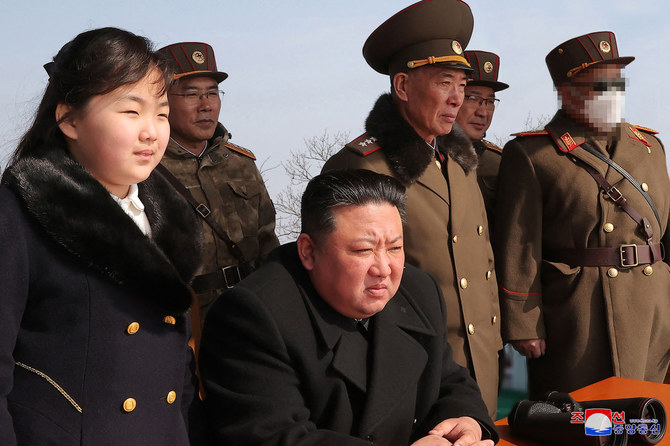
Photos published by North Korean state media showed Kim and his young daughter surrounded by uniformed officers watching the ICBM launch.
“If these firing drills were practice for real conflict, the leader would not be in the field with his daughter, posing with missiles for the cameras,” Easley told AFP.
Analysts previously said North Korea would likely use the US-South Korea drills as an excuse to carry out more missile launches and perhaps even a nuclear test.
This is turning the Korean peninsula into “a flashpoint with higher potential for a nuclear war,” said Lim Eul-chul, a professor at Kyungnam University’s Institute for Far Eastern Studies.
“As the intensity of the South Korea-US exercises increases, the possibility of unforeseen situations increases, and as a result, mutual physical clashes may occur,” he added.
Last year, North Korea declared itself an “irreversible” nuclear power and Kim recently called for an exponential increase in weapons production, including tactical nuclear weapons.


![]()

North Korea’s Kim leads ‘nuclear counterattack’ simulation drill
Short Url
https://arab.news/j6xsu
North Korea’s Kim leads ‘nuclear counterattack’ simulation drill
- The drills were the fourth show of force from Pyongyang in a week
- North Korea views all such exercises as rehearsals for invasion


Latest updates


Recommended


© 2026 SAUDI RESEARCH & PUBLISHING COMPANY, All Rights Reserved And subject to Terms of Use Agreement.