

WHO, advisers urge China to release all COVID-related data after new research

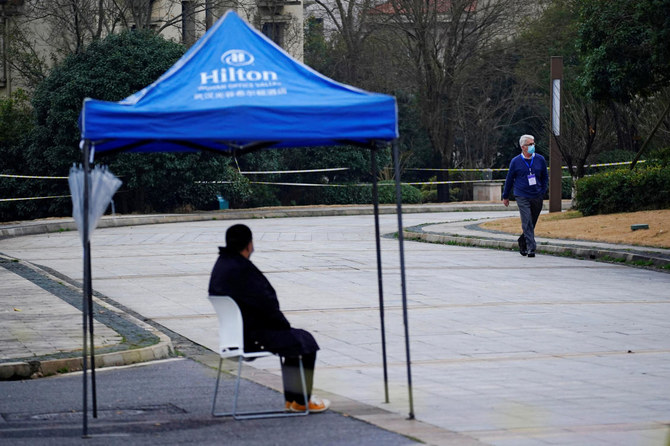
Dominic Dwyer, a member of the WHO team tasked with investigating the origins of the coronavirus disease, walks at their hotel in Wuhan, Hubei province, China. (File/Reuters)
Short Url
Updated 19 March 2023
Follow

WHO, advisers urge China to release all COVID-related data after new research

  • WHO officials say such information represents a new lead into the investigation of COVID’s origins

LONDON: Advisers to the World Health Organization have urged China to release all information related to the origin of the COVID-19 pandemic after new findings were briefly shared on an international database used to track pathogens.
New sequences of the SARS-CoV-2 virus, as well as additional genomic data based on samples taken from a live animal market in Wuhan, China in 2020 were briefly uploaded to the open access GISAID database by Chinese scientists earlier this year, allowing them to be viewed by researchers in other countries, according to a Saturday statement from the WHO’s Scientific Advisory Group for the Origins of Novel Pathogens (SAGO).
The sequences suggested that raccoon dogs were present in the market and may have also been infected by the coronavirus, providing a new clue in the chain of transmission that eventually reached humans, according to the WHO.
Access to the information was subsequently restricted “apparently to allow further data updates” by the Chinese Center for Disease Control and Prevention (CDC), the statement added.
WHO officials discussed the matter with Chinese colleagues, who explained that the new data were intended to be used to update a preprint study from 2022. China’s CDC plans to re-submit the paper to the scientific journal Nature for publication, according to the statement.
WHO officials say such information, while not conclusive, represents a new lead into the investigation of COVID’s origins and should have been shared immediately.
“These data do not provide a definitive answer to the question of how the pandemic began, but every piece of data is important in moving us closer to that answer,” WHO Director-General Tedros Adhanom Ghebreyesus said on Friday. “These data could have – and should have – been shared three years ago.”
“We continue to call on China to be transparent in sharing data, and to conduct the necessary investigations and share the results,” he said.
SAGO was tasked by the WHO to continue to investigate the origins of the pandemic that has killed nearly 7 million people worldwide.
The Chinese CDC did not immediately respond to the WHO’s latest statement.

’TOO EARLY’ FOR CONCLUSION
When asked by Reuters why the sequences were not uploaded before, George Gao, professor at the Institute of Microbiology at the Chinese Academy of Sciences and former head of the Chinese CDC, said the data uploaded were “nothing new.”
He added that GISAID, the Munich-based pathogen database, took down the sequences, not the Chinese scientists, and that he was in contact with WHO.
It’s “too early for any conclusion,” he added in an emailed statement. “All this must be left for scientists to work on, NOT for journalists or public. We are eager to know the answer.”
A spokesperson for GISAID said it does not take down data. They said the sequences had been “recalled” and “are currently being updated with newer and additional data as part of a manuscript currently under review”.
The Huanan Seafood Wholesale Market in Wuhan was shut down by Chinese authorities after the novel coronavirus emerged in the city in late 2019. The market has since been a focus of study of whether the virus had infected several other species before jumping to humans.
The WHO and other scientists have also said they cannot rule out the possibility that the virus emerged from a high-security laboratory in Wuhan that studies dangerous pathogens. China denies any such link.
The 2022 preprint paper said that a small portion of 923 samples collected from the stalls and sewage systems in and around the market tested positive for the virus; no virus was detected in 457 animal samples tested. The paper said initially that raccoon dogs were not among the animals tested.
The new analysis suggests “that raccoon dog and other animals may have been present before the market was cleaned as part of the public health intervention,” the SAGO statement said.


Russia puts death toll from Ukrainian strike on occupied village at 27. Kyiv rejects accusation

Updated 7 sec ago
Follow

Russia puts death toll from Ukrainian strike on occupied village at 27. Kyiv rejects accusation

Russian authorities said Friday that the death toll from a Ukrainian drone strike they said struck a café in a Russian-occupied village in Ukraine’s Kherson region rose to 27 people. Kyiv denied attacking civilian targets.
Svetlana Petrenko, spokeswoman of Russia’s main criminal investigation agency, the Investigative Committee, said in a statement that a Ukrainian drone strike on a café and hotel in the village of Khorly, where at least 100 civilians were celebrating New Year’s Eve overnight into Thursday, killed 27 people, including two minors. A total of 31, including five minors, were hospitalized with injuries.
A criminal probe on the charges of carrying out an act of terrorism has been opened, Petrenko said.
Kyiv denied attacking civilians. Spokesman of Ukraine’s General Staff, Dmytro Lykhovii, told Ukraine’s public broadcaster Suspilne on Thursday that Ukrainian forces “adhere to the norms of international humanitarian law” and “carry out strikes exclusively against Russian military targets, facilities of the Russian fuel and energy sector, and other lawful targets.”
Lykhovii said that General Staff has published an explicit list of targets that the Ukrainian army struck on the night of New Year’s Eve. The list did not include strikes on occupied parts of the Kherson region.
Lykhovii noted that Russia has repeatedly used disinformation and false statements to disrupt the ongoing peace negotiations.
The Associated Press could not independently verify claims made about the attack.
Russia’s accusations against Ukraine come amid a US-led diplomatic push to end the nearly four-year war in Ukraine. Earlier this week, Moscow alleged that Kyiv launched a long-range drone attack against a residence of Russian President Vladimir Putin in northwestern Russia overnight from Sunday to Monday.
Kyiv has called the allegations of an attack on Putin’s residence a ruse to derail ongoing peace negotiations, which have ramped up in recent weeks on both sides of the Atlantic.
In his New Year’s address, Ukrainian President Volodymyr Zelensky said that a peace deal was “90 percent ready” but warned that the remaining 10 percent, believed to include key sticking points such as territory, would “determine the fate of peace, the fate of Ukraine and Europe, how people will live.”
Trump’s special envoy Steve Witkoff said Wednesday that he, Secretary of State Marco Rubio and Trump’s son-in-law and adviser Jared Kushner had a “productive call” with the national security advisers of Britain, France, Germany and Ukraine “to discuss advancing the next steps in the European peace process.”
Elsewhere in Ukraine, Russia conducted what local authorities called “one of the most massive” drone attacks at Zaporizhzhia overnight.
At least nine Russian drones struck the city, damaging dozens of residential buildings and other civilian infrastructure, head of the regional administration, Ivan Fedorov, wrote on Telegram on Friday. There were no casualties, the official said.
Overall, Russia fired 116 long-range drones at Ukraine last night, according to Ukraine’s Air Force, which said that 86 drones were intercepted, while 27 more have reached their targets.
The Russian Defense Ministry reported Friday that its air defenses intercepted 64 Ukrainian drones overnight over multiple Russian regions.
Vyacheslav Gladkov, governor of Russia’s Belgorod region on the border with Ukraine, on Friday also accused Ukrainian forces of carrying out a missile strike on the city of Belgorod. Two women were hospitalized with injuries, Gladkov said. The strike shattered windows in multiple residential buildings and damaged an unspecified “commercial” facility and a number of cars, according to the official.