

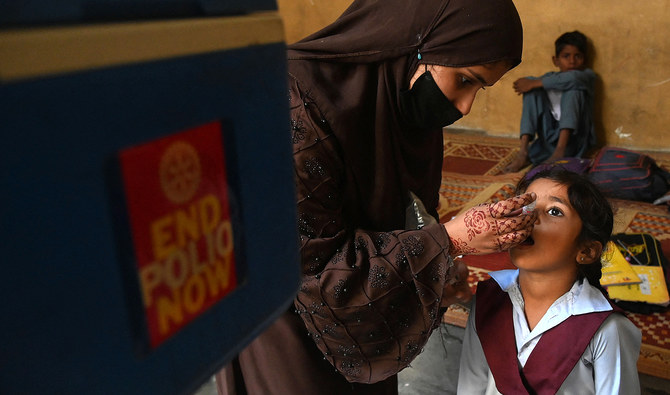

ISLAMABAD: The French Development Agency (AFD) on Sunday pledged $55 million to support Pakistan’s efforts to eradicate polio, a statement by the public agency said.
Polio is a highly infectious disease that is caused by the poliovirus, mainly affecting children under the age of five years. It invades the nervous system, and can cause paralysis or even death.
Pakistan reported its first poliovirus case on Friday as the FDA and Bill and Melinda Gates Foundation representatives were in the South Asian country on a week-long visit to analyze its polio eradication efforts.
On Friday, Pakistan reported its first polio case of the year when a three-year-old child from the northwestern Khyber Pakhtunkhwa (KP) province contracted polio. Pakistan and Afghanistan remain the only two countries in the world where the virus is still endemic.
In 2022, Pakistan reported 20 cases of polio, all of them in the KP province. Seventeen cases of the virus were reported in the North Waziristan district while Lakki Marwat and South Waziristan reported one each.
A delegation of the Bill and Melinda Gates Foundation and the AFD met special health secretary at the National Emergency Operations Center (NEOC) in Islamabad to discuss polio eradication efforts, the AFD said.
The AFD committed to supporting the Pakistan Polio Eradication Initiative (PEI) in immunization activities, disease surveillance, polio campaign monitoring and other technical areas, and filling the funding gap of $55 million (under the PC-1 for polio eradication, 2022-2026), the agency confirmed.
“We are very grateful to the French Government for this support,” NEOC Coordinator Dr. Shahzad Baig said. “The Pakistan Polio Eradication Programme is a vital part of our health care system and investing in polio is an investment in the country’s overall health system.”
Pakistan’s anti-polio campaigns are regularly marked by violence as militants often target polio teams and police protecting them, falsely claiming that the vaccination campaigns are a Western conspiracy to sterilize children.
Pakistan launched the first of its two-stage phases to vaccinate over 21.54 million children against polio on March 13. The second phase will be held from April 3 till April 7 – during the second week of Ramadan – to vaccinate more than 4.12 million children in 12 districts of Balochistan.
Meanwhile, 26 districts of Khyber Pakhtunkhwa, including the seven “endemic districts” in the southern region of the province, will also be targeted in the second phase of the campaign.


