

Anger as UK officials tell fleeing Afghans to get forms approved by Taliban

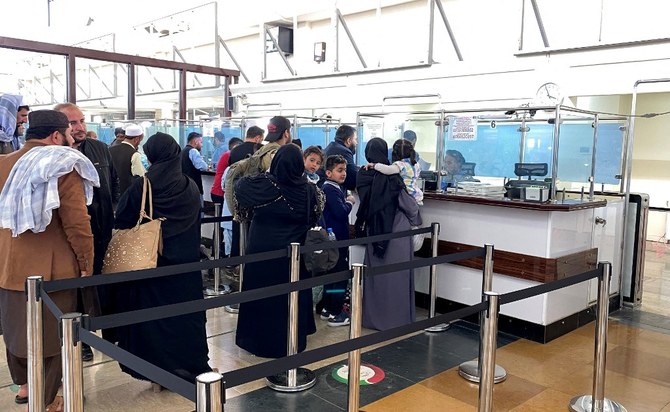
A group of Afghan athletes and their family members wait to board a flight. (File/AFP)
Short Url
Updated 19 March 2023
Follow

Anger as UK officials tell fleeing Afghans to get forms approved by Taliban

  • Relocations scheme approvals dropped dramatically in final months of 2022 after requirements became more stringent
  • Labour MP claims requirements will force people in hiding to ‘sign their own death warrant’ in bid to leave country

LONDON: UK officials have told Afghans hiding from the Taliban they will need documentation approved by the regime in Kabul to travel to Britain, an investigation by the Independent has found.

Thousands of people are currently awaiting the chance to leave the country under the UK’s Afghan Relocations and Assistance Policy scheme, but campaigners say the policy of requiring approved papers asks them to “sign their own death warrant.”

The ARAP scheme was established after the fall of Kabul to the Taliban in August 2021, and is meant to provide safe passage and relocation for Afghans who worked with British forces and authorities in the country, as well as their families.

So far, 11,200 people have traveled to the UK under the scheme, but those numbers have dropped dramatically over time, down from 6,200 approved applications between July and September 2021 to just 743 in the last quarter of 2022.

The UK Ministry of Defence has apologized after the Independent uncovered multiple examples of ARAP applicants being asked to provide Taliban-approved documentation, including birth and marriage certificates, which also need to be translated into English.

One former interpreter who worked with British forces in Afghanistan was told to get his forms approved by the country’s Ministry of Foreign Affairs while he and his family were in hiding.

In an email sent to ARAP applicants, UK officials said: “We understand that some of you may have received communications from ARAP telling you to visit the local authorities or Ministry of Foreign Affairs to obtain new documentation for your relocation to the UK.

“If you received one of these messages, this was incorrect, and we apologise for any misunderstanding or distress caused by this message.”

The MoD has estimated there to be around 4,600 people eligible for the ARAP scheme currently stuck in Afghanistan.

A previous military scheme for evacuating Afghans after the collapse of the government in August 2021, Operation Pitting, told people to provide documentation “if you have them,” but campaigners say the MoD has strengthened its requirements for the ARAP scheme.

The requirements that papers and certificates be provided in English is a particular issue, as that is not standard practise in Afghanistan, meaning any such document needs to go through the Ministry of Foreign Affairs — potentially alerting the Taliban to the whereabouts of people in hiding or their intentions to flee.

Dr. Sara de Jong, co-founder of the Sulha Alliance charity, said the requirements by the UK government highlighted a lack of understanding about the situation in Afghanistan, adding that the Taliban had “pretty much stopped” issuing children’s passports, making it harder for families to travel.

Sarah Fenby, from the non-governmental organization Global Witness, told the Independent: “The fact that Afghan interpreters, who risked their lives for the UK’s mission in Afghanistan, are still left behind, despite gaining eligibility under ARAP, is shameful. They are hiding, afraid, and unable to work to feed their children.

“The fact that they are then being asked, by ARAP, to take their documents to Taliban-controlled ministries to have them validated is completely unacceptable.”

British Member of Parliament Tobias Ellwood, chair of the House of Commons’ defence select committee, said: “We need to ensure our offers of protection are not compromised. We must do the right thing.”

Dan Jarvis MP, who served as a soldier in Afghanistan, said: “Asking our Afghan allies to have their papers approved by the Taliban Ministry of Foreign Affairs is like asking them to sign their own death warrant.

“These requests by the UK government show a complete disregard to the grave realities eligible Afghans face, pushing desperate men into perilous situations.”

His Labour colleague John Healey, the party’s shadow defence secretary, said: “Britain has a moral duty to assist and protect them. Ministers urgently need to fix the ARAP scheme – and speed up applications and relocations.”


US moves to counter China in Bangladesh, plans to pitch defense alternatives

Updated 3 sec ago
Follow

US moves to counter China in Bangladesh, plans to pitch defense alternatives

DHAKA: The United States is concerned about China’s ​expanding presence in South Asia and is planning to offer Bangladesh’s next government US and allied defense systems as alternatives to Chinese hardware, Washington’s ambassador to Dhaka told Reuters. Bangladesh votes in a general election on Thursday after a Gen Z-led uprising toppled India-allied premier Sheikh Hasina in August 2024. She has since taken refuge in New Delhi, allowing China to deepen its influence in Bangladesh as India’s presence wanes. China recently signed a defense agreement with Bangladesh to build a drone factory near the India border, worrying foreign diplomats. Bangladesh is also in talks with Pakistan to buy JF-17 Thunder fighter jets, a multi-role combat ‌aircraft jointly developed with ‌China.
“The United States is concerned about growing Chinese influence in South ​Asia ‌and ⁠is committed ​to ⁠working closely with the Bangladeshi government to clearly communicate the risks of certain types of engagement with China,” US Ambassador Brent T. Christensen said in an interview on Tuesday.
“The US offers a range of options to help Bangladesh meet its military capability needs, including US systems and those from allied partners, to provide alternatives to Chinese systems,” he said without offering further details.
The Chinese foreign ministry did not immediately respond to a request for comment.
Christensen also said that President Donald Trump’s administration would “like to see a good relationship between Bangladesh and India ⁠to support stability in the region.” New Delhi-Dhaka relations have nosedived since ‌Hasina fled, badly affecting visa services and cricket ties between the ‌two neighbors.

COMMERCIAL DIPLOMACY IS PRIORITY
Christensen said many US businesses were looking ​at potentially investing in Bangladesh but would want ‌the next government to show early and clear signs that it is “open for business.”
“Commercial diplomacy is one ‌of our top priorities, and we look forward to working with the new government to build on progress made with the interim government, particularly in strengthening commercial, economic, and security ties,” he said.
Energy producer Chevron has been in Bangladesh for decades but not many other US companies are visible in the densely populated country of 175 million people, ‌as high taxes and difficulties repatriating profits have created some hurdles.
There are no Starbucks or McDonald’s outlets in Bangladesh.
The envoy said Washington would ⁠work with “whichever government is elected ⁠by the Bangladeshi people.” The race is between two coalitions led by former allies, the Bangladesh Nationalist Party (BNP) and the Islamist Jamaat-e-Islami, with opinion polls suggesting the BNP holds an advantage.

AID FOR ROHINGYA REFUGEES
Regarding the 1.2 million Rohingya refugees sheltered in Bangladesh, the ambassador said the United States remained the largest contributor to humanitarian operations.
“The US remains the largest contributor to the Rohingya refugee response and continues robust health programming in Bangladesh,” he said, noting a recent $2 billion worldwide funding framework signed with the United Nations to improve the effectiveness of such assistance, including in Bangladesh.
He urged other international donors to take on a greater share of the burden.
“The US cannot sustain the bulk of the effort alone. International partners need to increase their support for the Rohingya response,” he said. In recent years, the UN refugee agency has ​been struggling to raise sufficient funds to support ​the Rohingya community, leading to cuts in their rations and the closure of some schools for them.