

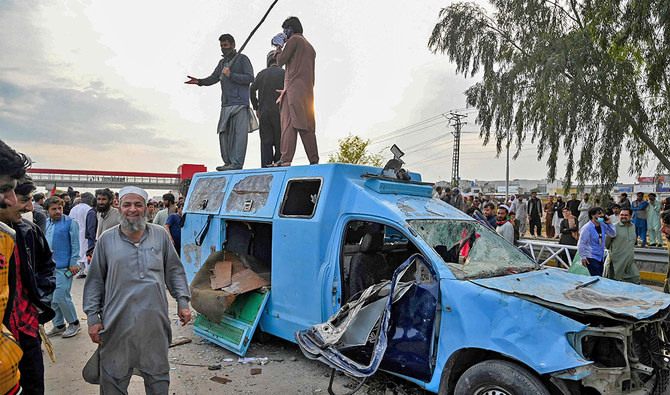

ISLAMABAD: Pakistan Prime Minister Shehbaz Sharif on Saturday said former premier Imran Khan’s recent antics had laid bare his “fascist & militant tendencies,” following fresh clashes between Khan supporters and police outside a district court in Islamabad.
Khan was scheduled to be indicted in a case involving the sale of state gifts, commonly known as the Toshakhana reference, but the court had to adjourn the proceedings after clashes broke out between his supporters and law enforcement personnel outside the Judicial Complex on Saturday evening. The court also cancelled Khan's arrest warrants issued earlier.
This was the second time in a week that Khan supporters clashed with law enforcers in a bid to keep them from arresting the former prime minister. The clashes first erupted in Lahore on Tuesday, leaving scores injured on both sides.
“If anyone had any doubt, Imran Niazi’s antics of the last few days have laid bare his fascist & militant tendencies,” PM Sharif said on Twitter.
The Pakistan prime minister likened the former premier’s defiant tactics to the Rashtriya Swayamsevak Sangh, a far-right Hindu paramilitary volunteer organization in India.
“From using people as human shields to throwing petrol bombs at police to leading ‘jathas’ to intimidate judiciary, he has taken a leaf out of the RSS book,” he said.
Khan, who was ousted in a parliamentary no-trust vote in April last year, has been leading nationwide protests and pressing for early national elections that are otherwise scheduled to be held by October this year.
The former premier faces a slew of cases across the country, with charges ranging against him from murder to terrorism and sedition, which carries a death penalty.

Men walk past a burning police vehicle during clashes between the supporters of former Pakistani Prime Minister Imran Khan and police in Islamabad, Pakistan, on March 18, 2023. (REUTERS)
On Saturday, police also stormed Khan’s residence in the eastern city of Lahore and arrested 61 people amid tear gas and clashes between Khan’s supporters and police.
The police broke open the main door of the former prime minister’s residence where they said “illegal structures” had been erected to shelter those who had been involved in attacks on law enforcement personnel. The raid came at a time when Khan was on his way to Islamabad to appear before the district court.
Khan’s party said it would file a contempt case against top Punjab police officials after they raided the residence of its leader in Lahore.
“We will file a contempt of court case against Punjab’s inspector-general (IG) of police for violating the court order,” he said, adding that the top police official launched the raid at the behest of the government.
Earlier in the day, Pakistan’s Interior Minister Rana Sanaullah said that the operation to clear a “no-go” area around Khan’s residence was carried out by Punjab’s caretaker government and the police in view of the “violent situation there.”
“All the terrorists present there had been arrested, and a case has been filed against them,” Sanaullah told Pakistan’s Geo News channel.
“A case will be registered against some people today too. The arms, petrol bombs, bomb-making equipment, and other things have been recovered from there, and you will see it in a bit. So, Imran Khan, and some senior journalists who had been managing the matter, a case will be filed against them and against the violent people arrested from there.”


