Millions of dead fish wash up amid heat wave in Australia

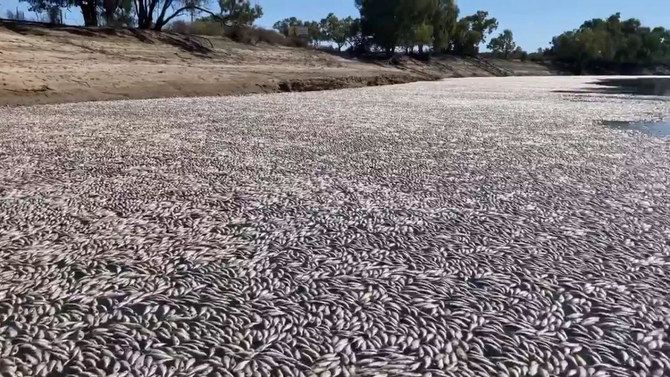
This image grab from a video taken on March 17, 2023 courtesy of Graeme McCrabb shows dead fish clogging a river near the town of Menindee in New South Wales. (AFP)
Short Url
Updated 18 March 2023
Follow

Millions of dead fish wash up amid heat wave in Australia

  • The deaths were likely caused by low oxygen levels as floods recede
  • Nature photographer Geoff Looney found huge clusters of dead fish near the main weir in Menindee

CANBERRA, Australia: Millions of fish have washed up dead in southeastern Australia in what authorities and scientists say is caused by floods and hot weather.
The Department of Primary Industries in New South Wales state said the fish deaths coincided with a heat wave that put stress on a system that has experienced extreme conditions from wide-scale flooding.
The deaths were likely caused by low oxygen levels as floods recede, a situation made worse by fish needing more oxygen because of the warmer weather, the department said.
Residents of the Outback town of Menindee complained of a terrible smell from the dead fish.
“We’ve just sort of started to clean up, and then this has happened, and that’s sort of you’re walking around in a dried-up mess and then you’re smelling this putrid smell. It’s a terrible smell and horrible to see all those dead fish,” said Jan Dening, a local.
Nature photographer Geoff Looney found huge clusters of dead fish near the main weir in Menindee on Thursday evening.
“The stink was terrible. I nearly had to put a mask on,” Looney said. “I was worried about my own health. That water right in the top comes down to our pumping station for the town. People north of Menindee say there’s cod and perch floating down the river everywhere.”
Mass kills have been reported on the Darling-Baaka River in recent weeks. Tens of thousands of fish were found at the same spot in late February, while there have been several reports of dead fish downstream toward Pooncarie, near the borders of South Australia and Victoria states.
Enormous fish kills occurred on the river at Menindee during severe drought conditions in late 2018 and early 2019, with locals estimating millions of deaths.


Philippines, US, Japanese planes drill over Bashi Channel

Updated 5 sec ago
Follow

Philippines, US, Japanese planes drill over Bashi Channel

  • Aircraft from the three nations patrolled over the Philippines’ northernmost Batanes islands in drills aimed at showcasing their “ability to operate seamlessly together in complex maritime environments,” the Philippine military said in a statement

MANILA: The Philippine, US and Japanese militaries conducted joint exercises this week over the Bashi Channel that separates the Philippines from Taiwan, officials said Friday.

Aircraft from the three nations patrolled over the Philippines’ northernmost Batanes islands in drills aimed at showcasing their “ability to operate seamlessly together in complex maritime environments,” the Philippine military said in a statement.

It marks the first time that so-called Multilateral Maritime Cooperative Activities involving the countries have expanded beyond the South China Sea, where the Philippines and China have engaged in repeated clashes over disputed territory.

Little more than 100 km separates the Philippines and self-ruled Taiwan, which China views as its territory and has not ruled out taking by force.

“Air operations were conducted within airspace over Philippine territory and its territorial sea, north of Luzon,” the Philippine military said in a statement, adding naval vessels had stayed west of the Batanes island chain.

Armed forces public affairs chief Colonel Xerxes Trinidad said it was the “first time” MMCA operations had been conducted in the “said operational box.”

The military’s statement said that box extended “up to the northern tip of Luzon, particularly Mavulis Island,” which hosts small Philippine navy and marine detachments.

China’s military reacted angrily to the drills on Friday.

“The Philippines co-opted countries outside the region to organise the so-called joint patrols, disrupting peace and stability in the region,” said Zhai Shichen, spokesperson for the PLA’s Southern Theater Command.

He added that China had conducted a “routine patrol” of the South China Sea from Feb. 23 to 26.

In November, Japanese Prime Minister Sanae Takaichi sent relations with Beijing into a tailspin by suggesting that Tokyo could intervene militarily in any attack on Taiwan.

Beijing imposed export restrictions and warned its citizens against visiting Japan, while accusing Tokyo of attempting to “revive militarism.”

Japan’s defense minister upped the ante by saying on Tuesday that Tokyo planned to deploy surface-to-air missiles on one of its remote western islands located near Taiwan by early 2031.

In August, Philippine President Ferdinand Marcos warned that the Philippines would be dragged “kicking and screaming” into any war over Taiwan.

“I hope it doesn’t happen ... But if it does, we have to plan for it already,” he said, citing the large numbers of Filipinos working in Taiwan.

The Philippine-US-Japanese exercise took place over six days and concluded on Thursday. It included a live-fire gunnery exercise conducted by the guided missile frigate BRP Antonio Luna.