

New Delhi wants better relations with Pakistan — Indian deputy high commissioner 

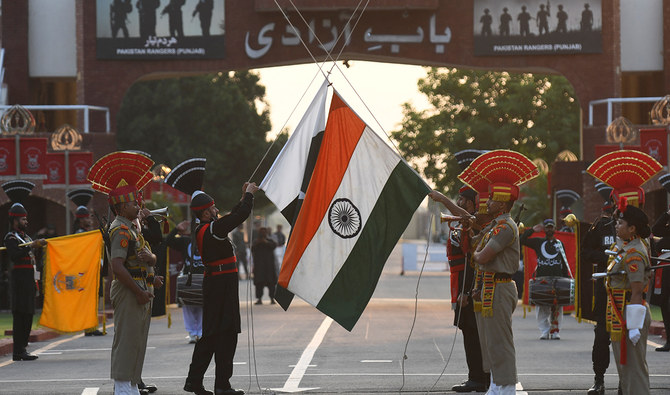
Indian Border Security Force (BSF) personnel and Pakistani Rangers (in black) lower their respective flag during the daily beating retreat at the India-Pakistan Wagah Post some 35 Km from Amritsar on September 17, 2021. (AFP/FILE)
Short Url
Updated 18 March 2023
Follow

New Delhi wants better relations with Pakistan — Indian deputy high commissioner 

  • Suresh Kumar says Central Asia was a big market and India needed access to it and vice versa 
  • Pakistan suspended bilateral relations with India after it revoked the Kashmir autonomy in 2019 

ISLAMABAD: New Delhi wants to have better relations, including trade ties, with Pakistan, the Indian deputy high commissioner (DHC) said on Friday, adding the two countries could not “change geography.” 

Relations between the bitter rivals hit a new low on August 5, 2019, after New Delhi revoked Kashmir’s special status, taking away the territory’s autonomy and dividing it into three federally administered territories. Pakistan, as a result of India’s move, closed its airspaces and suspended bilateral ties with India. 

The statement by the Indian HC for improvement of ties came at an event hosted by the Lahore Chamber of Commerce and Industry (LCCI) in the eastern Pakistani city on Friday. 

“India always wants better relations with Pakistan because we cannot change geography,” the LCCI quoted Indian DHC Suresh Kumar as saying at the event. 

“The two countries have always been neighbors. It would be better to see how we can change our problems and situations. We want to move toward normal relations.” 

Kumar also spoke about transit trade between the two countries and said its volume was “far below the potential” at present. 

“India has never stopped trade between the two countries but trade was closed by Pakistan,” he said. “The two countries are still doing trade but the volume is far below the potential.” 

The diplomat stressed the significance of transit trade, saying Central Asia was a big market and India needed access to it and vice versa. He noted that startups were rapidly growing in India and the country ranked third on the list of eco-startup countries. 

“Traditionally, we were in the service sector. If we can do all these things then Pakistan can also do it,” he said. 

“The importance of geo-economics cannot be denied. GT Road runs from India to Kabul. Connectivity is very important. We desperately need to work on it.” 

Since gaining independence from the British in 1947, nuclear-armed India and Pakistan have fought three wars, mainly over the Muslim-majority Himalayan region of Kashmir. 

The disputed region remains a bone of contention between the two neighbors and a de-facto border dividing it is often a site of skirmishes between the two militaries. 


Pakistan says ‘national security is non-negotiable’ after Afghanistan strikes

Updated 6 sec ago
Follow

Pakistan says ‘national security is non-negotiable’ after Afghanistan strikes

  • Islamabad says recent cross-border strikes targeted Afghanistan-based militants behind recent attacks
  • Kabul has condemned strikes, accused Pakistan of violating territorial sovereignty and killing civilians

ISLAMABAD: Pakistan’s Parliamentary Secretary for Information and Broadcasting Danyal Chaudhry said on Monday “national security is non-negotiable,” defending Islamabad’s recent cross-border strikes inside Afghanistan following a number of recent militant attacks.

The remarks come after Pakistan said it launched “intelligence-based selective targeting” of seven militant camps along the Afghan border in response to a mosque bombing in Islamabad and violence in the northwestern border districts of Bajaur and Bannu, among other attacks. Authorities say many of the assaults have been carried out by the Tehreek-e-Taliban Pakistan (TTP) and allied groups that Islamabad alleges are operating from sanctuaries in Afghanistan, whose government denies this.

Kabul has condemned Sunday’s strikes as a violation of its sovereignty and claimed civilians were killed. Pakistan has not responded to that allegation.

Tensions between the two neighbors have escalated sharply despite a fragile ceasefire agreed after deadly clashes in October. 

“Pakistan has always chosen the path of dialogue and peaceful coexistence. But when Afghan soil continues to be used for proxy attacks, we have no choice but to defend our homeland. National security is non-negotiable,” Chaudhry said in a statement.

He said the recent operation had “successfully neutralized militants involved in attacks on Pakistani soil,” adding that “every precaution was taken to protect innocent lives.”

Pakistan has repeatedly accused Afghanistan’s Taliban rulers of allowing TTP militants and fighters linked to the Islamic State Khorasan Province (ISKP), the regional affiliate of the Daesh group, to operate from Afghan territory, claims Kabul denies.

Chaudhry referred to a recent United Nations report, saying militants from 21 countries were now operating from Afghan territory and posed a threat to regional stability.

Afghanistan’s defense ministry earlier condemned what it called a breach of international law and vowed a “measured response at a suitable time.” Its foreign ministry summoned Pakistan’s ambassador over what it described as violations of Afghan airspace.

Islamabad has also accused neighboring India of backing anti-Pakistan militant groups, a charge New Delhi has consistently denied.

The latest exchange has raised concerns of renewed instability along the 2,600-kilometer frontier, where repeated border closures have disrupted trade and strained diplomatic ties. Analysts say the escalation risks undoing recent efforts at de-escalation, including the Saudi-mediated release of three Pakistani soldiers earlier this month.