

Inaugural AlUla Camel Cup is ‘special,’ says Swizz Beatz

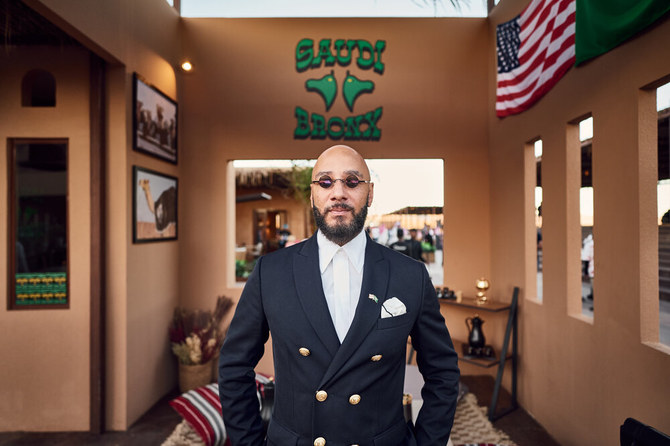
Grammy-award winning record producer Swizz Beatz has praised the inaugural AlUla Camel Cup as “special” and expressed his delight at being a part of AlUla’s growth. (Supplied)
Short Url
Updated 18 March 2023
Follow

Inaugural AlUla Camel Cup is ‘special,’ says Swizz Beatz

  • Grammy winner on hand to see Saudi Bronx team in action
  • First American to own a racing team in Saudi Arabia watches Mardiah placed 5th in race

ALULA, Saudi Arabia: Grammy-winning record producer Swizz Beatz described the inaugural AlUla Camel Cup as “special” as he delighted at being a part of its growth.
Beatz, the first American to own a camel racing team in the Kingdom, attended the racing to watch competitors from his Saudi Bronx team in action at the venue.
A Saudi Bronx pop-up store was erected at the site to offer branded merchandise to spectators.
The event, which was organized by the Royal Commission for AlUla — as part of the AlUla Moments calendar — in collaboration with the Saudi Camel Racing Federation, ended on March 17.


Beatz, who won his Grammy with Jay-Z for “On to the Next One” in 2011, said: “This place is very special to me and my family’s hearts. To be able to attend the first AlUla Camel Cup and with Saudi Bronx being the first American team in the history of the federation, is an honor.”
The Bronx-raised star saw his camel Mardiah to fifth place in Thursday’s 4:30 p.m. race, and said: “I’m cool with top five — Alhamdulillah. It’s just a pleasure and a blessing.”
He added: “Saudi Bronx is a global lifestyle, so there should be shirts available, there should be Saudi coffee available from Saudi Bronx, and records and songs and Spotify playlists. We want to create ways for people to get into the journey.
“Having Saudi Bronx here in AlUla is so beautiful. This was just sand where we were standing a month ago.
“AlUla teaches my family and other people to be open-minded.”
Beatz, who is a producer, performer, artist, and businessman, said: “AlUla is educational and shows different cultures.
“The energy in AlUla is very special, it’s very sacred. We even have our skating rink here, AlUla on Wheels, from my company Good Intentions.”


Sale of Saudi artist Safeya Binzagr’s work sets record at Sotheby’s auction in Riyadh

Updated 01 February 2026
Follow

Sale of Saudi artist Safeya Binzagr’s work sets record at Sotheby’s auction in Riyadh

RIYADH: A painting by Saudi artist Safeya Binzagr sold for $2.1 million at Sotheby’s “Origins II” auction in Riyadh on Saturday, emerging as the top lot of the evening and setting a new auction record for a Saudi artist.

The work, “Coffee Shop in Madina Road” (1968), sold for $1.65 million before the buyer’s premium, the additional fee paid by the purchaser to the auction house on top of the hammer price.

The result nearly doubled the previous auction record for a Saudi artist and became the most valuable artwork ever sold at auction in the Kingdom. It also ranks as the third-highest price achieved for an Arab artist at auction.

It was presented as part of “Origins II,” Sotheby’s second auction staged in Saudi Arabia, comprising 62 modern and contemporary lots and bringing together Saudi artists alongside regional and international names.

Collectors from more than 40 countries participated in the auction, with around one-third of the lots sold to buyers within Saudi Arabia.

The sale totaled $19.6 million, exceeding its pre-sale estimate and bringing the combined value of works offered across “Origins” and “Origins II” to over $32 million.

Saudi artists were central to the evening’s results. All nine Saudi works offered found buyers, achieving a combined total of $4.3 million, well above pre‑sale expectations.

Ashkan Baghestani, Sotheby’s head of contemporary art for the Middle East, told Arab News at the auction that “Safeya made more than any other artist tonight, which is incredible.”

He said the results demonstrated Sotheby’s broader objective in the Kingdom.

“The results tonight show exactly what we’re trying to do here. Bring international collectors to Saudi Arabia and give them exposure to Saudi artists, especially the pioneers.”

All nine works by Saudi artists offered in the sale found buyers, generating a combined $4.3 million. Additional auction records were set for Egyptian artist Ahmed Morsi and Sudanese artist Abdel Badie Abdel Hay.

An untitled work from 1989 by Mohammed Al-Saleem sold for a triple estimate of $756,000, while a second work by the artist, “Flow” from 1987, achieved $630,000.

The sale opened with the auction debut of Mohamed Siam, whose “Untitled (Camel Race)” sold for $94,500. Also making his first auction appearance, Dia Aziz Dia’s prize-winning “La Palma (The Palma)” achieved $226,800.

The sale coincided with the opening week of the Contemporary Art Biennale in Riyadh, reinforcing the city’s growing role as a focal point for both cultural institutions and the art market.

Baghestani added that Saudi modern artists are now receiving long‑overdue recognition in the market.

“There’s so much interest and so much demand, and the price is where it should be,” he said.

International highlights included works by Pablo Picasso, Roy Lichtenstein, Andy Warhol and Anish Kapoor, underscoring Saudi Arabia’s growing role as a destination for major global art events and collectors.

Picasso’s “Paysage,” painted during the final decade of the artist’s life, sold for $1,600,000, becoming the second most valuable artwork sold at auction in Saudi Arabia.

Seven works by Lichtenstein from the personal collection of the artist and his wife, including collages, prints, works on paper and sculptures, all found buyers. Warhol was represented in the sale with two works: “Disquieting Muses (After de Chirico),” which sold for $1,033,200, and a complete set of four screenprints of “Muhammad Ali,” which achieved $352,000.

Baghestani said the strength of the results was closely tied to the material’s freshness. “These were not works from the trade. Some of them had not been seen since the 1970s,” he said.