

Pressure mounts on Macron after unrest grows over pensions

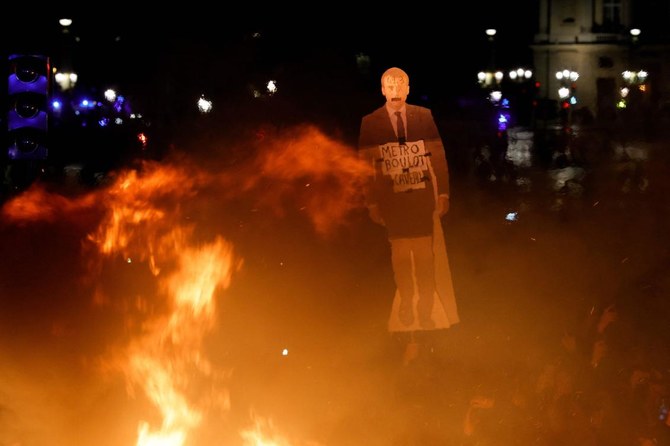
An effigy of French President Emmanuel Macron is held up near a fire during a demonstration in Paris on Mar. 17, 2023, the day after the French government pushed a pensions reform using the article 49.3 of the constitution. (AFP)
Short Url
Updated 17 March 2023
Follow

Pressure mounts on Macron after unrest grows over pensions

  • A new demonstration got underway in Paris on Friday evening, as protesters gathered in the city's Place de la Concorde
  • Demonstrators started off a fire burning in Place de la Concorde on Friday as they faced up to a line of riot police, with some chanting "Macron, Resign!"

PARIS: French President Emmanuel Macron on Friday faced the gravest challenge to his authority since the so-called Yellow Vest protests after his decision to push through a contested pension overhaul without a vote prompted a wave of protests.
A new demonstration got underway in Paris on Friday evening, as protesters gathered in the city’s Place de la Concorde, near the Assemblee Nationale parliament building, following demonstrations on Thursday which were marred by violence.
Demonstrators started off a fire burning in Place de la Concorde on Friday as they faced up to a line of riot police, with some chanting “Macron, Resign!“
“Something fundamental happened, and that is that, immediately, spontaneous mobilizations took place throughout the country,” hard-left leader Jean-Luc Melenchon said. “It goes without saying that I encourage them, I think that’s where it’s happening.”
The pension overhaul raises France’s retirement age by two years to 64, which the government says is essential to ensure the system does not go bust.
Unions, and most voters, disagree.
The French are deeply attached to keeping the official retirement age at 62, which is among the lowest in OECD countries.
More than eight out of 10 people are unhappy with the government’s decision to skip a vote in parliament, and 65 percent want strikes and protests to continue, a Toluna Harris Interactive poll for RTL radio showed.
Going ahead without a vote “is a denial of democracy...a total denial of what has been happening in the streets for several weeks,” 52-year-old psychologist Nathalie Alquier said in Paris. “It’s just unbearable.”
A broad alliance of France’s main unions said they would continue their mobilization to try and force a U-turn on the changes. Protests are planned for this week, with a new day of nationwide industrial action is scheduled for Thursday.
Teachers’ unions called for strikes next week, which could disrupt the emblematic Baccalaureate high-school exams.
While eight days of nationwide protests since mid-January, and many more local industrial actions, had so far been largely peaceful, the unrest on Thursday was reminiscent of the Yellow Vest protests that erupted in late 2018 over high fuel prices and forced Macron into a partial U-turn on a carbon tax.

’MAYHEM’
Interior Minister Gerald Darmanin said some 310 people had been arrested by police and promised to crack down on troublemakers.
“Opposition is legitimate, protests are legitimate but causing mayhem is not,” he told RTL radio.
Left-wing and centrist opposition lawmakers filed a motion of no-confidence in parliament on Friday afternoon.
But, even though Macron lost his absolute majority in the lower house of parliament in elections last year, there was little chance this would go through — unless a surprise alliance of MPs from all sides is formed, from the far-left to the far-right.
The leaders of the conservative Les Republicains party have ruled out such an alliance. None of them had sponsored the first motion of no confidence filed on Friday. The far-right was expected to file another later in the day.
Individual LR lawmakers have said they could break ranks, but the no confidence bill would require all of the other opposition MPs and half of LR’s 61 lawmakers to go through, which is a tall order.
“So far, French governments have usually won in such votes of no confidence,” said Berenberg chief economist Holger Schmieding.
He expected it would be the same again this time even if “by trying to by-pass parliament, Macron has already weakened his position.”
Votes in parliament were likely to take place over the weekend or on Monday.
Macron will want to turn the page quickly, with government officials already preparing more socially minded reforms. He can also choose, at some point, to fire Prime Minister Elisabeth Borne, who has been at the forefront of the pension debate.
But either or both moves may do little to quell anger on the streets. Neither of them had made public comments on Friday.


Neglected killer: kala-azar disease surges in Kenya

Updated 2 sec ago
Follow

Neglected killer: kala-azar disease surges in Kenya

MANDERA: For nearly a year, repeated misdiagnoses of the deadly kala-azar disease left 60-year-old Harada Hussein Abdirahman’s health deteriorating, as an outbreak in Kenya’s arid regions claimed a record number of lives.
Kala-azar is spread by sandflies and is one of the most dangerous neglected tropical diseases, with a fatality rate of 95 percent if untreated, causing fever, weight loss, and enlargement of the spleen and liver.
Cases of kala-azar, also known as visceral leishmaniasis, have spiked in Kenya, from 1,575 in 2024 to 3,577 in 2025, according to the health ministry.
It is spreading to previously untouched regions and becoming endemic, driven by changing climatic conditions and expanding human settlements, say health officials, with millions potentially at risk of infection.
Abdirahman, a 60-year-old grandmother, was bitten while herding livestock in Mandera county in Kenya’s northeast, a hotspot for the parasite but with only three treatment facilities capable of treating the disease.
She was forced to rely on a local pharmacist who repeatedly misdiagnosed her with malaria and dengue fever for about a year.
“I thought I was dying,” she told AFP. “It is worse than all the diseases they thought I had.”
She was left with hearing problems after the harsh treatment to remove the toxins from her body.
East Africa generally accounts for more than two-thirds of global cases, according to the World Health Organization.
“Climate change is expanding the range of sandflies and increasing the risk of outbreaks in new areas,” said Dr. Cherinet Adera, a researcher at the Drugs for Neglected Diseases Initiative in Nairobi.

- ‘So scared’ -

A surge in cases among migrant workers at a quarry site in Mandera last year led authorities to restrict movement at dusk and dawn when sandflies are most active.
At least two workers died, their colleagues said. Others returned to their villages and their fates are unknown.
“We did not know about the strange disease causing our colleagues to die,” said Evans Omondi, 34, who traveled hundreds of miles from western Kenya to work at the quarry.
“We were so scared,” added Peter Otieno, another worker from western Kenya, recalling how they watched their infected colleagues waste away day by day.
In 2023, the six most-affected African nations adopted a framework in Nairobi to eliminate the disease by 2030.
But there are “very few facilities in the country able to actively diagnose and treat,” kala-azar, Dr. Paul Kibati, tropical disease expert for health NGO Amref, told AFP.
He said more training is needed as mistakes in testing and treatment can be fatal.
The treatment can last up to 30 days and involves daily injections and often blood transfusions, costing as much as 100,000 Kenyan shillings ($775), excluding the cost of drugs, said Kibati, adding there is a need for “facilities to be adequately equipped.”
The sandfly commonly shelters in cracks in poorly plastered mud houses, anthills and soil fissures, multiplying during the rainy season after prolonged drought.
Northeastern Kenya, as well as neighboring regions in Ethiopia and Somalia, have experienced a devastating drought in recent months.
“Kala-azar affects mostly the poorest in our community,” Kibati said, exacerbated by malnutrition and weak immunity.
“We are expecting more cases when the rains start,” Kibati said.