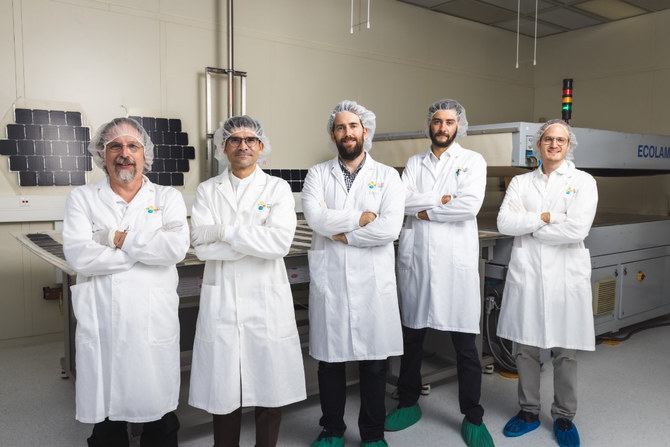


Mirai Solar, a solar technology startup of King Abdullah University of Science and Technology, is disrupting the greenhouse market by developing foldable roof shades that not only prevent fruits, vegetables and flowers from extreme sunlight but also generate electricity to run these facilities.
Established in 2019, the company manufactures retractable, semitransparent photovoltaic shade screens that convert blocked sunlight into electricity. The solution has two main components: the PV panels and the shade screen.
The PV panels are made of monocrystalline silicon solar cells that generate an electric current when exposed to sunlight, which is fed into the local power distribution panel to support the energy needs of the greenhouse.
On the other hand, the shade screen is made of specialized light diffusion material designed to regulate the amount of light that enters the greenhouse by sliding back and forth along a track. When the shade screen is fully extended, it blocks part of the sunlight from entering the greenhouse, and when it is retracted, it allows more sunlight to enter.
HIGHLIGHT
The PV panels are made of monocrystalline silicon solar cells that generate an electric current when exposed to sunlight, which is fed into the local power distribution panel to support the energy needs of the greenhouse.
The retractable PV shade screen is typically controlled by a computerized system that uses sensors to measure the amount of light entering the greenhouse. When the light is too high, the system automatically extends the shade screen to reduce the amount of light entering the greenhouse.
But for all practical purposes, the PV shade screens are controlled by a timer, allowing the user to set specific times for the screen to retract and extend.
“We wanted to provide ideal light management to the plants, so we engineered a screen that was retractable and had the flexibility of using solar cells with high efficiency and stability, offering us a huge advantage in performance and cost when compared with whatever PV technology was out there,” said Michael Salvador, CEO of Mirai Solar, a doctorate in physical chemistry who joined KAUST Solar Center in 2017.
Saudi greenhouse initiative
Of late, greenhouses have been under the spotlight in Saudi Arabia, especially after Abdulrahman Al-Fadhli, the minister of environment, water and agriculture, in January approved investments worth $1.06 billion until 2025 toward the plant resources sector and greenhouses.
It highlighted the role of greenhouses in the Kingdom, where the hot and arid climate with limited water resources makes it difficult to cultivate crops sustainably. In many ways, it cleared the deck for controlled environments that protected crops from excessive heat, wind and pests, facilitating a variety of crops throughout the year.
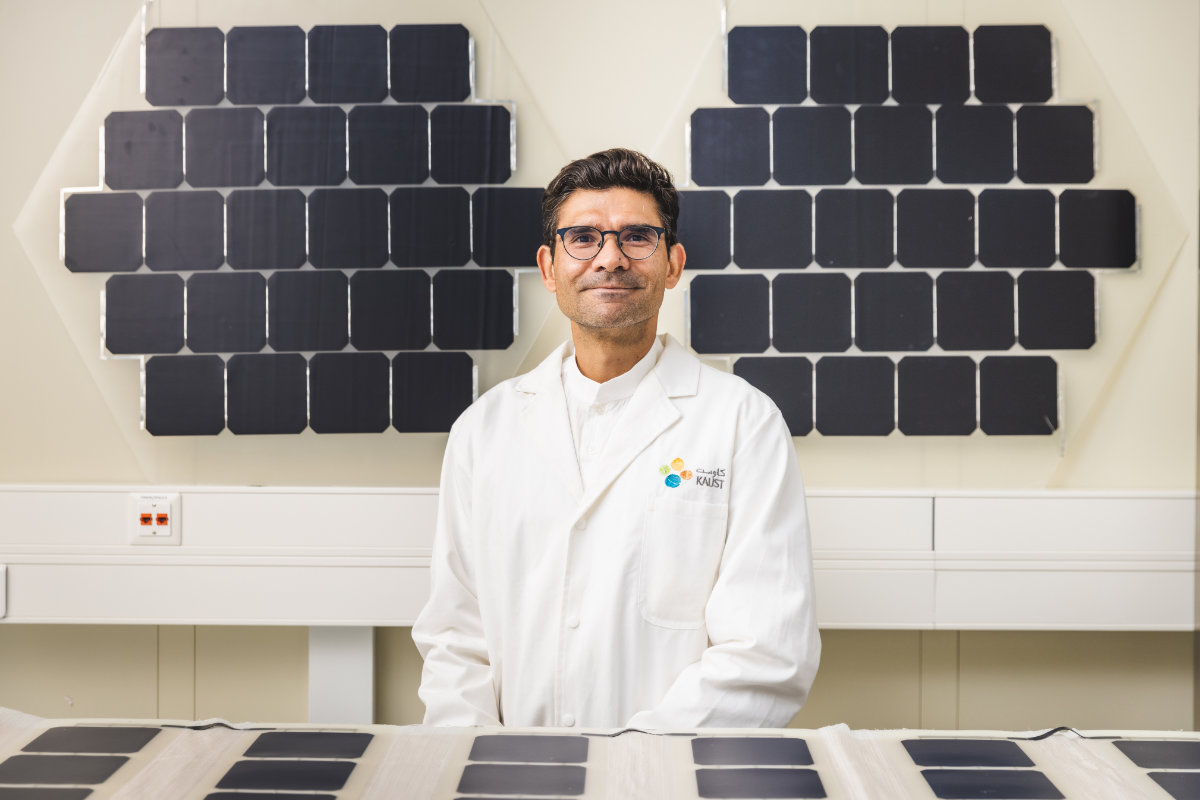
Mirai Solar’s co-founder and CEO Michael Salvador at the KAUST Solar Center. (Supplied)
These plant shelters are also vital for the country’s food security as they help increase the local production of fresh produce and reduce dependence on imported food. This is particularly important given the increasing population and the need to meet the growing demand for food.
However, greenhouses in Saudi Arabia require significant electricity to maintain optimal growing conditions in extreme weather. For example, during the summer, temperatures can reach up to 50 degrees Celsius, meaning that air conditioning and cooling systems will need to run continuously to keep the greenhouse at a suitable temperature.
According to industry reports, the basic energy consumption of a greenhouse includes light supplementation, dehumidification, heating and cooling, which could account for over 90 percent of the total power consumption. So, energy efficiency in greenhouses is paramount.
Energy efficiency
In such a scenario, the prospects of Mirai shade screens appear much brighter as it was particularly suited for mid-tech greenhouses that typically utilize 80 kilowatt-hours per square meter a year and high-tech facilities that consume 500 kWh per sq.m. per year.
“We are at a stage where we can deliver a minimum of 80kWh per sq.m. per year so we can fully cover the electricity needs of a mid-tech greenhouse and a certain percentage of the demand of a high-tech facility,” Salvador added.
The solution’s flexibility is such that it offers a drop-in replacement to conventional shade screens, which means it can be retrofitted to existing greenhouses or integrated with new greenhouse constructions.
Ask Salvador where he drew his inspiration for this innovation, and his reply: KAUST. After joining the university, Salvador chanced upon Ryan Lefers, one of the founders of Red Sea Farms, another innovative KAUST spinout that pioneered saltwater-based agriculture in the Kingdom.
Leyfus highlighted the concern of raising plants under conventional shade screens and planted the idea of a photovoltaic panel that mimics them and has the same functionality.
“We proposed the idea to the Technology Transfer Office of KAUST. They were convinced of the idea and provided us with a grant that helped us to develop a minimum viable product and later our first pilots on a sizable scale,” said Salvador, who ended up hosting a demonstration for Red Sea Farms at their greenhouse facility in the university campus.
Mirai Solar has been running several pilot installations in Saudi Arabia, including Estidamah and Al-Rasheed. The company is also manufacturing a PV system to be deployed in California around April, even as it scouts for funds to increase the scale of its operations, and this is just the beginning.
Soon, the solar technology startup will expand beyond the horizons of the greenhouse and create solar-powered car parking spaces for electric vehicles and deploy its foldable modules on mobile shipping containers to fuel their energy needs. And Salvador is committed to taking it to the next level.