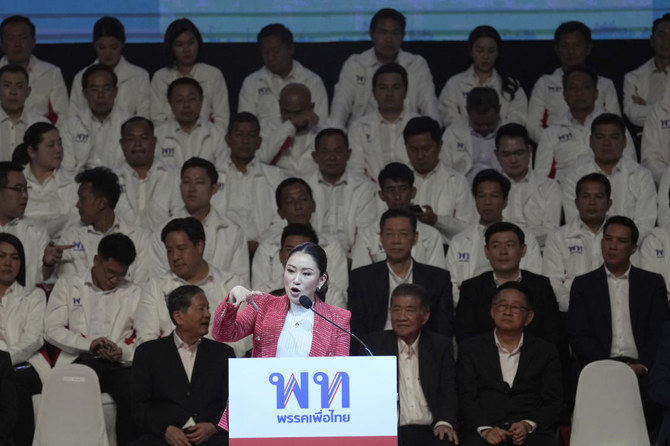
PATHUM THANI, Thailand: Thailand’s main opposition party on Friday paraded its slate of parliamentary candidates and outlined its policy pledges in a well-choreographed show of confidence ahead of the approaching general election.
Several thousand supporters clad in red cheered and waved banners as the 400 candidates of the Pheu Thai party marched behind flag-bearers into an indoor university stadium on the outskirts of Bangkok, where they took their seats on stage.
Prime Minister Prayuth Chan-ocha is expected to dissolve Parliament by Monday, shortly before its term expires, triggering polls likely to be scheduled for early May.
Pheu Thai is closely linked to Thaksin Shinawatra, the former prime minister ousted by a military coup in 2006. Thaksin, a telecommunications tycoon who upended tradition-bound Thai politics with populist policies, is despised by the military and ruling conservative establishment, whose influence he threatened. He now lives in exile to avoid a prison term on charges he calls politically motivated.
His sister, Yingluck Shinawatra, also served as prime minister from 2011 to 2014, when she was forced from office by a controversial legal ruling.
Despite attempts by his opponents to root out his family’s influence in Thai politics, Thaksin retains significant support, especially among poorer voters. As a consequence, Pheu Thai is being tipped by many analysts to win the most seats of any party and has been touting its prospects of a landslide victory.
Thaksin’s daughter, Paetongtarn Shinawatra, is expected to be its main candidate for the prime minister’s post.
On Friday, she outlined policies including improving labor conditions, guaranteeing a higher minimum wage, reducing pollution and turning Thailand into a financial technology hub.
“I hope everyone wins their elections by a landslide, winning the people’s hearts by a lot,” she said to the assembled candidates, receiving enthusiastic applause. “Together we will fix the problems that have piled up over the last eight years, make them diminish and disappear.”
Even if Pheu Thai wins the most seats, it may not necessarily provide the prime minister. The top post is chosen by a combined vote of the elected lawmakers and the appointed 250-strong Senate. The Senate is widely expected to vote as a bloc in favor of a conservative candidate and against anyone from the Shinawatra camp.
Prime Minister Prayuth has led the country since seizing power in a 2014 military coup that toppled the Pheu Thai government led by Yingluck Shinawatra. Prayuth then continued as prime minister after the 2019 election, which was conducted under laws his junta had introduced to favor his return to power.


![]()

Thailand’s opposition party unveils policies and candidates
Short Url
https://arab.news/j9xwn
Thailand’s opposition party unveils policies and candidates
- Well-choreographed show of confidence ahead of the approaching general election
- Former prime minister Thaksin Shinawatra’s daughter, Paetongtarn, is expected to be main candidate


Latest updates


© 2026 SAUDI RESEARCH & PUBLISHING COMPANY, All Rights Reserved And subject to Terms of Use Agreement.