

Court bar on police operation to arrest former Pakistani PM Imran Khan ends today

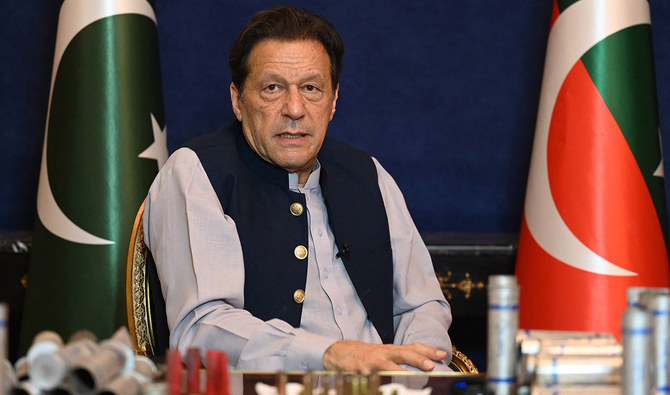
Former Pakistan's prime minister Imran Khan speaks during an interview with AFP at his residence in Lahore on March 15, 2023. Former Pakistan prime Minister Imran Khan on March 15 said the government wanted him behind bars in order to stop him taking part in elections due later this year. (AFP/FILE)
Short Url
Updated 17 March 2023
Follow

Court bar on police operation to arrest former Pakistani PM Imran Khan ends today

  • This week saw days of clashes between police and supporters of Khan who have vowed to prevent his arrest
  • Police arrived at Khan’s Lahore home on Tuesday with court orders to arrest him in case involving sale of state gifts

ISLAMABAD: All eyes are on Pakistan’s Lahore and former Prime Minister Imran Khan’s Zaman Park residence there as the city high court’s bar on a police operation to arrest the ex-premier ends today, Friday.

Police arrived on Tuesday outside Khan’s Lahore residence with a court-issued order to arrest him, unleashing clashes with supporters that lasted two days and led to injuries on both sides. The Lahore High Court on Wednesday barred police from arresting Khan until Thursday, and on Thursday extended the deadline until today, Friday. Today, the court will hear the case again.

“Yesterday, after negotiations with the Punjab administration, it was agreed to resolve the issues,” Chaudhry Fawad Hussain, a top Khan aide, said on Friday. “Today in the court of Justice Tariq Shaikh in the Lahore High Court, a consensus solution will be given.”


Police say a court in Islamabad ordered Khan’s arrest for not appearing before it despite repeated summon in the Toshakhana reference, involving the sale of state gifts given by foreign leaders while Khan was prime minister. Khan and his aides cite security concerns for the non-appearance. The ex-PM received gunshot wounds in November last year while leading an anti-government rally.

Apart from the Toshakhana reference, the ex-premier has been booked in over 75 different cases on various charges, including blasphemy, terrorism and sedition, which carries the death penalty in Pakistan. He has appeared in court in other cases. Khan says the cases against him are politically motivated which the government denies.

“85 cases were made against me, they will complete the century, they want to put me in jail,” Khan was quoted as saying by his Pakistan Tehreek-e-Insaf (PTI) on Twitter. “But there is also a plan of Allah and that is the right.”


With Khan expected to present himself before the sessions court in Islamabad tomorrow, Saturday, it remains to be seen if non-bailable arrest warrants issued by the sessions court in the Toshakhana case will be suspended today or if the Lahore High court will extend its bar on the police operation to arrest the former PM.


Meanwhile, Khan supporters remain camped out in the hundreds outside his Zaman Park home in Lahore, vowing to thwart any attempt by authorities to arrest their leader.

Khan was ousted from power in a parliamentary vote of no-confidence last April and has since held massive rallies and protest marches to ask the government to announce snap national elections.


Pakistan launches crypto testing framework to regulate digital assets

Updated 7 sec ago
Follow

Pakistan launches crypto testing framework to regulate digital assets

  • Regulatory ‘sandbox’ to let firms test crypto products under supervision
  • Move comes amid broader push to formalize Pakistan’s digital asset sector

ISLAMABAD: Pakistan’s Virtual Assets Regulatory Authority (PVARA) on Friday launched a crypto testing framework to regulate digital assets, allowing firms to trial new products and services under official supervision.

The initiative, formally structured as a regulatory “sandbox,” creates a controlled environment where companies can test crypto-related services under the oversight of the regulator before full-scale approval.

According to PVARA, the sandbox will support real-world use cases including tokenization, stablecoins, remittances and on- and off-ramp infrastructure.

Tokenization refers to converting real-world assets into digital tokens on a blockchain, while stablecoins are cryptocurrencies pegged to a fiat currency to maintain a stable value. On- and off-ramp infrastructure allows users to convert between fiat money and digital assets, enabling the practical use of virtual asset products.
“The Pakistan Virtual Assets Regulatory Authority has formally approved and launched its Regulatory Sandbox for virtual assets,” PVARA said in a post on X. “Sandbox Guidelines and the application process will be published shortly on our website.”

The move comes as the government seeks to build a formal regulatory framework for digital assets while attracting investment and strengthening oversight of the sector.

Pakistan has stepped up efforts recently to regulate its digital asset sector and is exploring digital currency initiatives as part of broader measures to reduce cash usage.

In January, Pakistan signed a memorandum of understanding with a company affiliated with World Liberty Financial, a crypto-based finance platform launched in September 2024 and linked to US President Donald Trump’s family to explore the use of a dollar-linked stablecoin for cross-border payments.