China Foreign Minister in rare call with Ukraine counterpart

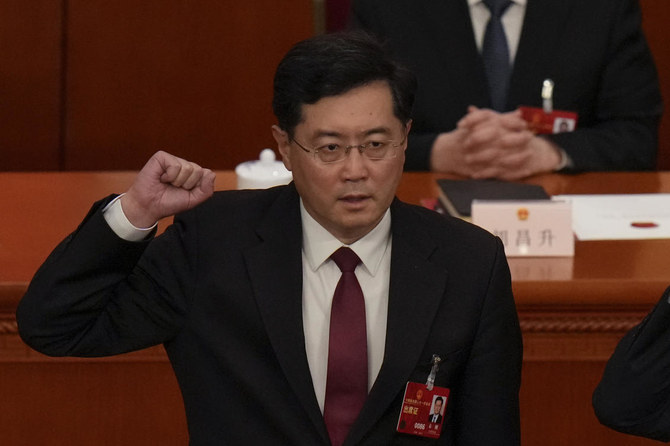
In a rare phone conversation with his Ukrainian counterpart on Mar. 16, China’s foreign minister Qin Gang says Beijing is concerned about the year-old grinding conflict with Russia spinning out of control and urged talks on a political solution with Moscow. (AP)
Short Url
Updated 16 March 2023
Follow

China Foreign Minister in rare call with Ukraine counterpart

  • China and Ukraine have retained diplomatic ties but their top officials are believed to have had only sporadic contact
  • Beijing has also accused the West of “fanning the flames” by providing Ukraine with weaponry to fend off the Russian invasion

BEIJING: In a rare phone conversation with his Ukrainian counterpart Thursday, China’s foreign minister says Beijing is concerned about the year-old grinding conflict with Russia spinning out of control and urged talks on a political solution with Moscow.
Qin Gang told Dmytro Kuleba that China has “always upheld an objective and fair stance on the Ukraine issue, has committed itself to promoting peace and advancing negotiations and calls on the international community to create conditions for peace talks,” China’s Foreign Ministry said in a statement posted on its website.
In 2022, China declared it had a “no-limits” friendship with Russia and has refused to condemn Moscow’s invasion while condemning Western sanctions and accusing NATO and the United States of provoking Russia into military action.
China and Ukraine have retained diplomatic ties but their top officials are believed to have had only sporadic contact.
Beijing has also accused the West of “fanning the flames” by providing Ukraine with weaponry to fend off the Russian invasion.
A Chinese peace proposal for Ukraine issued in February urged a cease-fire and peace talks, drawing praise from Russia but dismissals from the West. US officials have repeatedly accused China of considering the provision of weapons to Russia for use in the war.
At a March 7 news conference, Qin insinuated America was undermining efforts for peace in Ukraine in order to extend the conflict for its own benefit, saying, “There seems to be an invisible hand pushing for the protraction and escalation of the conflict and using the Ukraine crisis to serve a certain geopolitical agenda.”
The Foreign Ministry made no mention of Qin repeating such remarks to Kuleba or of raising the peace proposal.
“We hope that all parties will remain calm, rational and restrained, resume peace talks as soon as possible, and push for a return to the track of political settlement,” Qin was quoted as saying.
“China will continue to play a constructive role toward reaching a cease-fire, ending warfare, mitigating the crisis and restoring peace,” he said.
Chinese President Xi Jinping is due to visit Russia, possibly as early as next week, although neither side has confirmed any exact dates.


Ethiopia’s prime minister accuses Eritrea of mass killings during Tigray war

Updated 03 February 2026
Follow

Ethiopia’s prime minister accuses Eritrea of mass killings during Tigray war

  • Landlocked Ethiopia says that Eritrea is arming rebel groups, while Eritrea says Ethiopia’s aspiration is to gain access to a seaport
  • Ethiopia lost sovereign access to the Red Sea when Eritrea seceded in 1993 after decades of guerrilla warfare

ADDIS ABABA: Ethiopia’s government Tuesday for the first time acknowledged the involvement of troops from neighboring Eritrea in the war in the Tigray region that ended in 2022, accusing them of mass killings, amid reports of renewed fighting in the region.
Ethiopian Prime Minister Abiy Ahmed, while addressing parliament Tuesday, accused Eritrean troops fighting alongside Ethiopian forces of mass killings in the war, during which more than 400,000 people are estimated to have died.
Eritrean and Ethiopian troops fought against regional forces in the northern Tigray region in a war that ended in 2022 with the signing of a peace agreement.
Eritrea’s Information Minister Yemane Gebremeskel told The Associated Press that Ahmed’s comments were “cheap and despicable lies” and did not merit a response.
Both nations have been accusing each other of provoking a potential civil war, with landlocked Ethiopia saying that Eritrea is arming and funding rebel groups, while Eritrea says Ethiopia’s aspiration is to gain access to a seaport.
“The rift did not begin with the Red Sea issue, as many people think,” Ahmed told parliamentarians. “It started in the first round of the war in Tigray, when the Eritrean army followed us into Shire and began demolishing houses, massacred our youth in Axum, looted factories in Adwa, and uprooted our factories.”
“The Red Sea and Ethiopia cannot remain separated forever,” he added.
Ethiopia lost sovereign access to the Red Sea when Eritrea seceded in 1993 after decades of guerrilla warfare.
Gebremeskel said the prime minister has only recently changed his tune in his push for access to the Red Sea.
Ahmed “and his top military brass were profusely showering praises and State Medals on the Eritrea army and its senior officers. … But when he later developed the delusional malaise of ‘sovereignty access to the sea’ and an agenda of war against Eritrea, he began to sing to a different chorus,” he said.
Eritrea and Ethiopia initially made peace after Abiy came to power in 2018, with Abiy winning a Nobel Peace Prize for his efforts toward reconciliation.
In June, Eritrea accused Ethiopia of having a “long-brewing war agenda” aimed at seizing its Red Sea ports. Ethiopia recently said that Eritrea was “actively preparing to wage war against it.”
Analysts say an alliance between Eritrea and regional forces in the troubled Tigray region may be forming, as fighting has been reported in recent weeks. Flights by the national carrier to the region were canceled last week over the renewed clashes.