

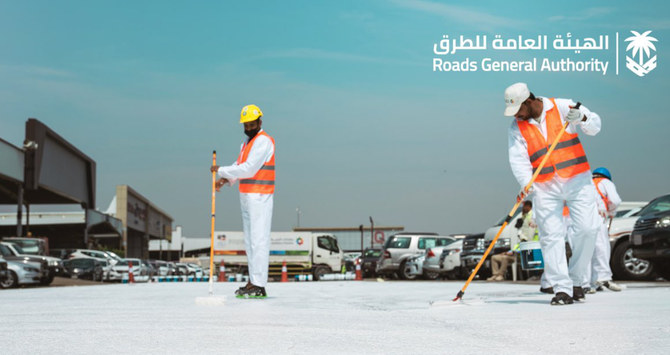
Saudi Arabia is testing a new technology for road cooling

The Roads General Authority, in partnership with the Ministry of Municipal, Rural Affairs, and Housing, has begun conducting a new experiment to cool the roads in the Kingdom. (Twitter: @RGAsaudi)
Short Url
Updated 17 March 2023
Follow

Saudi Arabia is testing a new technology for road cooling

RIYADH: The Roads General Authority, in partnership with the Ministry of Municipal, Rural Affairs, and Housing, has begun conducting a new experiment to cool the roads in the Kingdom.

The newly developed technology aims to reduce the heat absorbed by roads during the day. With roads reaching high temperatures of 70 degrees Celsius, the heat they absorb is released at night, which causes a scientific phenomenon known as a heat island.

The heat island phenomenon is what keeps people from taking a walk during summer nights, a representative from the Roads General Authority told Arab News.

The newly developed technology uses cold pavements, which absorb and reflect less solar radiation, thus reducing the surface temperature of the roads compared to traditional pavement and making temperatures much more moderate during summer nights.

The technology has been developed for residential roads and populated areas, including the waiting areas at bus stops and metros and walking areas in residential zones, the representative said.

It was tested in two major locations in Riyadh, and results have demonstrated its success, added the representative.  

The new technology is part of a series of initiatives taken by the Kingdom to improve the quality of life and lower temperatures, such as a project undertaken by the ministry to paint buildings with specific materials to reduce the heat they absorb.

“The Roads General Authority recently opened a central laboratory that is conducting studies to improve the experience of road users in the Kingdom,” the representative added.
 

Decoder

Heat Island Effect

Heat islands form in urban settings where vegetation is replaced by concrete structures such as roads and buildings, making surfaces absorb — instead of reflect — the sun's heat. With roads reaching high temperatures of 70 degrees Celsius, the heat absorbed is released at night, keeping people from taking a walk during summer nights. To address this, Saudi Arabia's Roads General Authority is testing a newly technology that uses cold pavements, which are meant to reduce road surface temperatures.


Program to train experts in forest rehabilitation

Updated 4 sec ago
Follow

Program to train experts in forest rehabilitation

  • Forest Ambassadors program is one of several specialized training initiatives designed to equip forestry personnel, relevant authorities, and university students
  • Program focuses on providing trainees with advanced scientific knowledge and skills in fieldwork, data management, and technical report writing

RIYADH: The National Center for Vegetation Cover Development and Combating Desertification continues to strengthen national capabilities to implement environmental initiatives requiring advanced technical skills and scientific expertise in assessing and rehabilitating vegetation resources.

The Forest Ambassadors program is one of several specialized training initiatives designed to equip forestry personnel, relevant authorities, and university students with the knowledge and skills to conduct vegetation inventories, assessments, and prepare technical plans for rehabilitating degraded forest areas.

The program offers a mix of theoretical and practical training, including presentations, educational modules, group discussions, and case studies, according to the Saudi Press Agency.

These components enable participants to conduct vegetation inventories and assessments, identify degradation, determine rehabilitation needs, and develop technical forest management plans.

The program focuses on providing trainees with advanced scientific knowledge and skills in fieldwork, data management, and technical report writing, the SPA reported.

It serves as a model for building highly qualified national cadres capable of applying best scientific practices in forest management and rehabilitation, contributing to the protection of natural resources, advancing the Saudi Green Initiative, and supporting the long-term sustainability of the Kingdom’s vegetation cover.